Alfred Manuel Martin, Jr.
(and Friend)
(Click on the image to zoom in.)
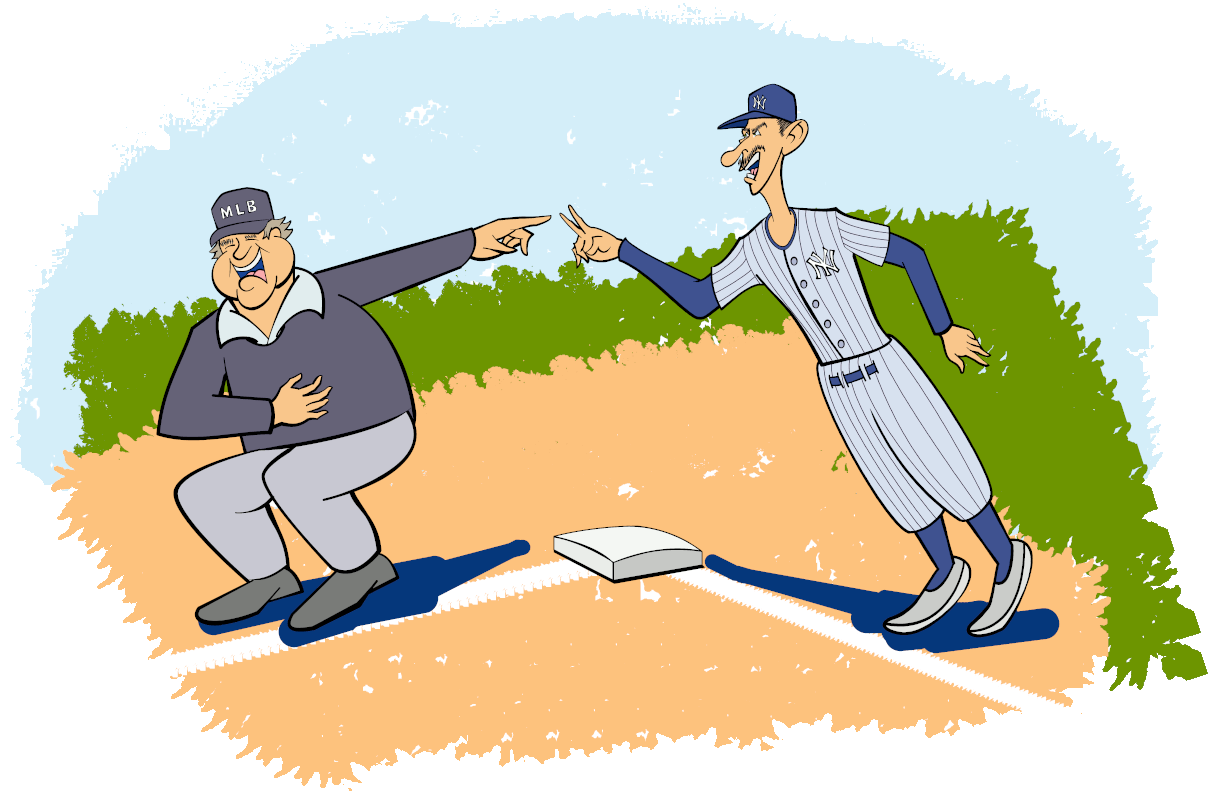
Nothing ever gets solved by arguing.
- Leo Durocher, 1961.
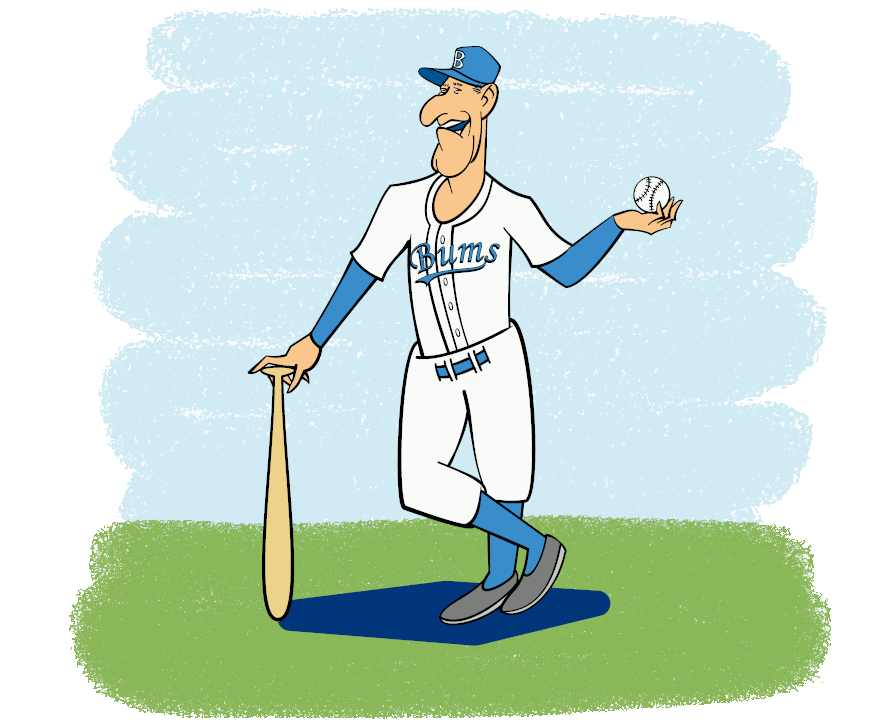
Léo le Lèvre
Rien ne se résout jamais par la dispute.
(Cliquez sur l'image pour effectuer un zoom avant ou arrière.)1
Footnote
Leo's parents were French Canadian immigrants and the name would have originally been pronounced duh-roh-SHAY. According to one popular informational reference, Leo only spoke French until he started school.
Of course a bit of context is needed for the quote from the long time Brooklyn Dodgers manager Leo Durocher. Yes, Leo did make the statement when giving advice to some young athletes. Leo told the young men that they should be kind to each other and avoid arguments - because nothing ever gets solved by arguing.
But ... (and it's a big but) ...
It should be noted that Leo delivered his inspirational speech in a motion picture. Not just any motion picture either, but a comedy. At first the viewers couldn't see who was speaking. But then after the kids accepted the advice, the camera panned up to show it was Leo Durocher who was talking.
Today the humor about Leo saying that nothing ever gets solved by arguing may be so obscure as to require considerable elaboration. But at one time it would have been so familiar as to require no explanation. If there was anyone who ever tried to solve matters by arguing it was Leo "The Lip" Durocher.
Leo, of course, was not alone. Arguing with the umpire is as much a part of the game as throwing out the first pitch and pausing the game for the seventh inning stretch.2 Everyone has seen the manager come barging onto the field to stand yelling nose-to-nose with the umpire. Then after a heated exchange, the manager storms off the field even though the calls never get reversed.
Footnote
Debate exists about when the custom of the seventh-inning stretch began - that is, the crowd literally stands up between the bottom and the top of the seventh inning and taking a refreshing stretch.
One of the tellings stretches - no pun intended - back to President William Howard Taft. This was in Washington D. C., on April 14, 1910, when the Washington Senators hosted the Philadelphia Athletics. That was also the day William threw out the first game ball. The story is that in the middle of the seventh inning, William - getting tired and stiff from sitting so long on a hard wooden bench - stood up and took a stretch. So everyone followed suit.
By consulting the contemporary newspapers the baseball scholar will find that the actual phrase "seventh inning stretch" didn't become widespread until after 1912. That would indeed fit with the custom beginning with William.
However, as early as August 1910, we read:
The first triple play of the Cactus league season was pulled off by the El Paso team in the fifth inning, causing the Clifton crowd to stand up on their toes like a seventh inning stretch.
So although this reference is a few months after William attended the ball game, the phrase is being used as if it was an old custom. The usage seems a bit quick for the stretch to begin only the previous April.
Furthermore there are scholars who mention that in 1869, Harry Wright of the Cincinnati Red Stockings wrote that during a game:
The spectators all arise between halves of the seventh inning, extend their legs and arms and sometimes walk about. In so doing they enjoy the relief afforded by relaxation from a long posture upon hard benches.
No doubt this was the seventh inning stretch in deed, if not in name.
However the actual documentation for Harry's quote seems to be lacking. One recent citation goes back to Cincinnati Magazine from 1982. Yes, that's 1982 - scarcely a contemporary reference.
Of course a possible resolution to the apparently insoluble conundrum is that the custom of taking a break in the middle of the seventh goes way back into the early days of the game, but the actual phrase "seventh inning stretch" didn't come into use until the early 20th Century. If this explanation isn't actually correct, it is at least credible.
Well, as the Captain of the Pinafore said, hardly ever. Although it is rare, calls are reversed on occasion.3 But with all the arguing you see in ball games, it's a bit of a surprise to read that the official rules state flat out:
Footnote
One instance of a reversal was on April 11, 2011, when the Chicago White Sox were playing the Tampa Bay Rays. By the sixth-inning Chicago was down 6-1.
Then Don Johnson hit a grounder to first base. Normally this would be an easy out. But the umpire, Doug Eddings and who had been an umpire for the Majors for over 10 years, called him safe. The hit also let the man on third go on to score.
Chicago's manager Ozzie Guillan came out of the dugout and as he was permitted to do asked that all the umpires discuss among themselves whether the call was correct. They decided that Don had indeed been out. Although Tampa's manager Joe Maddon objected, the reversed call was allowed to stand. So the run didn't count either.
If a player, coach, or manager leaves his position to argue balls and strikes (including half swings), he should be warned to immediately return or he will be automatically ejected.
Not just can be ejected but will be and automatically ejected.
But if this is true, then why do we see the players and managers arguing about the calls? And without anyone getting tossed?
Well, it seems that the rules also state:
MLB Umpires should attempt to listen to managers and players if their comments and demeanor are reasonable.
So it seems that it's the arguments about balls and strikes - the judgement calls at the plate - that are prohibited and lead to an ejection. But if a manager comes out of the dugout he may just asking for the umpires to consult. If done with proper demeanor, that would be OK. Of course, the umpires may also cut the managers some slack.
And besides, rarely does anyone get to actually hear the arguments. Scholars of the game point out that sometimes the - quote - "argument" - unquote - is more for show than for substance. Once after a call, the manager stormed out and went up to the umpire and started shouting:
My pitcher is terrible. My bullpen can't get anybody out. My hitters haven't hit a ball out of the infield in three days.
The manager then had to tell the umpire not to laugh.
So what actually gets a player or manager bounced? Well, there are a number of - ah - "activities" - that can get a player removed during an argument. Physically touching an umpire is definitely an ejectable offense. Then a malefactor can also get tossed simply for using bad language - particularly really bad language - to the ump.
In fact there have been players ejected that were sitting in the dugout and not even playing in the game but who voiced a mal mot that the umpire could hear. This happened in Game 7 of the 1952 World Series between the New York Yankees and the Brooklyn Dodgers (no, Leo was no longer the manager). Ralph Branca of the Dodgers was ejected by home plate umpire Larry Goetz for some discourteous remark. Ejections in the World Series are rare and an ejection of someone not even actively playing was unheard of. But Ralph was "bench jockeying" and so was tossed.
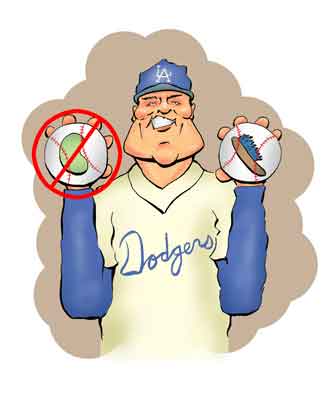
Don Drysdale
No Beans.
Remember the rule states that questioning a call about ball and strikes will get a manager ejected. So it seems all the more odd that a pitcher tossing a "bean ball" - that is, deliberately trying to hit the batter (of which Dodger Don Drysdale had been accused of4) - may draw nothing more than a warning. For instance the rules state that if the pitcher intentionally throws the ball at the batter:
Footnote
Don, though, insisted he was simply an "inside pitcher". That is, he threw the ball so it would pass over the part of the plate nearest the batter. But since the ball passes closer to the batter than a pitch that is over the center or the outside part of the plate, accidentally hitting the batter becomes more likely.
Don said the problem was that inside pitching was becoming a lost art and so the players didn't know how to avoid being hit with an errant throw. Some, though, thought Don had protesteth a bit too much. Mickey Mantle once said, "When [Don] was pitching that day before a World Series or an All Star Game or something, he'd punch me around and he'd say "Where would you like to have one today?".
If in the umpire’s judgment, such a violation occurs, the umpire may elect either to:
(A) Expel the pitcher, or the manager and the pitcher, from the game, or
(B) may warn the pitcher and the manager of both teams that another such pitch will result in the immediate expulsion of that pitcher (or a replacement) and the manager.
If, in the umpire’s judgment, circumstances warrant, both teams may be officially “warned” prior to the game or at any time during the game.
So for a bean ball the umpire can eject a player or not. It depends on what he wants.
Certainly in the mind of many, one of the Champion Umpire Arguers - and who some may think even eclipsed Leo the Lip in linguistic lambastics - was Alfred Manuel Martin Jr., known better as Billy. Billy was famous in baseball as a player for the New York Yankees, the Kansas City Athletics, the Detroit Tigers, Cleveland Indians, Cincinnati Red, Milwaukee Braves, Minnesota Twins and then as manager for the Minnesota Twins, Detroit Tigers, Texas Rangers, New York Yankees, Oakland Athletics, and then coming a full circle back to the Yankees. But as the many video clips of Billy attest, he was also famous for arguing most voraciously with the umpires.
But in fairness to Billy, if the actual numbers are consulted, Billy doesn't really come off as that cantankerous.
| Ranking | Manager | Ejections |
| 1 | Bobby Cox | 162 |
| 2 | John McGraw | 121 |
| 3 | Leo Durocher | 100 |
| 4 | Earl Weaver | 96 |
| 5 | Tony La Russa | 93 |
| 6 | Bruce Bochy | 89 |
| 7 | Frankie Frisch | 88 |
| 8 | Ron Gardenhire | 84 |
| 9 | Paul Richards | 82 |
| 10 | Jim Leyland | 73 |
| 11 | Clark Griffith | 73 |
| 12 | Joe Torre | 70 |
| 13 | Bob Melvin | 68 |
| 14 | Lou Piniella | 64 |
| 15 | Clint Hurdle | 64 |
| 16 | Bill Rigney | 64 |
| 17 | Joe Maddon | 59 |
| 18 | Dick Williams | 57 |
| 19 | Sparky Anderson | 56 |
| 20 | Gene Mauch | 54 |
| 21 | Terry Francona | 54 |
| 22 | John Gibbons | 53 |
| 23 | Charlie Manuel | 52 |
| 24 | Jimmy Dykes | 51 |
| 25 | Mike Hargrove | 50 |
| 26 | Tommy Lasorda | 48 |
| 27 | Billy Martin | 48 |
| 28 | Mike Scioscia | 47 |
| 29 | Ned Yost | 47 |
| 30 | Jim Fregosi | 46 |
| 31 | Aaron Boone | 46 |
| 32 | Ralph Houk | 45 |
| 33 | Fred Hutchinson | 45 |
| 34 | Bobby Valentine | 44 |
| 35 | Phil Garner | 44 |
| 36 | Joe Girardi | 43 |
| 37 | Whitey Herzog | 42 |
| 38 | Buddy Bell | 42 |
| 39 | Casey Stengel | 40 |
| 40 | Terry Collins | 40 |
| 41 | Chuck Tanner | 38 |
| 42 | Bud Black | 38 |
| 43 | Don Mattingly | 38 |
| 44 | Pat Corrales | 38 |
| 45 | Walter Alston | 37 |
| 46 | Dave Bristol | 37 |
| 47 | Buck Showalter | 36 |
| 48 | Davey Johnson | 36 |
| 49 | Bill Dahlen | 36 |
| 50 | Fred Clarke | 35 |
So if you go by the total number of times a manager got the old heave-ho Billy doesn't even make the top twenty. Way below Leo.
Admittedly the rankings are a bit of a surprise. Joe Torre never came off as grumpier than Billy, nor did Charlie Manuel. Of course what we're seeing here is the total number of ejections which is not necessarily a complete measure of contention. A better marker might be the ejection rate, that is the number of ejections as the percentage of games played. And what we see then is veeerrrrryyyyy interesting.
| Ranking | Manager | Ejections | Games | Percentage |
| 1 | Bill Dahlen | 36 | 615 | 5.85 |
| 2 | Paul Richards | 82 | 1837 | 4.46 |
| 3 | Frankie Frisch | 88 | 2246 | 3.92 |
| 4 | Aaron Boone | 46 | 1194 | 3.85 |
| 5 | Earl Weaver | 96 | 2541 | 3.78 |
| 6 | Bobby Cox | 162 | 4508 | 3.59 |
| 7 | Ron Gardenhire | 84 | 2480 | 3.39 |
| 8 | Buddy Bell | 42 | 1243 | 3.38 |
| 9 | John Gibbons | 53 | 1582 | 3.35 |
| 10 | Pat Corrales | 38 | 1211 | 3.14 |
| 11 | Charlie Manuel | 52 | 1826 | 2.85 |
| 12 | Fred Hutchinson | 45 | 1666 | 2.7 |
| 13 | Leo Durocher | 100 | 3739 | 2.67 |
| 14 | Dave Bristol | 37 | 1424 | 2.6 |
| 15 | John McGraw | 121 | 4769 | 2.54 |
| 16 | Clark Griffith | 73 | 2917 | 2.5 |
| 17 | Bill Rigney | 64 | 2561 | 2.5 |
| 18 | Clint Hurdle | 64 | 2615 | 2.45 |
| 19 | Joe Maddon | 59 | 2599 | 2.27 |
| 20 | Jim Fregosi | 46 | 2122 | 2.17 |
| 21 | Phil Garner | 44 | 2040 | 2.16 |
| 22 | Billy Martin | 48 | 2267 | 2.12 |
| 23 | Mike Hargrove | 50 | 2363 | 2.12 |
| 24 | Joe Girardi | 43 | 2055 | 2.09 |
| 25 | Jim Leyland | 73 | 3499 | 2.09 |
| 26 | Bob Melvin | 68 | 3266 | 2.08 |
| 27 | Don Mattingly | 38 | 1839 | 2.07 |
| 28 | Terry Collins | 40 | 2012 | 1.99 |
| 29 | Bruce Bochy | 89 | 4518 | 1.97 |
| 30 | Dick Williams | 57 | 3023 | 1.89 |
| 31 | Bobby Valentine | 44 | 2351 | 1.87 |
| 32 | Ned Yost | 47 | 2544 | 1.85 |
| 33 | Lou Piniella | 64 | 3548 | 1.80 |
| 34 | Whitey Herzog | 42 | 2409 | 1.74 |
| 35 | Tony La Russa | 93 | 5387 | 1.73 |
| 36 | Jimmy Dykes | 51 | 2962 | 1.72 |
| 37 | Joe Torre | 70 | 4329 | 1.62 |
| 38 | Tommy Lasorda | 48 | 3040 | 1.58 |
| 39 | Mike Scioscia | 47 | 3078 | 1.53 |
| 40 | Davey Johnson | 36 | 2445 | 1.47 |
| 41 | Bud Black | 38 | 2596 | 1.46 |
| 42 | Terry Francona | 54 | 3784 | 1.43 |
| 43 | Ralph Houk | 45 | 3157 | 1.43 |
| 44 | Sparky Anderson | 56 | 4030 | 1.39 |
| 45 | Chuck Tanner | 38 | 2738 | 1.39 |
| 46 | Gene Mauch | 54 | 3942 | 1.37 |
| 47 | Fred Clarke | 35 | 2826 | 1.24 |
| 48 | Casey Stengel | 40 | 3766 | 1.06 |
| 49 | Buck Showalter | 36 | 3393 | 1.06 |
| 50 | Walter Alston | 37 | 3658 | 1.01 |
In that case Leo, who comes in at a 2.6% ejection rate, drops below the Top 10. That's lower than even Charlie Manuel (2.8%). Joe Torre is actually quite cheerful at 1.6%. Even Billy is still below the Top 20 with a 2.2% ranking. So Billy was scarcely the most fractious of managers and Casey Stengel barely makes the list at all.5
Footnote
Some just criticism may also be directed at the percentage as a proper ranking as it deals only with the matter of the ejection but not the manner. For instance, Lou Piniella who sequentially managed the New York Yankees, Cincinnati Reds, Seattle Mariners, Tampa Bay Devil Rays, and the Chicago Cubs has a mere 1.8% ranking and so comes off as quite mild.
But what Lou has lacked in quantity he compensated in quality. He is famous for showing his displeasure by kicking dirt on the umpires and even covering up home plate. In one game after an objectionable call he ran out of the dugout and began shouting and threw his hat on the ground. The umpire then signaled that Lou was out of the game.
Rather than go back to the club house - ejected players are supposed to leave the playing area - Lou yanked out the first base bag and tossed it into right field. He then walked over, picked up the base again and threw it again even further.
You read that that ejections occur less frequently today, another topic of discussion for the scholars. For one thing ejections today require the umpire to file a written report. Not only is the paperwork a bother, but if the reasons for the ejection are deemed insufficient, the umpire can be subject to sanctions.
But the consensus seems to be that the decline in tossing is because video reviews of a call are allowed. Managers can ask for one review of a play in the first six innings and two more after that. On the other hand, if after a review a call is reversed and the manager still objects, that is an automatic ejection.
So with the Era of Arguments fading, it seems only appropriate to wind up this discussion with some pleasantries. Among the baseball bon mots are:
What's the difference between Einstein and a baseball manager?
Einstein didn't think he was a baseball manager.
What does a manager do when he gets old, decrepit, and blind?
He becomes an umpire.
And then there's:
There was once a baseball umpire who was always griping at his family. Then one day he realized he should try to be nicer to everyone and when he got home he asked his young son to come sit on his lap. But the boy wouldn't do it.
After all, the son never sits on the brutish umpire.
References and Further Reading
Billy Martin: Baseball's Flawed Genius, Bill Pennington, Houghton-Mifflin Harcourt, 2015.
Leo Durocher: Baseball's Prodigal Son, Paul Dickson, Bloomsbury, 2017.
Major League Baseball Umpire Manual, Office of the Commissioner of Baseball, 2019.
"Ejection", Baseball Reference.
"Debate at the Plate: Baseball's Unwritten Rules for Arguing Balls and Strikes", Lee Judge, Kansas City Star, July 13, 2018.
"My Pitcher Is Terrible, My Bullpen Can't Get Anybody Out": What Managers Really Yell About While Arguing With Umpires", Barry Petchesky, Deadspin, December 17, 2012.
"You’re Outa Here!", Indiana High School Coaches Association, March 11, 2025.
"Career Leaders & Records for Manager Ejections", Baseball Reference.
"20 Greatest Manager Meltdowns in Baseball History", Rick Weiner, Major League Baseball, June 4, 2018.
"El Paso Wins Two Games From Clifton - Both Teams Play Well", El Paso [Texas] Herald, August 8, 1910, p. 8.
"Seventh-Inning Stretch", Michael Aubrecht, Baseball Almanac.
"Nothing But the Facts", Cincinnati Magazine, April, 1982, p. 111.
"Rays Fall To White Sox 6-1, Drop to 1-8 On Season", Erik Hahmann, DraysBay, April 10, 2011.
"A Brief History of Overturned Calls", Jack Moore, The Score,, October 24, 2013.
"Piniella: From Storyteller to Maniac", Marc Topkin, Tampa Bay Times,
"The 30 Biggest Temper Tantrums in MLB History", Doug Mead, Bleacher Report, June 6, 2018.
"Bench Jockey", Baseball Dictionary.
"Bench Jockey", Dickson Baseball Dictionary, Norton, 2011, Third Edition (First Edition, 1982).
"MLB to Expand Instant Replay in 2014", ESPN, August 15, 2013.
"Interview with Mickey Mantle, Duke Snider, and Willie Mayes", Warner Wolf (interviewer), The Warner Wolf Show, WCBS, October 6, 1981.
The Errand Boy, Jerry Lewis (actor, writer, director), Ernest Gluscksman (producer), Stanley Adams (actor), Felicia Atkins (actor), Herb Vigran (actor), Barry Livingston (actor), Milton Frome (actor), Leo Durocher (cameo), Lorne Greene (cameo), Dan Blocker (cameo), Pernell Roberts (cameo), Michael Landon (cameo), Joe Besser (cameo), Walter Scharf (music), Paramount, 1961.