Eddie Foy, Sr.
(Click on the image to zoom in.)
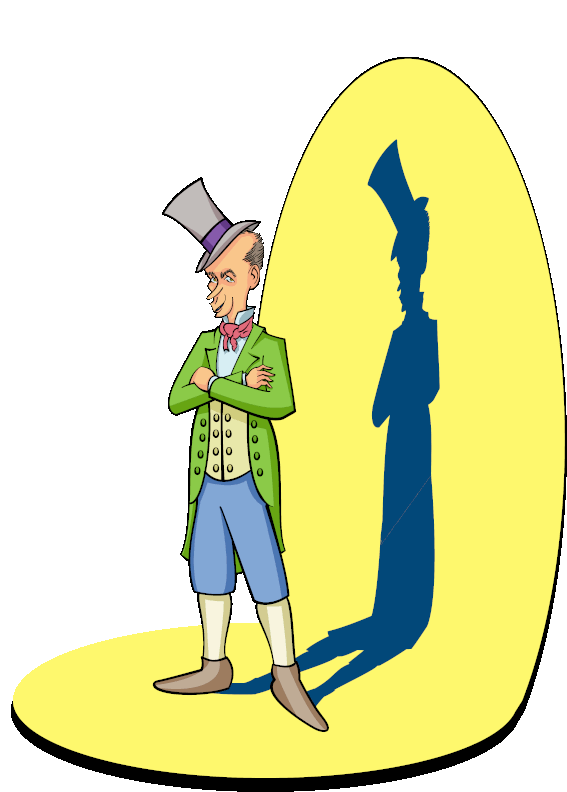
We were going merrily on with the dance when suddenly, Bang! Bang! Bang! came a roar of eight or ten big pistols from the outer darkness. Bat Masterson was just in the act of dealing in a game of Spanish monte with Doc Holliday, and I was impressed by the instantaneous manner in which they flattened out like pancakes on the floor."
- Eddie Foy, Sr., 1928
Today what's most notable about the lists of - quote - "Top Celebrities of All Time" - unquote - is how little agreement there is on just who is a Top Celebrity. But even more notable is how fast the lists change and that the - quote - "Top Celebrities of All Time" - unquote - are forgotten, or at least relegated to the "Whatever Became Of ..." lists. Pick out a news story about some motion picture star, television actor, or pop musician and you'll end-up scratching your head and wondering just who the heck they're talking about.
And yet in a day before television or radio, EVERYBODY, that's EVERYBODY knew who Eddie Foy was. As you might guess from the image he was one of the top comedians of late 19th and early 20th Century. Arguably his peak years for national fame were around 1905 to 1910, but evenn Marshall Pickney Wilder, often cited as one of the WORLD'S top comics in the pre-Twenties Era, didn't get the notice that Eddie did.

Marshall Pickney Wilder
The Top Comic
(Click to zoom in and out.)
Eddie's parents were Richard and Mary Fitzgerald. They already had two daughters, Catherine and Mary Ann, when they arrived in New York City from Ireland in 1855. Eddie was born the next year and a third daughter in 1857. Since Eddie and Ellen were born in the United States they were natural-born citizens and enjoyed all the rights and privileges thereof.
But as was often true of the newly arrived immigrants, Eddie did not live in affluence even though his dad set up a tailor shop which would normally have served as a decent living. But the Civil War began when Eddie was only five and in 1862, Richard joined the Union Army.
However Richard only served a few months before being wounded at the Second Battle of Bull Run. He was discharged and the wound did not heal well. Soon his behavior began to make Eddie and Mary fear for their safety, and finally Richard was taken to the insane asylum on Blackwell Island. Not long after his admittance he wandered down to the East River and drowned.
Mary supported the family by doing washing and sewing and sometimes working as a nurse. Although she lived for another half a century she never remarried and Eddie said that was her choice. To help the family out Eddie began selling newspapers and shining shoes.
Eddie found he could also pick up some nickels and dimes by putting his cap down and dancing on the street corners and soon the owner of a tavern saw him and invited him to entertain the customers. Then a fiddler (who Eddie only knew as Huggins) then said they should team up. Eddie agreed and they traveled around New York and New Jersey performing in the bars and on the streets. Huggins seems to have kept the lion's share of the earnings but Eddie's pay was enough to keep him going. Besides, it sure beat shining shoes.
The duo of Huggins and Fitzgerald ended in about a year when Eddie and his mom moved to Chicago where her brother lived. At age 12, Eddie went back to shining shoes and selling newspapers and he also briefly attended night school. Sometimes his mom's nursing jobs took her away from home and Eddie stayed in a special dormitory that had been established for the newsboys. Among other activities, the kids would stage performances for their entertainment and Eddie's specialty was singing and "acrobatic" dancing.
It was immediately after the Civil War that came the era of the music hall which was the immediate precursor of what became known as vaudeville. Originally from Britain, the term music hall refers more to the type of entertainment rather than the buildings per se. Music hall performers sang, danced, and played musical instruments before the crowds but there would also be comedians trading zingers between songs. Eddie didn't have enough money to attend professional performances but he would sell his papers next to the theaters. So at least he could hear the actors and musicians.
But the most popular genre of entertainment of the 19th Century was minstrel show. Arising out of the popularity of the songs of Stephen Foster, minstrel shows featured music, dancing, and comedy routines where the actors - both white and black - routinely wore blackface makeup. Seen today as horribly insulting and racist, the minstrel shows remained a major attraction throughout the 19th century. But even well past the mid-20th Century minstrel shows were still performed even by civic leaders in the more quaint American towns, and as late as the 1980's blackface skits could still seen in the quainter among the public schools. Eddie, with his singing and dancing skills, was able to handle the minstrel routines easily.
In 1871 Eddie was fifteen when on October 7, a fire broke out just a few blocks from where the Foys lived. At first it seemed to have been contained but on October 8 it began spreading and it was clear that a disaster was in the making.
Eddie's account of the Great Chicago Fire is harrowing. Eddie's sister was now grown and married and he was given charge of his her baby and told to go to the house of some friends. But as the fire began spreading faster and further, he had to wander away from the neighborhood. Finally after about thirty-six hours everyone was finally reunited. The family's house had been destroyed and after relocating briefly back to New York they returned to Chicago.
Gradually the family saw some improvement in their economics. Mary continued her work as a nurse and was hired to help care for Mary Lincoln who had moved to Chicago. Eddie continued to perform and he and a friend, Jack Finnegan, put together a song and dance act. They weren't sure what to call themselves - Finnegan and Fitzgerald sounded kind of a like a brand of whiskey or maybe a law firm - so finally they decided on Edwards and Foy.
The team of Edwards and Foy found work around Chicago in what Eddie called "honky-tonks". They began to tour and ranged as far away as Milwaukee. Travel was by train - freight train that is - and they often got tossed out of the boxcars by the railroad "bulls".
But it was in Chicago at the Cosmopolitan Beer Hall that they actually got what was a real "engagement". The Cosmopolitan was a step up from their usual venues - it actually had a stage for the performers - and Jack and Eddie played there for a whole week. As usual they put on an act with songs and vigorous acrobatic dances. But one night the vigor of the performance ended up putting Jack on the floor. The other actors razzed him so bad that he refused to perform for the rest of the week and so Eddie had to finish up the stint solo.

Edwin Booth
Eddie and Jack next teamed up with another performer named Ben Collins. In addition to their song and dance act, they also began getting parts in plays which often featured big name stars. Eddie even appeared in Shakespeare performances of Julius Caesar and in Macbeth which starred Edwin Booth. Although Eddie confessed at one point he aspired to be a serious actor and play the part of Hamlet, he finally realized his appearance was best suited for comedy.
In the mid-1870's Ben and Eddie did what many kids dreamed about and joined a circus. There Eddie began focusing on his acrobatic stunts, one of which was jumping over 10 horses. Unlike many other performers, Eddie found that traveling around the country was a leisurely and enjoyable experience. Mitigating the congenial work was that the pay was rather slow in coming although the circus kept packing in the crowds. Then to make things worse one of the managers suddenly skinned out with the money and left everyone else high and dry.
So Eddie and Ben along with a violinist named Fritz and a ticket-taker named Sam Bigley decided to strike out on their own. They formed a minstrel act where they would sing what the crowed took as authentic "plantation" songs. Sam was also what was called a short change" artist. The tickets cost 25¢ apiece and if a family showed up and the father handed over a $10 bill, Sam would count out the change saying "A dollar for the tickets - two - three - four - five - six - seven - eight - nine - and a dollar for the tickets." Sam would then shove the money into the man's hand and usher him in.
After a while the grind of the road began to get to them and so they they wound themselves back toward Chicago. There they decided to disband and go their separate ways. But Eddie was still dedicated to being a performer and he kept finding performing jobs around the area.
Then at Fort Wayne, Indiana, Eddie was appearing at a theater which was also featuring a well-known performer named Jim Thompson. After the show Jim asked Eddie if he wanted to form an act. Naturally Eddie agreed and Jim's reputation was able to get them more extended contracts, one of which was a four week stint in Kansas City. As before a major part of the performance a minstrel show but afterwards the individual performers would come on stage alone in what was called the olio. All together the shows would go on for hours, beginning at around 7:00 in the evening and not ending until 2 or 3 in the morning.
Their next job was in a town that even then had become legendary. That was Dodge City, Kansas. Dodge was in the southwest part of the state and was quite a haul from Chicago. But you could catch a train to Kansas City and from there you would take the Atchison, Topeka and Santa Fe Railway on to Dodge. Unfortunately it was not a direct line and took a rather convoluted route along the rivers. Still, Eddie described the train trip as "leisurely" and Dodge as "ugly but fascinating".
Originally Fort Dodge was established to keep the Indians on the reservations and protect the settlers who were moving in. The small town that inevitably arose nearby became a center for buffalo hunters, and later it was a hub for the cattle industry where the herds from Texas were driven north through what was then called Indian Territory. Of course, a large part of Dodge's local businesses were dedicated to providing entertainment to the soldiers, hunters, and cowboys - "drovers" was the preferred term - who came into town.
Among the luminaries Eddie met was John Henry Holliday who with a DDS from the Dental College of Philadelphia - he even wrote a thesis - had set up a practice. This allows us to pinpoint Eddie's time in Dodge as encompassing the summer of 1878. If Eddie's memories are correct it seems that Doc had already branched into, well, other means of gaining his income. Doc certainly spent more time in the saloons and at the card tables than in the office.1
Footnote
Of course, there are towns that boast of taverns and pubs named "The Office". So you can tell people you had to stay late at "The Office". It's also not unheard of that college towns have pubs named "The Library".
In the saloons and dance halls Eddie would perform his usual routines where he would sing, dance, and trade one-liners with Jim. At one point Eddie made some remarks about the cowboys that produced sufficient umbrage that they tossed Eddie in a horse trough. But as Eddie took the "hoorawing" in stride, he became one of their favorites performers.

Wyatt Earp
(Or is it "Erb"?)
Interestingly, in his memories Eddie does mention Wyatt Earp and states that the name was sometimes spelled "Erb" in the papers. That Eddie seemed compelled to mention that "Earp" was likely the correct spelling indicates that at the time of Eddie's writing - 1928 - Wyatt had not yet acquired his legendary status. That is in fact correct. It was only in 1931 that Stuart Lake published his book Wyatt Earp: Frontier Marshal and propelled Wyatt to that lofty position of being brave, courageous, and bold.
Eddie remained in Dodge through two summers. That practically stamped him as a permanent resident and he became part of the city's community even to the point of serving on a posse. However, sooner or later entertainers had to travel to find new audiences and in 1880, Eddie and Jim headed further west to Leadville, Colorado. Leadville, Eddie said, made Dodge City look like Sunday School.
Naturally during their travels Eddie and Jim made met other performers. In Chicago they had met a singing duo made up of the Howland sisters. Now the girls suddenly showed up in Leadville (along with their mother) and as Eddie had always had the eyes for Rose, they soon got married. Unfortunately, the marriage was short when Rose died in 1883.
Leadville was certainly a bit rough and Eddie decided it was also time to move on to larger and more lucrative venues. The logical stop was Denver, even then a major city, and hopefully a little more genteel than Dodge or Leadville.
Eddie continued his tours in the West to good success. He and Jim played a four week engagement in Tombstone, Arizona at the famous Birdcage Theater which was then called the Bird Cage Varieties. In the 1930's there was a scholar who was researching the history of early entertainment and he wrote that in October 26, 1881 Eddie witnessed an altercation involving firearms that occurred on the vacant half of Lot 2 of Block 17 between Camillus Fly's boarding house and photography shop and the building owned by William Harwood. Fortunately for the many book covers, title pages, and movie marquees, the battle was close enough to a local livery stable that it was styled somewhat inaccurately as the Gunfight at the OK Corral.
Eddie, though, didn't mention anything about the famous gunfight which involved his acquaintances from Dodge, Wyatt Earp and Doc Holliday. So most likely didn't see the famous confronation. But in Arizona he did meet a rather blustery and boisterous character named Dave Rudabaugh. Today Dave is best known to Western History fans somewhat discourteously as Dirty Dave Rudabaugh and who was one of the more disreputable characters who rode in a gang of rustlers led by Billy the Kid.
Eddie still aspired for brighter lights and the next move up from Denver was San Francisco. With the finding of gold at Sutter's Mill, the city - then called Yerba Buena - had become one of the most cosmopolitan cities in the United States and it also boasted one of the highest populations of millionaires. There Eddie and Jim continued to perform their singing and dancing act as well as appearing in stage plays which sometimes changed weekly.
In 1882 while still in San Francisco Eddie and Jim got an offer from one of the biggest stars of the day. That was Billy Emerson who was the leader of the group known as Emerson's Minstrels. Emerson's Minstrels had toured internationally even as far away as Australia, and yes, Emerson's Minstrels put on a minstrel show. Of course Bill and Eddie appeared in black greasepaint and they were billed as "Artistic Ethiopian Eccentrics".
With the turn of the Fin de Siècle, the act of Foy and Thompson was becoming famous. However, financing was always touch and go. Although they might have been given decent pay, both were now married and they still had to meet expenses for themselves and their wives. Finally after one tour of the smaller California towns, they returned to San Francisco to find themselves dead broke.
But just when they were about to give up on show business, Jim and Eddie got an offer from the newest and most booming of the boom towns. That was in Butte, Montana, where copper had become king. They were offered an unlimited engagement at $75 a week. Better still, their contract guaranteed transportation costs which included train tickets for their wives.
At long last Eddie and Jim were finding regular employment and making a good if perhaps hectic living. But Eddie was wanting to try for the REALLY big time. That meant moving back East. So when Eddie and Jim got an offer to play in Philadelphia with the Carncrofts Minsrels - the biggest minstrel show in the country - they jumped at the chance. So they left Butte and after a brief stay in Chicago, Eddie relocated to the East more or less permanently.
Of course, Eddie continued to tour and it was back in Chicago on December 30, 1903, that Eddie was performing in Mr. Bluebeard in the Iroquois Theater. He was about to go on stage when an arc light set fire to the curtains. Naturally the people began to panic and Eddie went onstage and tried to calm the audience even as the fire was spreading. Although Eddie received praise for his efforts and most people of the over 1100 people were able to escape, still over 600 died. Today the Iroquois Theater Fire is the worst theater disaster in American history.
Eddie was now recognized as one America's top comedians and he continued to perform in plays and musicals such as Over the River, The Strollers, Up and Down Broadway, The Orchid, Piff Paff!! Pouf!!!, The Earl and the Girl, Mr. Hamlet of Broadway, The Wild Rose, The Earl and the Girl. As today's theater patrons may note, none of these are in the modern repertory.
But one of Eddie's biggest hits was an act of his own creation. Eddie had remarried in 1895 to an actress named Madeline Morandom and she and Eddie had seven kids. These were in order Brian, Charley, Mary, Madeline, Eddie Jr., Richard, and Irving. They were all cut from the same cloth as their mom and dad and in 1910 Eddie and the kids all began touring in a song and dance act. Eddie Foy and the Seven Little Foys was a smash and continued for the next six years. Of course, by that time, some of the Little Foys weren't all that Little.
But the times - as a future Nobel Prize winner would write - were a-changin'. The first two decades of the 20th Century brought in a cultural revolution as dramatic as that of the last two decades. Traditional methods of travel and communication were being replaced by innovations that shrunk the world. Trips that took months a generation earlier could now be spanned in a few days. Messages - earlier limited to correspondence carried by cart, trains, or boat - could literally be sent at the speed of light.
Most of all entertainment was changing. For the previous 5000 years, entertainment had to be live entertainment. If you wanted music you had to have live musicians. If you wanted to see a drama you had to have live dramatic actors. And for comedy, you had to have real honest-to-goodness and live comedians.
Then in 1895 two brothers from France, Auguste and Louis Lumière - pronounced loo-mee-AIR - had demonstrated a method where an audience could see actors that weren't there. A series of photographs were taken onto a single strip of celluloid film which captured the action at 16 images - that is, "frames" - a second. By projecting a light through the film the action could be projected onto a screen hanging on a wall.
So unlike the earlier moving pictures which could only be viewed by one person at a time, the films of the Lumière brothers could be seen by a large audience. There was no sound and although any dialog and song lyrics could be displayed as text, the best films were those that focused on action.

Thomas Edison
Various Inventions
Others quickly adopted the Lumière's techniques. In 1902 Georges Méliès produced Le Voyage dans la Lune (A Trip to the Moon) which was the first film with a real plot and multiple scenes. It was also (obviously) the first science fiction film. In 1903 Thomas Alva Edison, in between working on various inventions ranging from vacuum sealed fruit containers to concrete furniture, produced The Great Train Robbery which was also the first Western. The film - with the inevitable chase scene filmed in the wilds of New Jersey - lasted a whopping 12 minutes.
And Eddie? How did he weather the new technology? Well, mostly he didn't. Except for a 1915 motion picture A Favorite Fool which was about Eddie and the Seven Little Foys, he avoided films. After all despite Eddie's appearance and actions contributing to his humor, he relied mostly the spoken word and songs. It was over ten years after A Favortie Fool that The Jazz Singer demonstrated convincingly that cinema with sound was going to be the entertainment of the future.
Unfortunately, there don't appear to be any copies of A Favorite Fool left. Still, if Eddie had lived longer - he died in 1928 - he might have become one of the early stars of Hollywood. Instead the world had to wait until 1955 to see Bob Hope play as a facsimile of Eddie. The Seven Little Foys also starred Lee Erickson as Charley, Paul de Rolf as Richard, Lydia Reed as Mary, Linda Bennett as Madeleine, Jimmy Baird as Eddie, Jr., and Tommy Duran as Irving. What was unusual for a Bob Hope film was that Bob had to do some serious acting as well as playing a comedian. In 2007 The Seven Little Foys was made into a musical.
And the REAL (not the REEL) Seven Little Foys?
Can we see them?
Well, yes and no.
There is a newsreel with sound from 1928 where six of the Seven Little Foys - now all grown - performed before the camera. There were examples of the acrobatic dances, some songs, and a bit of the comedy (mainly provided by Eddie, Jr.) Although the performance was brief - less than 10 minutes - this is at least an example of the REAL Seven Little Foys in action.
Some of the kids stayed with show business. The eldest, Bryan, became a motion picture producer and director, not retiring until 1963 after he produced PT-109 where Cliff Robertson played the then Lieutenant John F. Kennedy as speaking with a baritone Midwestern accent. Charles continued to act in films until 1936 and then became a restauranteur with his sister Mary. Madeline appeared in a few films although she seems never has aspired to be a big star. She finally retired in 1967.
But it was Eddie, Jr., who continued in his father's footsteps. From 1928 to 1978 he was in over 40 motion pictures including The Swell Head (1928), Queen of the Night Clubs (1929), Leathernecking (1930), Nearly Naked (1933), Broadway Thru a Keyhole (1933), Myrt and Marge (1933), Moulin Rouge (1934), Wonder Bar (1934), King of Burlesque (1936), Star for a Night (1936), College Holiday (1936), Turn Off the Moon (1937), Secret Service of the Air (1939), Women in the Wind (1939), Code of the Secret Service (1939), Frontier Marshal (1939), The Cowboy Quarterback (1939), Smashing the Money Ring (1939), Lillian Russell (1940), Murder in the Air (1940), A Fugitive from Justice (1940), Scatterbrain (1940), The Texas Rangers Ride Again (1941), The Case of the Black Parrot (1941), Rookies on Parade (1941), Country Fair (1941), Puddin' Head (1941), Four Jacks and a Jill (1942), Yokel Boy (1942), Yankee Doodle Dandy (1942), Powder Town (1942), Moonlight Masquerade (1942), Joan of Ozark (1942), Dixie Dugan (1943), Dixie (1943), And the Angels Sing (1944), Wilson (1944), Honeychile (1951), The Farmer Takes a Wife (1953), Lucky Me (1954), The Pajama Game (1957), The Right Price on Alfred Hitchcock Presents (1959) (Season 4 Episode 22: "The Right Price"), Bells Are Ringing (1960), Gidget Goes Hawaiian (1961), Gidget Goes to Rome (1963), 30 Is a Dangerous Age, Cynthia (1968), and Won Ton Ton, the Dog Who Saved Hollywood (1976).
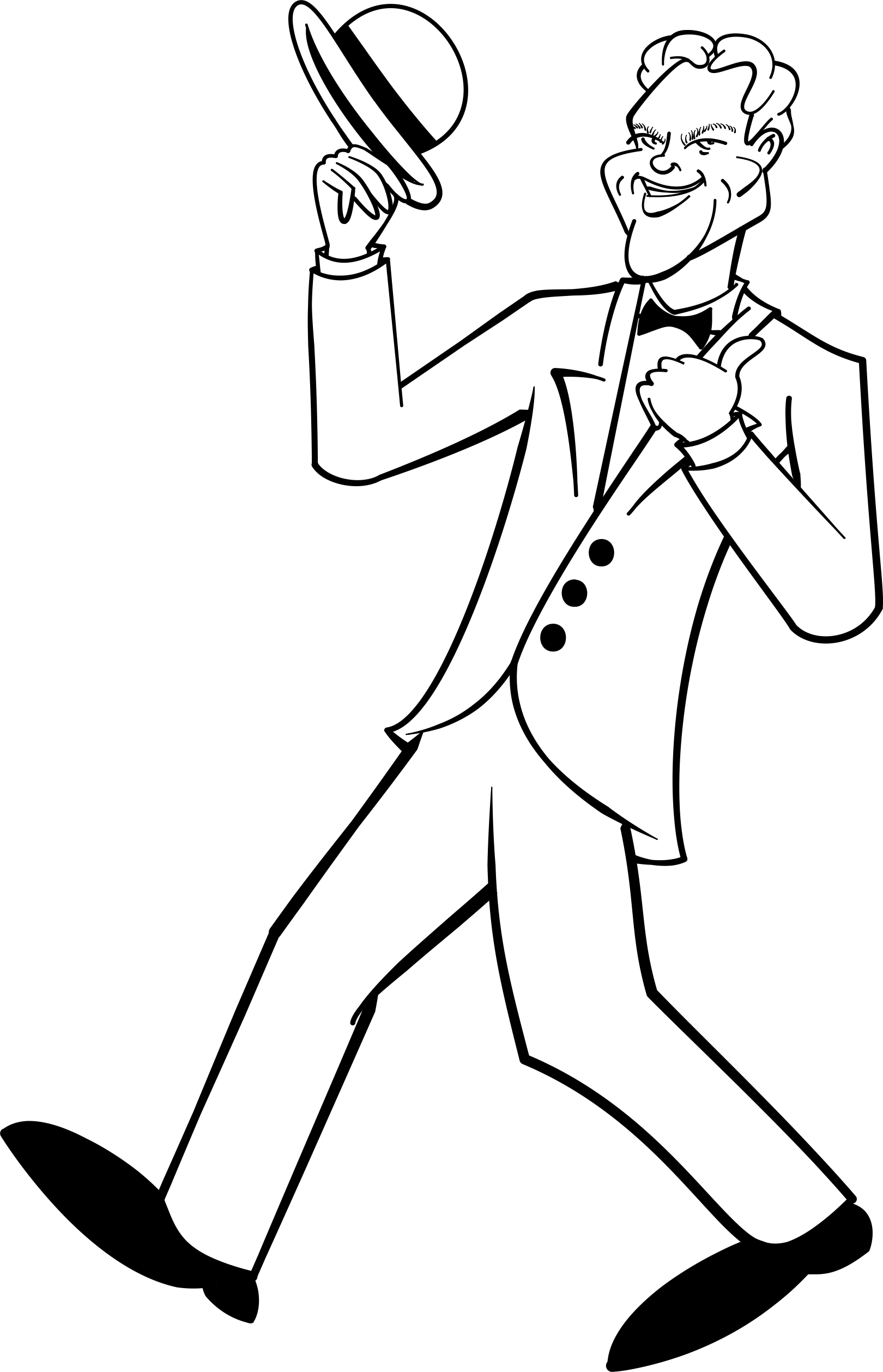
Most of Eddie, Jr.'s, roles were comedic or at least had a comedic element. In 1942 he played his dad in Yankee Doodle Dandy where James Cagney played George M. Cohan. James, by the way, had also played George M. Cohan alongside Bob Hope in The Seven Little Foys.
But what exactly kind of jokes did Eddie Foy, Sr., tell that made him the most famous and popular comedian of his time? Well, he left us with a sampling from the time he was appearing with Sam Bigley and Ben Collins. Naturally Eddie would start the jokes off:
"Mr. Bigley, why is a dog's tail like the end of the world?"
"I am sure I do not know, Mr. Foy. There seems to be no resemblance. Why is a dog's tail like the end of the world?"
"Because it's fur to the end."
"But suppose the dog has no tail?"
"Oh, then it ain't so fur!"
Even Eddie admitted the jokes were pretty corny.
References and Further Reading
Eddie Foy: A Biography of the Early Popular Stage Comedian, Armond Fields, McFarland Publishing, 1999.
Clowning Through Life, Eddie Foy and Alvin Harlow, E. F. Dutton Company, 1928.
The Gunfighters, Paul Tractman, Time-Life, 1981.
"Eddie Foy, Sr., (1856-1928)", The Historical Dictionary of the American Theater.
"The Foy Family - Chips of the Old Block (1928)", Vitaphone Varieties, Vitaphone, 1928.