I'd gone to the Hippodrome to see Houdini do miracles instead of tricks, and therefore I was a bit disappointed in his performance.
- John Scarne, The Odds Against Me, Simon and Schuster, 1966.
Of course, when he saw Houdini perform, John Scarne was already a skilled sleight-of-hand magician. John was born Orlando Carmelo Scarnecchia in Steubenville, Ohio, but the family - John , Mom Maria, Pop Fiorangelo, and older sister Lucy - moved to North Bergen, New Jersey. In school John was something of a mathematical whiz but living in the New York City area he soon got introduced to the flourishing (and illegal) gambling industry. This was also the era of Vaudeville and after watching a number of magicians, John also became interested in learning conjuring, particularly card tricks.
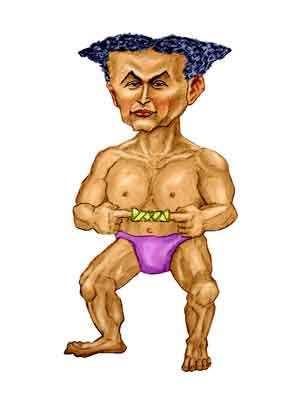
Harry Houdini
Fiorangelo died while he and Maria were on a trip to Italy, leaving John to help support his mom (in the interim Lucy had married). He found work in a shirt factory and went to school at night. But the job also gave him enough cash to indulge in games of chance himself. Then in one poker game he was able to recognize the game wasn't quite on the up-and-up. He could tell by feel that the cards were "strippers" - that is they were shaved down so the low and high cards could be separated. He then found that accusing card hustlers of being cheats was not a good idea, and he had to beat a quick retreat.
Other players likewise expressed their displeasure at the game's organizer but remained in the room to try to recover their losses. The discussions raised quite the ruckus and as John hid outside, he saw the cops come in and haul off the players. Some were rather the worse for the arguments.
John's mom, like many moms, wasn't fooled, and when she read in the papers a fifteen-year-old boy was wanted for questioning, she told John she didn't want a card cheat in the family. But a performing magician was fine. John agreed to mend his ways and he began practicing his card manipulations for legitimate purposes while his mom took to her knitting.
John honed his skills performing for friends and charity events. But he wanted to turn professional and so he went to a theatrical agent. There he found out that professionals were supposed to have business cards. So he hied off to a local printing shop where he had a batch of cards run off. The printer was quite a jokester who said he was also hoping to become an entertainer. As he left the shop, John wished Henny Youngman good luck in his career.
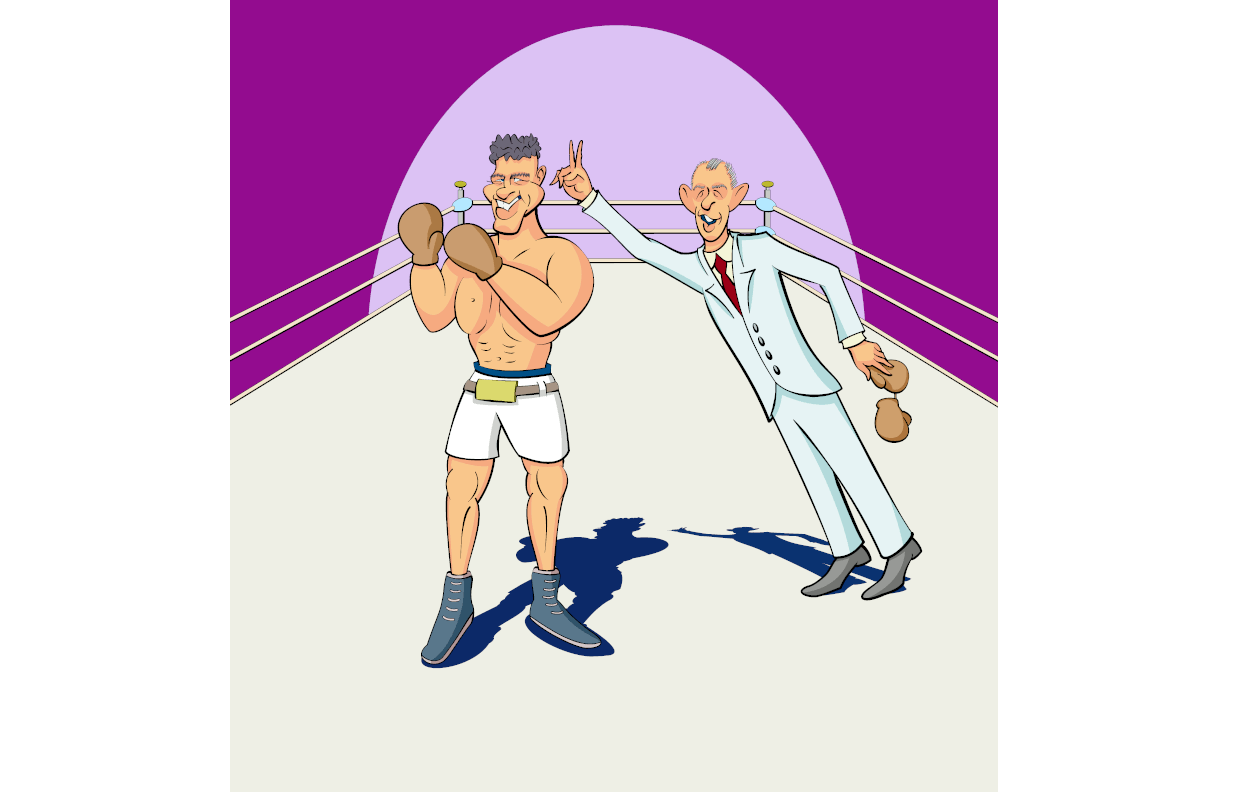
John began performing mainly for private functions and parties in and around New York City. But he had always been a boxing fan and one of his boyhood friends was James J. Braddock, later to be famous as the "Cinderella Man" who went from living on relief to being the heavyweight champion of the world. John would sometimes show up at the gym where Jimmy trained and with his sleight-of-hand he would entertain the big-name fight managers like Bill Daly, Lew Diamond, Pete Reilly, and Joe Gould.
Bill Daly then asked John if he'd perform at the House of Morgan nightclub for the birthday party of Doc Kearns who during his long career managed Jack Dempsey and Mickey Walker (among others). When John showed up he did tricks for Doc and the others at his table. These included Al Jolson and his soon to be wife Ruby Keeler, Texas Guinan who hosted at the 300 Club (where she greeted the customers with a cheerful "Hello, suckers!"), and a, well, a "gentleman" named Salvatore Lucania who was known around town as Lucky Luciano.
Al Jolson
He was with Ruby.
(Click on the image to zoom in and out.)
Texas Guinan
(Click on the image to zoom in and out.)
Mr. Lucania
Lucky
Later Bill approached John and said that Doc needed a favor. Doc had been playing a card game called Ace-Deuce-Jack that was being held at the - quote - "business establishment" - unquote - of a lady named Polly Adler. The game was simple. One person was designated the banker. After he shuffled the cards, he cut the deck into three stacks. The players would bet that the bottom of the piles concealed an ace, deuce, or a jack. If the bottom card of any of the stacks was at least one of those cards, the player won. Doc had been taking the role as the banker (after all, he was loaded) but had been losing money. He asked John to find out if he had been cheated.
John went with Bill and Doc to Polly's Place and watched the game (that's all he did, he said). He later informed Doc that he wasn't being cheated but that he was playing the game at odds which gave him more than a 10% disadvantage. Doc handed John $200 as a fee, and John was suddenly not only a magician but also a gambling consultant.
For those curious to know how to calculate the players' advantage - and the banker's disadvantage - you have to calculate the odds that cutting a deck into three stacks puts an ace, deuce, or jack at the bottom of one of the piles.
Well, how do we do that? you might ask. We've always wanted to know that.
No doubt you have, as Captain Mephisto said to Sidney Brand. This is a surprisingly simple calculation and requires only a little middle school arithmetic.
The first thing is to recognize that shuffling a deck and making three piles is the same as dealing three cards at random. You can also simplify things by realizing that you can take the standard deck with the ace, deuce, jack, and all the other cards and replace it with a deck with only two types of cards. On 12 of the cards there is a W for the cards that win. The other 40 cards are blank.
Next you shuffle and then pull out three cards. The only way the player can loose is for all three cards to be blank. But if even one of the three cards is a W, then the player wins. The question then becomes what are the odds that you draw three cards and at least one has a W.
Well oddly enough, the best way is to first calculate the odds that at least one card is a W is to first calculate the odds that all three cards are blank. That is you calculate the odds the player will loose.
That's easy. First calculate the odds that the first card will be a blank. This is simply the number of blank cards divided by the total number of cards. That's 40 divided by 52.
        Prob(Card #1 = Blank)       =      40/52
                                                     =      10/13
                                                     =      0.796
Now we calculate the odds that the second card will also be blank.
But note! We've taken one card out of the deck. So there are now 39 blank cards left in the deck of 51 cards. Then the correct probability for the second card being blank is:
         Prob(Card #1 = Blank)       =      39/51
                                                       =      13/17
                                                       =      0.765
And now it's clear that for the third card we have 38 blank cards out of a total of 50 cards left in the deck. So the probability that the third card is blank is:
          Prob(Card #1 = Blank)       =      38/50
                                                       =      19/25
                                                       =      0.760
So the probability that ALL THREE CARDS are blank is the product of the individual probabilities:
    Prob(3 Cards = Blank)      =      10/13 × 13/17 × 19/25
                                               =     38/85
                                               =     0.447
Remember this is the probability that NONE of the cards will be a W or equivalently that in a standard deck none of the cards would be an ace, deuce, or jack.
So this means the probability of GETTING AT LEAST ONE JACK, DEUCE, OR ACE is:
       Prob(Ace, Deuce, or Jack)      =      1 -  38/85
                                                        =     47/85
                                                        =     0.553
So the odds of the player winning are 0.553 or 55.3 %. The odds of the banker winning is 0.447 or 44.7 %.
And what, as Flakey Foont asked Mr. Natural does it all mean?
It means - not Mr. Natural's famous reply - that if a player bets $100 on a hand, on the average he'll win 55 % of the time. That is, the banker pays him $100.
Conversely, the banker wins and takes the player's bet only about 45 % of the time.
So this gives a house advantage (ergo, the banker's edge) for each $100 bet as:
   Banker's Edge    =   Banker's Winnings
                                   ×  Probability Banker Wins
                                   - Player's Winnings
                                   × Probability Player Wins

                               =   $100 × 38/85
                                 - $100 × 47/85 -

                               =   $100 × (38 - 47)/85

                               =   $100 × -9/85

                               =   -$900/85

                               =   -$180/17

                               =   -$10.59
Ha? (To quote Shakespeare?) That's a NEGATIVE number! Does this mean the banker LOOSES over $10 for each $100 bet?
Indeed. (Again Shakespeare.) So if you play Ace-Deuce-Jack in the way described, the banker will end up loosing - just as John told Doc.1
Footnote
John calculated the odds a bit differently than here. He used combinatorial theory which calculates the total number of ways you can draw cards that win or lose.
Remember that the game is essentially drawing three cards from a deck. So first John calculated the total number of combinations of choosing three cards from a 52 card deck.
This is from the formula:
                  Comb(3/52)    =   52 × 51 × 50
                                                 3 × 2 × 1
                                           =  22100
Next John calculated the number of ways you can draw three cards and none of them being an ace, deuce, or jack. That's the same as removing all the aces, deuces, and jacks from the deck, and drawing a card from the remaining 40 cards. So the number of ways you can now draw three cards is:
                  Comb(3/40)    =   40 × 39 × 38
                                                 3 × 2 × 1
                                           =  9880
So the way to draw the three cards with at least one ace, deuce, or jack is simply the difference of the numbers. That's the number of winning hands for the players and is:
                   Winning Hands     =   22100 - 9880

                                                 =   12220
So the probability of winning and losing are:
                       Prob(Lose)    =   9880/22100
                                             =  0.447


                         Prob(Win)    =   12220/22100
                                              =  0.553
Which are the same probabilities calculated above.
John, though, doesn't specify how he calculated the player's advantage, but states that with the odds of winning at 12220 to 9880, the player's edge is 101/123 % or 10.008 % rather than the 10.588 %.
Doc helped John get some paying jobs but always as a magician. Once Doc ask John to perform at a banquet for a $500 fee even though it would mean taking a train from New York to Chicago. From Doc's description of the event, John thought he was playing for the mayor.
So he was a bit surprised to learn that the host at the party was a man identified on his business cards as Albert Brown, Used Furniture Dealer. The show went well and after John finished up the act with some of his best tricks, Al Capone and his gang gave John a standing ovation.
John met Harry Houdini in the early 1920's at Frank Ducrot's Martinka Magic Supply Shop in Manhattan. John had been introduced to Harry as an aspiring magician, and Harry, not being aware of John's skill, began showing John the basic card moves. John on the other hand thought Harry's manipulations looked a bit clumsy and amateurish. John then demonstrated to Harry what has become known as the "Scarne Aces" trick which flummoxed Harry completely.
For Scarne Aces the aces are shown to the spectators and then shuffled in with the other cards in the deck. Then the magician squares up the deck and with no further manipulations correctly cuts out all aces. Today this trick is performed by a number of magicians but strangely no one can really say if they are following John's actual method.
The difficulty in explaining how a famous trick is done is that most of the time the explanation is how someone THINKS the trick MIGHT BE DONE. After all, there are a number of techniques to achieve an effect and cutting a specified card from a deck can done by various ways.
One way is to put a slight bend - a "crimp" - in the card which can be felt along the side of the deck. So the deck can be cut at that card. Next the deck can be trimmed where the aces protrude slightly making a cut relatively easy. Of course, this requires a prepared deck provided by the cheat. Finally the faces of the desired cards can be waxed where they will separate easier than the other cards (called using "slick aces"). Of course, using slick aces also requires a prepared deck.
The debate might seem all the more perplexing and pointless since John told how he did it in his autobiography The Odds Against Me. John wrote that he used an honest unaltered deck. He said that he shuffled the deck so he could see the corners of the card faces as they were riffled. He then counted how many cards were above each ace. Finally he would square up the deck and by feel he would pull off the correct number of cards to cut to the aces.
Some scholars have expressed doubt that this is really the way John did his trick. He gave his explanation when he was performing for a bunch of gangsters at the apartment of mob boss Arnold Rothstein. Instead John may have been using a new and hard to detect crimp. So John's count-down-to-the-aces explanation would have been his way to avoid giving the secret to the mobsters who could turn the method to nefarious purposes. So John made up a story about a technique that he knew the mobsters couldn't do themselves.
But John stuck to his story. He said he could cut a given number of cards nine out of ten times. He never claimed perfection and when he performed the trick in 1979 on The Tomorrow Show hosted by Tom Snyder, at one point before he cut an ace he said he thought he would be off by one (he was).
Another favorite of John's tricks was the Card in the Wallet. He also did this on The Tomorrow Show. He asked Tom to pick a card and sign it with a pen. He then had Tom tear off a corner to further mark the card. Tom kept the torn corner as an additional check on the card's identity.
John then put the card back in the deck and made a series of shuffles and cuts. Then he spread out the cards face up in a fan. Tom then looked for his card but found it wasn't in the deck.
John then reached into his coat pocket and pulled out his wallet. It was wrapped in six rubber bands. John then took off the bands and opened the wallet. Inside was the card with Tom's signature and the torn corner.
John told Tom that no other magician could do the trick, and in The Odds Against Me he said he had invented it himself. Today, though, the aspiring magician can buy a Card-In-The-Wallet trick from magic supply companies. Although not necessarily a staple for most magicians, it can sometimes be seen.
Complicating the narrative further, in his book Scarne on Card Tricks first published in 1950, John again mentions he invented the Card-in-the-Wallet but in the book he gives instructions. The magician uses two identical decks. He surreptitiously takes out one card and puts the card in his wallet. The secretly hides the deck minus the cards in his coat pocket.
The magician then starts the trick using the other full deck. The next step is to "force" a card on the spectator. That is, the magician tells the person to select a card but by various subterfuges and manipulations makes him pick the card he wants. The forced card is, of course, the same as the card in his wallet. Forcing a card is a basic magician's move and there are a number of ways to do this.
Once the card is selected (ergo, forced), John places it on top of the deck. He then shuffles and cuts the deck. Afterwards he indulges in some magician's patter that involves gesturing with his hands, during which he places the deck in his pocket that has the other deck. After some more conversation, he reaches into the pocket and brings out the deck - but the deck with the card removed.
The magician now fans the cards face up on the table and asks the spectator to look for his card. Of course, he can't find it and the magician pulls out his wallet to show everyone the card.
This description, though, is far removed from what John did on The Tomorrow Show. The trick in the book did not - and could not - involve writing anything on the card or tearing off a corner. The televised trick was also much simpler. John did not put the shuffled deck in his pocket nor did he do the rather complicated card force as described in the book.
Of course, it is considered quite gauche to reveal the secret of a magician's trick. But remember that there is nothing wrong with discussing how any trick might be done.
So possibly after Tom made his selection John made a series of false shuffles and cuts followed by a straightforward (but difficult) card palm. That is John puts Tom's card on the top or bottom of the deck. Then when he shuffled the cards he makes sure the top or bottom card remained where it was (a fairly simple shuffle technique). That way Tom's signed card wouldn't be mixed in with the others. False cuts, although more difficult than the surreptitious shuffles, are standard moves for a skilled magician.
So after the shuffle and cuts, Tom's selected card was still on the top or bottom of the deck. Then just before he spreads the cards on the table he palms the card. What to watch for is that as John spreads the deck, he quickly drops his left hand down by his side. Doing something with one hand while indulging in trickery with the other is a classic example of magician's misdirection.
But .. but ... but ... If all this is true, how did the card get in the wallet?
Here's where John's prestidigitatorial skill would come in. Note as he spread the deck John kept his left hand down by his side and partially hidden by the table. When Tom agreed his card wasn't in the deck John quickly reached into his coat with his left hand.
Here John kind of tips off his trick. Once his hand is inside his coat, he spends what seems to be an inordinate amount of time fumbling around in his pocket - certainly more time than expected for retrieving a quite thin and small wallet.
A careful review of the tape does show that while the wallet is wrapped with six rubber bands, they are thin and would not hold the wallet shut very tightly. So during his "fumbling" John would be able to pry open the wallet even with the bands and slide the card in. Further fumbling would let John slide the bands back in place. Then he pulls out the wallet, removes the rubber bands, and shows the marked card with the torn corner.
So in all likelihood, John's Card-in-the-Wallet trick was standard magic fare - that is standard fare for a highly skilled sleight-of-hand artist. The trick did not involve a forced card, but did require false shuffles and cuts, a card palm, and misdirection. Such a trick is not something for a fledgling magician and so in Scarne on Card Tricks, John creates a beginner's - and less impressive and more complex - Card-in-the-Wallet trick.
As to those who wonder if John was actually skilled enough to manipulate the cards so adroitly, there are some close-up films of John doing his card tricks. As many people know, John was the stand-in for Paul Newman's hands in the movie The Sting and there is a film from 1945 where John demonstrates the cheating methods of card "mechanics". Even when the camera switches to slow motion, it's hard to spot the palms and switches.
But probably the most impressive sample of John's card tricks is the now famous Schaefer beer commercial from 1972. The commercial shows some of John's tricks which include flourishes, card palms, and switches. John's ability is most impressive.
As a magician John did more than just card tricks and there is a movie - a "short subject" starring Robert Benchley - called Dark Magic that was released in 1939. Robert goes into a department store to buy some magic tricks for his son. John - playing a magic demonstrator named Mr. Calypso - shows Robert some tricks including the famous cups and balls and the rope cutting trick. From the lines he speaks it's pretty clear John is from the New York City area, a distinct manner of enunciation that he still had when he appeared on The Tomorrow Show forty years later.
John later said that Robert kept missing his lines. So the scene required a number of re-takes. Later Robert admitted he was trying to get John to repeat the tricks so he could see how they were done.

Cup and Balls (?) at Beni-Hasan.
John's performance of the Cup-and-Balls was expertly done. But probably the best practitioner of what may be one of the oldest tricks in the world was the Canadian magician Dai Vernon. Known as the Professor to his fellow magicians Dai spent much of his time performing before other expert magicians. Dai, who was a friend of John, would even explain how he did the Cups-and-Balls and even then he would still fool everyone.
Dai Vernon
The Professor
(Click on the image to zoom in and out.)
By the time he saw Harry's show John was one of the best card magicians around and he knew the in-and-outs of stage performing as well. He could tell or at least guess how Houdini did most of his tricks. When he was still young John even learned to free himself from a straitjacket from a carnival performer named Sailor Martin. Although Houdini's escape was faster, it was essentially the same escape John had learned. John also guessed that the handcuff escapes - usually done in a cabinet hidden from the audience - were achieved simply by picking the lock. John realized later that his disappointment in the show was because he expected miracles and got a magic show.
But one of Harry's tricks that did impress John was called the East Indian Needle Trick. Harry brought out a packet of needles. He placed them in his mouth and then brought out about four feet of sewing thread. He next folded the thread and placed it in his mouth leaving a strand hanging six inches dangling outside his mouth. Finally Harry drank a glass of water.
Harry then said - in a dramatic fashion according to John - that he would thread the needles in his stomach. He then took the thread hanging out of his lip and slowly drew it out with all the needles threaded about an inch apart. The audience roared it's approval.
This was one of Harry's favorite tricks and he repeated it throughout his career. Harry and his wife Bess just called it the "Needles". But it was not original with Harry and had long been known to other magicians. The trick was not then - and today is not - often performed. It is - as one recent performer cautioned - quite dangerous for the magician.
The fact that there are needles placed in the magician's mouth presents hazards enough and during the trick there are many opportunities for things to go wrong and cause serious injury. Most how-to magic books no longer mention the trick and one that did - now out of print - cautioned that only highly skilled professionals should attempt it and probably not even then. The trick was provided, the author said, for informational purposes only.
But today if anyone knows about John Scarne it's as a gambling expert and author of Scarne on Dice, Scarne on Cards, Scarne's Guide to Casino Gambling, and Scarne's Complete Guide to Gambling, all once staples in bookstores and libraries. As a gambling authority, though, John is a bit controversial. He claimed he was the first to determine the odds at blackjack and that his stand-and-hit strategy was superior to those developed by computer scientists. John issued several challenges to his competitors but they never could come to terms. Of course, one of John's reported stipulations was that he insisted on being the dealer and this may have deterred the prospective challengers.2
Footnote
In his book John said that he often avoided card games because if he won people would think he was cheating. But he liked the occasional game of chance and the Fairview Athletic Club put up posters specifying the rules he had to follow.
Stud Poker Rules Pertaining to John Scarne The World's Greatest Card Manipulator
- Due to his liking for practical jokes and because his ability to deal himself the winning poker hand is so highly developed that he often deals same unintentionally, Scarne must pass the deal when it is his turn to deal out the cards. The above rule also holds true when it is his turn to cut the cards.
- Due to the fact that Scarne can change a Deuce into an Ace simply by passing the card from hand to hand, he shall not be permitted to pick up any of the cards dealt to him. He can only look at his hole card [face-down card] by lifting its corner slightly with the thumb and forefinger of his left hand.
- Due to Scarne's highly developed skill in palming cards without being detected, he shall not be permitted to touch the deck, the discards or for that matter any card other than his hole card.
- Any infraction of these rules automatically results in a misdeal and a new deck of cards shall be put into play.
At that time, though, it must be pointed out that gambling even in private clubs was forbidden by New Jersey laws. Today, though, social gambling is allowed. A number of states, though, still prohibit social gambling which even includes people playing at a friend's house for low stakes. That the laws are rarely enforced doesn't mean its legal.
Complicating matters is that the term "social gambling" has undergone something of a change in definition. Today "social gambling" includes gambling at a "social casino". A social casino is a place - usually a website - where you can play casino games like slot machines, blackjack, roulette, and even poker but do not use real money. Since social casinos don't involve real money playing the games is not really gambling. Social casinos should not be confused with online gambling which uses real money and where you can easily lose your shirt and about everything else.
But if the meaning of a social game is playing with friends for money, that still might be illegal in a given state. Although arrests in such poker games are rare, they are still possible and the topic has even been used in a plot on a television drama. In "The Great Gambling Raid" on The Law and Mr. Jones, Abraham Jones (played by James Whitmore) defends some poker players who were arrested at their home playing penny-ante poker. What happened is that one of the regular players (played by Star Trek's "Trouble with Tribbles" actor Stanley Jones) had been excluded from the games and out of spite he reported the others to the cops. At one point Mr. Jones tells the players that despite the fact that they were just gambling for pennies, the judge could fine them up to $500.
However, computer simulations have shown that when playing with a single full deck where the player follows the dealer's rules - standing on seventeen and drawing on sixteen - the odds are what John calculated - a bit less than 6 % against the player. But there are some differences in John's calculations if the player deviates from the dealer's play. To get real blackjack odds, you have to run intensive computer simulations using different strategies which is something John could not do.
Some scholars have commented, perhaps a little admonishingly, that John was a consummate self-promoter. Of course, so are virtually all other magicians. On the other hand some of the stories John related in his aggrandizement don't fit the documented historical record.
For instance, there's one part in The Odds Against Me where it's John who gives Houdini advice. In fact, the reading makes it seems that John was the master and Harry the student.
The story involved Harry's famous competition with the Egyptian magician Rahman Bey (who was really Italian). Bey would allow himself to be enclosed in a water-tight coffin and then be lowered under water. Bey maintained no one could survive more than a few minutes, but he stayed under between fifteen and twenty minutes.
John tells us of a befuddled and perplexed Harry Houdini who said he should have listened to John that Bey had air pumped into the coffin. You come away believing Harry never figured out how Bey did the trick and that Harry came out second best in this Battle of the Magicians.
But John's account is completely contrary to what is known from contemporary statements and newspaper reports - and Harry's own records. The "trick" - and don't try this at home, kids - was achieved by proper breath control and training. In a test in the New York's Sheraton Hotel swimming pool, Harry bested Rahman Bey by a large margin. Bey remained submerged for 20 minutes at most. But Harry stayed under for an hour-and-a-half which was the limit he had put on his stay before he was pulled to the surface.
Harry was a man who left virtually nothing to chance. He practiced the stunt beforehand and took careful readings of the temperature in the coffin during his time spent inside. One practice sheet showed him staying in the coffin for an hour (the temperature rose to 80 degrees F). Despite Harry's careful preparation, it was, needless to say, a very dangerous stunt.
Some of John's other stories might also be pondered upon. He told how he was once invited to Bugsy Siegel's apartment at the Flamingo Hotel in Las Vegas (Bugsy was always called "Ben" to his face unless you wanted a punch in the nose) and his friends. He did some card tricks for Bugsy and the others. He later told how the conversation drifted to blackjack odds and John told Bugsy that he could beat the game.
So John and a skeptical Bugsy went down to the casino and by counting down the cards, John won $1000 in an hour. Bugsy congratulated John and then banned him from playing in the casino. Later John said he went to other casinos and beat the blackjack games. Eventually John tells us he was banned from gambling in every casino in America.
Again the stories don't always jibe. One author pointed out that in early editions of John's books he claimed counting cards didn't work and he didn't mention anything about his beating the blackjack tables (the books though were later revised to include card casing). And in another book, John placed the conversation with Bugsy about blackjack in the casino not in Bugsy's rooms.3
Footnote
John said he kept track of the aces and ten-count cards by buying several stacks of chips and using one stack for card counting. The chips come in stacks of twenty and you take four of them and put them aside to count the aces. The other sixteen represent the 10-count cards. Each time you see an ace or ten-count played you remove one of the chips from their stack. That way you can tell at any point how many aces and ten count cards remain.
Well, maybe for a little while. This trick will almost certainly be spotted by the casino dealer. Any hint of card counting will likely get you booted from the game.
But as far as the tricks that John said he performed for Bugsy, one of them would have required him to have snuck outside Bugsy's hotel room patio door and stick a playing card on the window.
Sneak around outside Bugsy Siegel's window at night? "Not," as Eliza Doolittle said, "bloody likely!"
Bugsy Siegel (and Friend)
Sneaking Around Outside?
(Click on the image to zoom in and out.)
Yet one more example of the circumstances changing over time is John calculating the house advantage of Ace-Deuce-Jack. In his autobiography he said he first calculated the odds for the benefit of Doc Kearns. But in the earlier book Scarne On Cards (1949), his warning about the lopsided odds were given to a big-time horse race bookmaker.
Strictly speaking, though, the two accounts were not completely exclusive as John could have given the advice to Doc Kearns and later to the bookmaker. But it seems like if John had given the advice to Doc as he said, he would have mentioned advising the famous boxing manager as well as the horse bookie.4
Footnote
Of course, when Scarne On Cards was published Doc Kearns was alive, well, and active. So John may not have wanted to put on record how some grifters took Doc Kearns for a sucker.
John's books are not as widespread as they were once and one major metropolitan library lists none of John's works on its shelves or in any of the branch libraries. But if found they can still be an entertaining read.
At least John was honest in his "How-To-Gamble" books. Over the long haul, you cannot, he said, win at casino games. That's because it's impossible to play a game with negative odds for the player - which is the way casinos run their games - and end up with a positive outcome; ergo, win. Eventually the house advantage will whittle down your bankroll until you literally have nothing left. All his books could really do, John said, was show you how to loose your money slower.
References and Further Reading
The Odds Against Me, John Scarne, Simon and Schuster, 1966.
Scarne On Cards, John Scarne, Crown Publishers, 1949.
Tomorrow Show with Tom Snyder, Tom Snyder (host), John Scarne (guest), January 5, 1979.
"The Shelton Pool Test at 90", John Cox, Wild About Harry, August 5, 2016.
"Houdini Remains Long Under Water", New Britain [Connecticut] Daily Herald, August 6, 1926, p. 5.
"Edward Thorp and John Scarne: John Scarne Faces Off with Edward Thorp", Blackjack Hero.