Nous vous présentons maintenant le groupe de jazz le plus célèbre de tous les temps
(Click on the image to zoom in.)
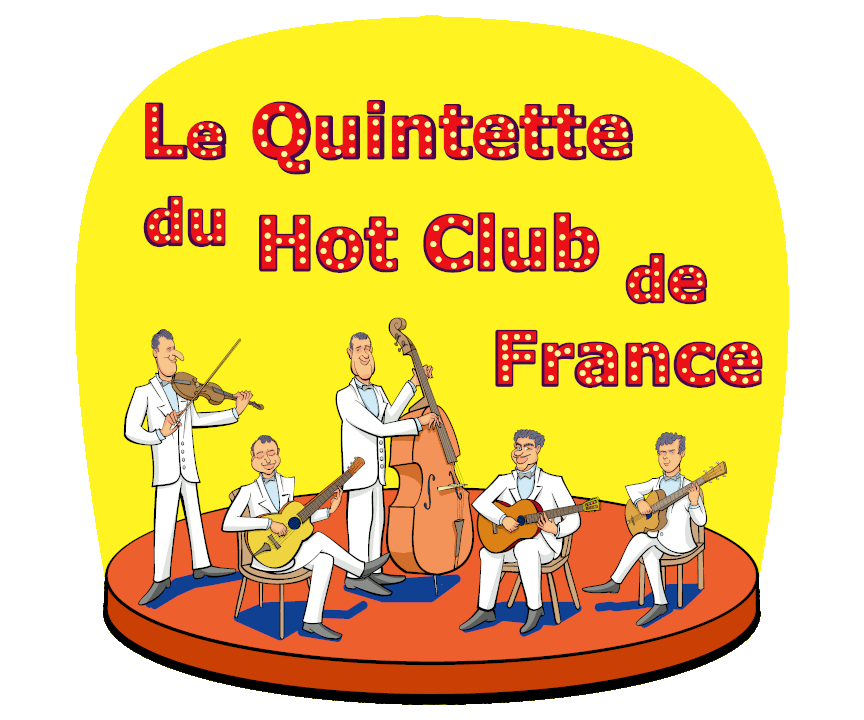
(L-R: Stephane, Django, Louis, Joseph, Roger)
Of course, many jazz aficianodos will object to the qualifier plus célèbre de tous les temps. After all what about other jazz greats and groups? There's Al Hirt, Pete Fountain, the Dukes of Dixieland, Jelly Roll Morton, Doc Severinsen, Les Paul and Mary Ford, Miles Davis, and of course, Louis Armstrong and His All-Stars.
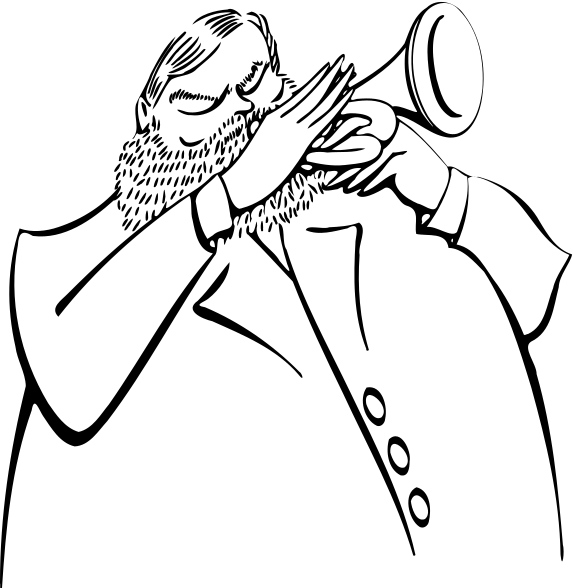
Al
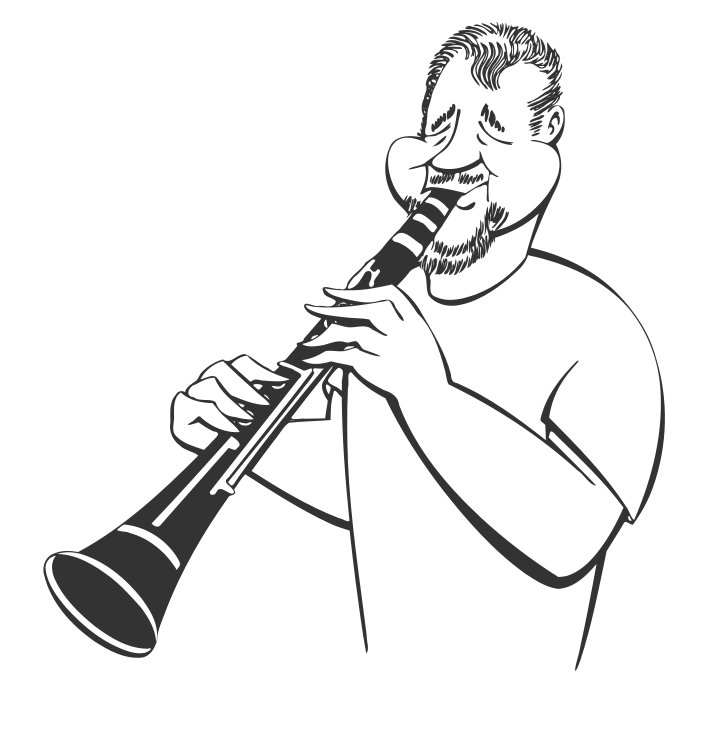
Pete
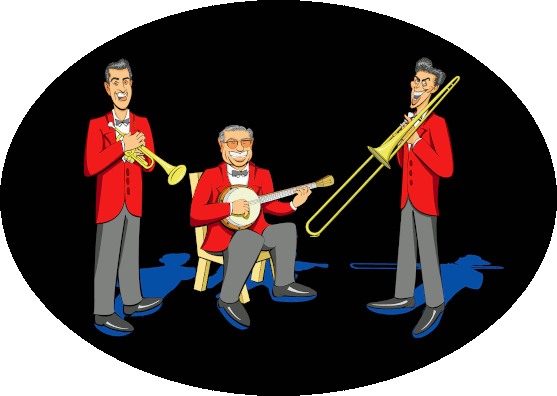
The Dukes
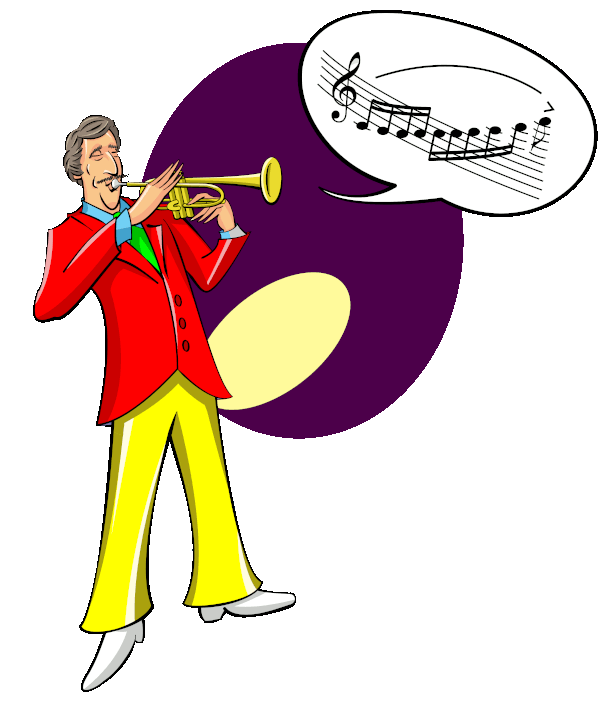
Doc

Jelly Roll
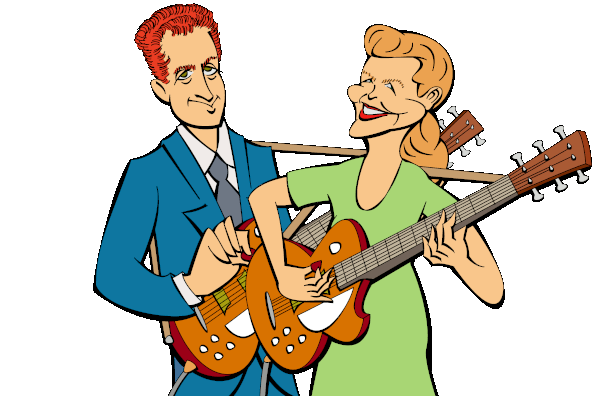
Les and Mary
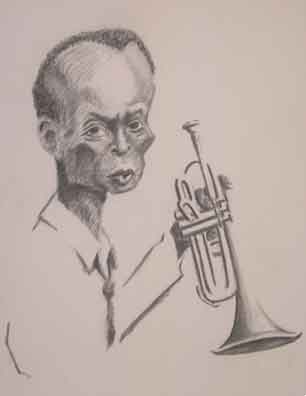
Miles
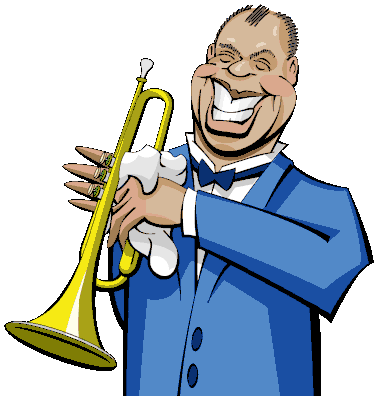
Louis
On the other hand what is the best in any art is a matter of opinion. That's particularly the case for jazz. And as in matters de jazzibus just as in matters de gustibus, non est disputatndum.
As far as Le Quintette du Hot Club de France this was - as you might guess from the name - a quintette of musicians who appeared at the Hot Club in Paris, France. That, though, isn't quite correct.
True, The Hot Club of France (to use the English translation) was established in 1931 and is still ongoing. However, it is an organization and not a particular performing venue.
But it was in 1935 that the famous group known as Le Quintette de Hot Club de France was organized. It was led by guitarist Jean "Django" Reinhardt with ("avec") violinist Stephane Grapelli. Filling out the other trois slots was Django's brother Joseph on rhythm guitar, Roger Chaput (also rhythm guitar), and Louis Vola on bass.
But as far as the origins of the the Hot Club the sources seem to vary. Some references of authority say Django founded the Hot Club but others say it was Charles Delaunay who also was the founder of the magazine Revue Jazz Hot. Actually it seems the "founding" of the Hot Club was more of a process than a specific event.
What scholarly research has shown is that the Hot Club started off with three teenagers, yes, teenagers, Jacques Auxenfans, Elwyn Dirats, and Pierre Gazères. They were jazz enthusiasts and Pierre wanted to take their efforts beyond arranging dances for their high school. So in 1932, they got ahold of a newspaper columnist Hugues Panassié who wrote for a small periodical called Jazz Tango. Hughes was interested in the idea but insisted that the organization should be called Le Hot Club de France.
By 1933 the Hot Club was being administered by Hugues along with Jacques Bureau, Pierre Nourry, and Charles Delaunay. They announced the goal of the organization was to "Disseminate this genre [jazz], make it appreciated, defend it, and win it the place it deserves among the expressions of art of our time." To this end they decided to arrange jazz concerts. The father of one of the club members owned a theater and in October 1933, the Hot Club Orchestra made its first performance.
This was not just a bunch of teenagers and twenty-somethings putting together a concert for friends to help pay the rent. The concert attracted no less an attendee than Spencer Williams the composer of "Basin Street Blues". But the Hot Club Orchestra soon stepped aside for the now legendary Quintette du Hot Club de France.
Who actually pulled the Quintette together is a story with some variability. Some sources cite Charles as the Hot Clubber who heard Django. Other sources state that it was bassist Louis Vola who first hired the skilled guitarist. Stephane himself said the group began just with some guys sitting backstage and jamming. Of course, none of the stories are mutually exclusive.
The Quintette was soon packing them in. The group - particularly the lead players, Stephane and Django - became celebrities. For five years things were looking, well, hot.
Then came 1939.
There was, of course, a war on. But with outbreak of war in September 1939, the quintet happened to be playing in England. Stephane had just taken ill which delayed his departure. Then two days before he planned to leave, England stopped all travel to France. So Stephane stayed in England for the duration of the war.
Django, though, had returned to Paris and with Stephane unavailable formed a new quintet. Such dedication was quite dangerous since in 1940 Germany had invaded France and set up a nominally independent but actually collaborationist government of Vichy (and later took that region over as well). Django, with his gypsy heritage, was considered by the Nazi's to be an "undesirable", and many gypsies were in fact sent to and died in concentration camps.
But Django and the Hot Club were left alone. It seems that the Germans hoped to gain the hearts and minds of the French and on the surface let the life of Gay Paree continue although the city was being really being run by a military dictatorship. Paris was also, we should note, a great place for German officers and soldiers to take some R and R when not at the front.
Although jazz was considered a corrupting and malignant influence by the official Nazi party line (and we should mention by a lot of "proper" people in other countries as well), the club was popular with German soldiers. There was one officer of the Wehrmacht who was a jazz fan and he used his influence to establish an unofficial "hands-off" policy on the Hot Club. The officer might not have been so tolerant had he learned the Hot Club also became a meeting place for the French Resistance and British spies. The Club was raided at least once by the Gestapo, but Django and the Quintet were left alone and survived the war.
Sadly Django lived less than ten years after the War but probably more people know about him and his music now than in the Quintette's heyday. But the others kept performing for decades and even in his later years Stephane continued to be one of the most celebrated violinists with a status equal to that not just of Joe Venuti but Yehudi Menuhin, David Oistrakh, and Jascha Heifetz. By one tabulation, Stephane released or appeared on over 90 albums.
There still is a Hot Club de France which is dedicated to promoting jazz. And yes, people still sometimes confuse the Hot Club the Organization with the actual location of the concerts or performances. But if you have a Hot Club you have to have a Quintette, and in 2024 at the Salle Cortot in Paris the New Quintette du Hot Club de France performed featuring Daniel Garlitsky (violin), Pierre Richeux (guitar), Scott Koehler (bass), Duved Dunayevsky (guitar), and Andrea Soria (guitar).
What makes everyone take note of the Hot Club and its history is how the name blends English with French in a most effective manner. But we do wonder if the famous Académie Française has an official position of the name of the band.
In the 1970's the Académie began a program for removing the English borrowings (loanwords) they considered unsuitable. For instance, the Académie recently demanded no more "les e-sports". Instead say "les jeux video de competition" and that "le streamer" must be "le joueur-animateur en direct".
However, some franglais is practiced without much censure. One common English borrowing is "le week-end" which when spelled with a hyphen is generally acceptable. But if in doubt or in highly formal situations, the official French is "la fin de semaine".
But Hot Club? What should the true scholar say?
Well, the problem is that en français "club" and "hot" have many meanings as they do en anglais . For instance, if we say "Le Bâton Chaud de France" that is translatable as "The Hot Club of France". But a better rendering is "The Excessively Warm Stick of France". Similarly "Le Gourdin Épicé de France" can also mean "The Hot Club of France" but is better translated as "The Spicy Cudgel of France".
We menntioned that people who first learn of Le Quintette du Hot Club de France think of a night club. "Club" in this case would be boîte de nuit and "hot" in this context would be more like tremendous, fantastic, or terrific. So we have Le Quintette de la Boîte de Nuit Formidable de France or Le Quintette de la Boîte de Nuit Sensationnel de France.
But by now we know that "club" in the Hot Club was an organization. The "real" French would be "la maison" or "house". So the rendering would be Le Quintette de la Maison Sensationnel de France. You could also say "la association" and so have Le Quintette de la Association Excellente de France
We'll just stick with Le Hot Club de France.
Perhaps one of the biggest ironies is the expression that the Académie Française uses to describe words and phrases from English related to computer technology, particularly words ultimately arising from the Silicon Valley. You might think that they would use a good French expression like mots dérivés de la technologie informatique.
But what did they decide to call those objectionable high-tech words that are creeping into the French language?
Les Californisms.
Sacre bleu!
References and Further Reading
Django: The Life and Music of a Gypsy Legend, Michael Dregni, Oxford University Press, 2004
"History of the Hot Club of France", Melissa Jones, February 16, 2021.
Stéphane Grappelli and the Hot Club Quintet, Frank Murphy, Beiträge zur Jazzforschung, 2019.
"The Quintet of the Hot Club of France: Django Reinhardt and Stephane Grappelli", Roots & Rhythm Revue, October 2, 2024.
Django Reinhardt, Charles Delaunay, Da Capo Press, 1981.
"History of Jazz in France", Margo Lestz, The Good Life France, July 20, 2014.
Sing Out, Volume 51, 1950.
"Académie Française Rails Against 'Californisms', Language Magazine, March 22, 2022.
"French Jazz Fans Outsmart Hitler", Margo Lestz, Curious Rambler, July 9, 2014.
"The Double Life of French Jazz", Daisy Fancourt, Music and the Holocaust.
"History and Rebirth of the Quintette du Hot Club de France", Brice Moss, Syncopated Times, December 31, 2024.