Claudia Cardinale, Charles Bronson, Sergio Leone, Henry Fonda, and Jason Robards in
Once Upon a Time in the West
(Click on the image to zoom in and out.)
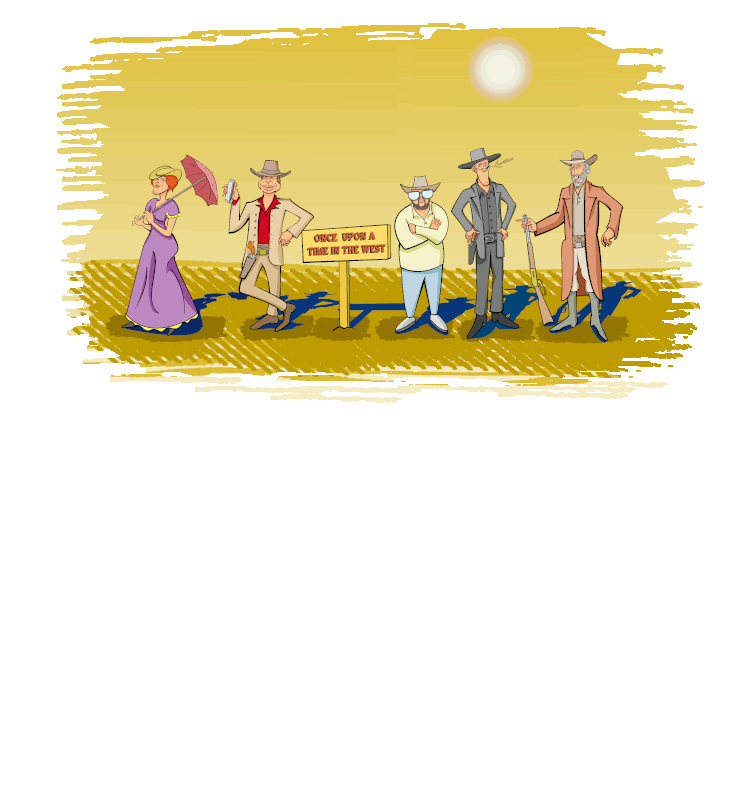
Once Upon a Time in the West has been rated as one of the top motion pictures produced during of the Golden Age of Cinema. With an all-star cast, first-rate cinematography, a top-notch score, a great script, and one of the most capable directors in the chair, it could hardly have been less. Many young and impressionable moviegoers who saw the movie agreed.
Note the reference was not to the Golden Age of 
 Cinema. That famous epoch had pretty much ended by the early 1960's.
Instead released in 1968, Once Upon a Time in the West can be considered one of the inaugural films of the Golden Age of the International Cinema or more generally the Age of the Independent Productions. Although the word "Hollywood" was still used as a generic term for film productions, fewer and fewer movies came out of the Big Studios.
WARNING!!!!
MAJOR
SPOILER ALERT!!!!!
The movie opens with a windswept and virtually deserted train station. Three gunfighters arrive named Snaky, Stony, and Knuckles (played by Jack Elam, Woody Strobe, and Al Mulock). Although the scene is without dialogue until the end, the three gunmen's comically strange behavior makes it clear that they are true psychopaths.
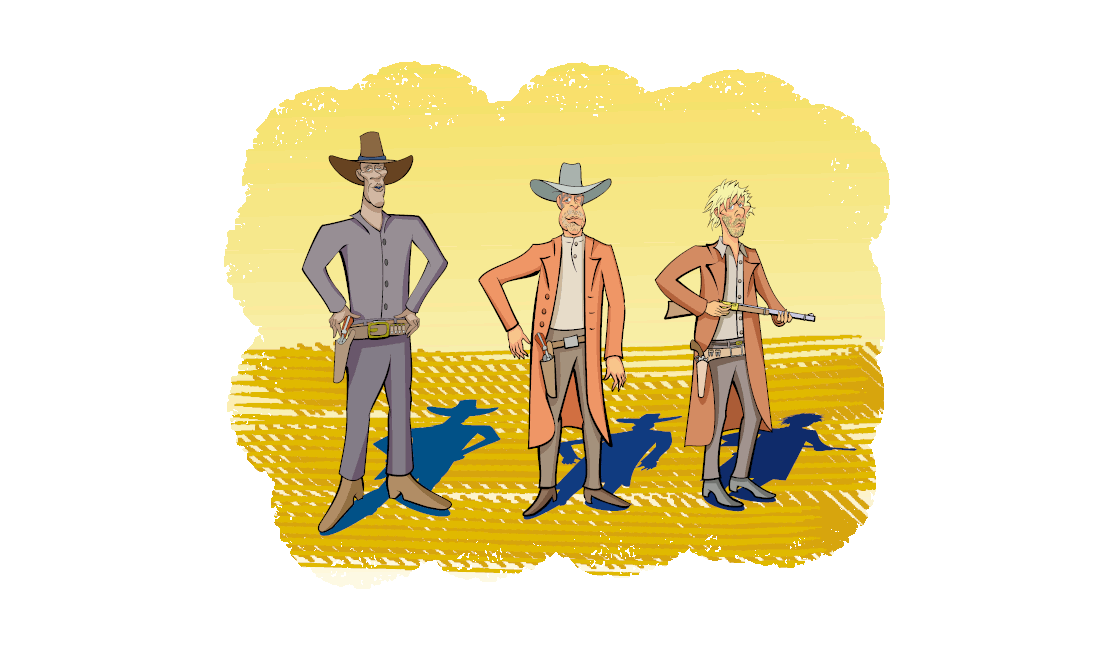
Stony, Snaky, and Knuckles
(Woody, Jack, and Al)
(Click on the image to zoom in and out.)
They are there to meet a character known only as Harmonica (Charles Bronson). Harmonica had arranged to meet someone named Frank who is played by Henry Fonda in a most uncharacteristic role. What Harmonica's business is with Frank no one knows.
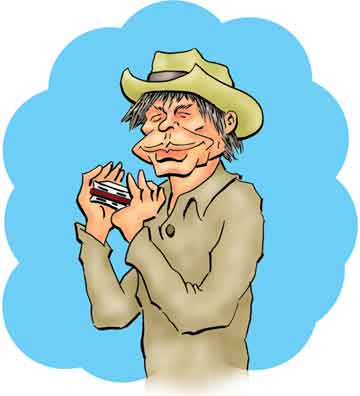
Snaky, Stony, and Knuckles wait as the train pulls in and unloads some freight. But no one gets off. So they turn to leave only to hear an eerie wailing behind them. The train pulls out revealing Harmonica standing across the tracks. He holds a duffle bag in his right hand while playing his namesake instrument with his left.
Harmonica expected to meet Frank himself. So as the gunmen stare at him, he looks at Snaky and asks:
And Frank?
Snaky replies.
Frank sent us.
Harmonica sees there's only three horses tethered in the background.
You bring a horse for me?
Snaky looks back at the horses and laughs.
Looks like we're - [chuckles] - looks like we're shy one horse.
Stony and Knuckles join in the laughter.
But Harmonica slowly shakes his head and answers.
You brought two too many.
Snaky and the others immediately pull their guns but Harmonica drops his bag to show he was hiding his revolver. He fires rapidly - evidently using a double action revolver - and hits all three gunmen. But a stray shot from Stony hits Harmonica and brings him down.
Once Upon a Time in the West was one of the "Spaghetti Westerns" directed by Sergio Leone. Today Baby Boomers remember these films as breaking the mold of the Western but few realize that Sergio also directed the cheesy swords-and-sandals movies The Last Days of Pompeii and The Colossus of Rhodes both starring beefcake strongman Steve Reeves.
Part of the mold that was broken is there really weren't good guys and bad guys in the plot. There were just varying degrees of badness. Of course, we immediately recognize that Harmonica was a "good bad guy" as was Cheyenne (Jason Robards) and the [girl] with the heart of gold, Jill, (played by Claudia Cardinale).
Henry's character, though, was a major departure for the actor who was best known for playing honorable men of unimpeachable character like Abraham Lincoln and Clarence Darrow. In Once Upon a Time in the West Frank was a merciless killer who would gun down a six-year old boy to keep his identity secret.
After the opening scene the action cuts to the homestead of Brett McBain. Brett has settled on land with the only source of water for fifty miles. So that's where trains would have to stop to take on water. Brett signed a contract with the railroad that he would create a station for the train and would let the railroad lay the track over his land. But if the station wasn't ready by the time the trains came through, the land would revert to the railroad.
But the railroad tycoon who we only know as Morton (Gabriele Ferzetti) hires Frank to scare the family so they'll sell out cheap. Morton is unable to walk due to spinal tuberculosis and he follows the construction crews in his luxurious private car. But now the railroad is getting close to the McBain ranch and he's running out of time.
Back at the ranch the McBain family prepares to hold a reception for their neighbors to meet Brett's new wife, Jill, who is arriving in town by train. She and Brett were married in New Orleans in circumstances that the viewer can figure out.
But now Brett is out hunting birds for the dinner. After he shoots a couple of grouse, he hears another gunshot. He thinks it's simply another hunter but then he looks toward his daughter Maureen who is setting up the buffet. She crumples to the ground and as Brett runs to her aid he himself is gunned down. Brett's eldest son Patrick (about seventeen years old) was getting the buggy ready to go pick up his stepmother when he too is shot.
Frank and his gang come walking out of the brush dressed in long duster overcoats. As they reach the front of the house they see that the youngest son Timmy, who is about five or six years old, was overlooked. Timmy stands looking at Frank and his men.
Frank looks back and his face softens into a faint smile.
Then one of the gunmen looks over.
What are we going to do with this one, Frank?
Frank's expression changes to one of irritation.
Now that you called me by name.
He then pulls his pistol.
With the whole family dead, Frank plants some evidence to make it look like the murders were by Cheyenne who is an escaped convict with a $5000 reward on his head. Now Cheyenne is leading an outlaw gang although it's not quite clear what kind of outlawry they deal in.
But in the town Jill saw no one was there to pick her up. So she manages to hire a buggy to take her to the ranch.
There she finds the guests standing around the dead family. Then one of the men finds the planted evidence and everyone now thinks Cheyenne is the culprit.
Back at the train, Morton tells Frank he wanted him to scare the family off. Not kill them.
"Tell me, was it necessary that you kill all of them?" Morton asks. "I only told you to scare them."
Frank just replies, "People scare better when they're dying."
Morton points out that the whole massacre was pointless since Jill, who had legally married Brett, has now shown up. Frank shrugs it off as a minor complication that he can handle.
After the guests leave and the funeral arrangements are made, Jill began looking around for the deed to the land and the contract. Finding nothing she gives up and decides to return to New Orleans. But as she opens the door to go outside she finds Cheyenne standing there blocking her way.
After some discussion, Cheyenne manages to convince Jill that he is innocent. He and his men leave and she plans to return to New Orleans. But then she's captured by Frank's men. It looks bad for Jill.
In the meantime, we find that Harmonica finds Wobbles, the man who arranged the meeting with Frank. Harmonica deals with Wobbles most rudely and points out Frank was supposed to be at the station, not three gunmen.
You know, Wobbles. I'm kind of mad at you. Frank wasn't there. Frank wasn't there because he was at the McBain's.
Wobbles, who is so concerned about keeping his trousers in place that he wears both a belt and suspenders, pleads his innocence.
That's not true. Cheyenne did that job. Everyone knows that. We got proof.
Harmonica says it was Frank.
That was always one of Frank's tricks. Faking evidence.
Leaving Wobbles a bit worse for wear, Harmonica then heads to Morton's train. But he's quickly discovered and taken before Frank and Morton. There Frank learns that Harmonica was the man who arranged the meeting at the railroad station - and killed three of his best henchmen.
So you're the one who makes appointments.
Harmonica admits it.
And you're the one who doesn't keep them.
Frank roughs Harmonica up and asks who he is. But Harmonica just replies with the names of men Frank has killed.
Frank is now convinced Wobbles was double-crossing him. Wobbles denies it.
You've known me a long time, Frank. You know you can trust me.
Frank is not in a forgiving mood.
How can you trust a man who wears both a belt and suspenders? The man can't even trust his own pants.
Frank shoves Wobbles off the train. But as Wobbles hits the dirt he sees Cheyenne hiding underneath the chassis. Cheyenne signals him to be quiet but as Wobbles gets up to warn Frank, Frank shoots Wobbles through both his suspenders and through his belt buckle. Cheyenne shakes his head sympathetically.
I told you to keep quiet.
Two other members of Frank's gang now show up. Frank asks if the others had gone to the McBain ranch and killed Jill. They replied the men were found dead and Jill had escaped. Evidently Cheyenne had been busy.
Frank leaves Harmonica guarded by his gang in Morton's car. But Cheyenne manages to free Harmonica and they head off to the ranch. There Harmonica lays out an area to construct a ramshackle building that will serve as a station therefore fulfilling the letter of the contract. He tells Cheyenne about the agreement McBain made with Morton.
Cheyenne is intrigued.
You could make a fortune, huh? Hundreds of thousands of dollars.
He thinks a minute.
Hey, more than that. Thousands of thousands.
Harmonica replies.
They call them millions.
The rest of the movie has Morton and Frank trying to get control of the McBain ranch. At one point Frank believes his masculine charms have convinced Jill to auction off the land to save her life. But he plants his men in the crowd to stop people from bidding. The sheriff (Keenan Wynn) who is conducting the sale is flabbergasted that no one is bidding.
Then suddenly Harmonica appears. He says he'll bid $5000.
The sheriff isn't sure if he heard right.
You said $5,000?
Harmonica said yes.
It's on its way.
Now Cheyenne steps forward. Harmonica is holding him at gunpoint.
That's the reward for this man.
Cheyenne expresses his displeasure.
Judas was content with $4,970 less.
Harmonica replies.
There were no dollars in them days.
Cheyenne say maybe not.
But s--s of b-----s, yeah.
So Harmonica buys the ranch and gives it back to Jill. Cheyenne is put on the train back to prison but two of his men also get on the train and spring their boss.
By now Frank has decided to take over the railroad business without Morton. So he holds Morton prisoner and he has some of his men stand guard.
But Morton then bribes them to kill their former boss. So they ambush Frank but Harmonica shows up and helps Frank defend himself. Jill was watching from a safe distance and when all of Frank's former henchmen get killed, she contemptuously points out he saved Frank's life. Harmonica says he stopped the men from killing Frank - which isn't the same thing.
Frank returns to Morton's car to find Morton has been ambushed by Cheyenne's men. He's still alive but is laying on the ground outside the car. Frank draws his gun but doesn't shoot. He just leaves Morton to die.
Finally Harmonica and Frank meet at the McBain ranch where Cheyenne and Jill wait inside the house. Frank goes up to Harmonica and says things have changed.
Nothing matters now. Not the land, not the money, not the woman. I came here to see you. Because I know that now you'll tell me what you're after.
Harmonica makes a qualification.
Only at the point of dying.
Harmonica and Frank have the classic fast draw duel, which, of course, Frank loses. But before Frank dies, Harmonica in a dramatic gesture places his harmonica in Frank's mouth.
Years ago Frank led a gang of killers and had been hired to kill Harmonica's brother. He did so in a fiendish manner in Harmonica's presence. But before the brother died Frank took a harmonica and stuffed it in Harmonica's mouth sneering "Keep your loving brother happy". Now Frank understands and nods his head before dying.
Harmonica then says good-by to Jill and says he might return someday. Cheyenne also leaves and Jill now owns the ranch where the construction crews are now laying the track. Jill, we surmise, lives happily - and richly - ever after.
When the movie was released American audiences noted some holes in the plot. For instance, after Harmonica shoots Stony, Snaky, and Knuckles at the station, Woody gets off a shot that brings Harmonica down. But then Harmonica soon shows up at Wobbles's place apparently unharmed. What is going on?
The problem here though wasn't the script but the editing. The final film runs for nearly three hours which at that time this was a long movie - too long for some American audiences the producers thought. So in some releases, particularly in the United States, a number of scenes were cut. Yes, this shortened the movie, but it also left gaps in the story line.
And one of the important but deleted scenes was that after the opening shootout, Harmonica painfully recovers consciousness (he was shot in the arm). He manages to leave the station (despite what some critics said, this scene was omitted in the original American theatrical release). Other cuttings also left out parts of the story that would have helped keep the action flowing smoothly.
There is, though, one true and glaring hole in the basic plot. Harmonica had arranged the meeting with Frank but Frank didn't know what it was about. And he didn't care. Rather than take any chances, he sent Stony, Snaky, and Knuckles to take care of the stranger right then and there, no questions asked.
But at a number of places in the movie, Frank has the opportunity to take care of Harmonica once and for all. For instance, he could easily have dispatched Harmonica when he was holding him prisoner in Morton's car.
But Frank, a cold-blooded murderer who would literally massacre a whole family and had planned to murder Harmonica at the train station, goes off leaving Harmonica alive and soon to be rescued by Cheyenne. Few people - including the critics - seemed to recognize the illogic of such a plot. Lack of logic, though, never spoils a good movie.
Despite the current standing that Once Upon a Time in the West is one of the best Westerns ever produced, some of its early fans were teemingly surprised when they read the rather lukewarm and even negative reviews. Not only was the movie too long one critic said, but the picture was nothing more than a series of scenes where the actors stare, deliver a line, and stare again.
But in the end, the public won out and even the critics became convinced that Once Upon a Time in the West was a landmark in cinema. Eventually the film was selected by the Library of Congress as being of particular cultural and historical importance.
Movies like Once Upon a Time in the West infused new life into an old genre. It seemed that the Western motion picture was going to continue to be part of World Culture to the end of the Millennium and beyond.
But the Swinging Sixties was actually the swan song of the Western. What had been a staple of motion pictures and television for more than half a century soon faded to be replaced by stories of advanced civilizations in galaxies long, long ago and far, far away. Although Westerns are still being made, they arrive and fade almost unnoticed by the audiences who now prefer to see people with superpowers who wander around wearing masks and leotards.
References
"Once Upon a Time in the West", Colin Covert, Film Society, Minneapolis-St. Paul.
Once Upon a Time in the Italian West, Howard Hughes, Palgrave Macmillan, 2004.
Sergio Leone, Michael Carson, Harpenden Pocket Essentials, 2001.
"On TV Westerns of the 1950s and '60s," Stephen Kiss, New York Public Library, December 1, 2012.
"Once Upon a Time...", Harvard Film Archive.