In Which Possible and Completely Hypothetical Explanations Are Advanced and Offered as Possible Explanations for the Modus Operandi of Famous Conjuring Effects Without Any Intention of Broaching Standards of Propriety Among the Prestidigitators and Their Admirers.
In a Quaint Town somewhat long ago and fairly far away, a young man was astonished when a house guest performed Acts of Wonder and Amazement. Objects vanished into and were plucked from thin air. Items fragmented and were reassembled with a gesture. Coins entered containers where entrance was impossible and were recovered as if - well, as if by magic.
When the young man - who had a never-ending curiosity and was dedicated to eradicating ignorance and superstition - asked how the tricks were done, the guest pulled a card out of his wallet. On it were words to the effect:
As a magician, I promise I will never reveal the secret of any illusion either in word or writing unless to those who are members of the organization and are also bound in secrecy to the by-laws of this organization and by this oath.
So it was with some surprise that not long afterwards the young man found that the modus performerandi of the Acts of Wonder and Amazement could be found in books at the local library. A bigger surprise was that many of the books revealing the secrets were written by the famous magicians themselves!
Of course, not all towns have well-stocked libraries and in the years before instantaneous communication learning how to perform Acts of Wonder and Amazement could take considerable time and effort - and expense. Perhaps one of the most time-consuming (and expensive) quests to learn the tricks was by the writer John A. Keel.
Born in 1930 in Hornell, New York, Alva John Kiehle (John's real name) had been doing magic tricks to amuse his friends since he was a boy. He learned conjuring from whatever books were available but the resources in rural New York for the aspiring conjurer were limited.
After high school John went to New York City where he found work as a continuity writer for comic books. Then in the early 1950's he was drafted into the Army and worked in the American Forces Network in Germany which provided radio entertainment and news for the servicemen stationed in Europe. Then after he was discharged in 1954, he decided to travel to India via Egypt and the Middle East to learn firsthand the "Mysteries of the Orient". To support himself he would write articles about his adventures and have an agent send them to the men's adventure magazines which were then in vogue.
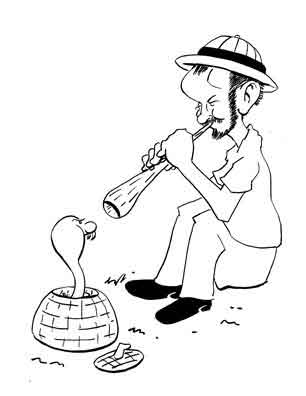
John A. Keel
He went to India.
John himself was quite a skilled magician (there is a video of him performing) but there were three tricks that John had never been able to figure out. One was the secret of the snake charmers. Next was the famous Indian Rope Trick - which many professional magicians thought was simply a legend. Finally John wanted to learn the Secret of the X-Ray Eyes.
It was the X-Ray Eyes that John particularly wanted to learn. There were several variants, but often cotton pads or chunks of bread dough were placed over both of the magician's eyes. Sometimes metal plates would be placed over the pads or bread dough and everything was held in place by wrapping the magician's head with gauze bandages. This was the method used by Pakistani magician Kuda Bux who had performed extensively in America. Other magicians - including the most famous of the Indian stage magicians, P. C. Socar - used a regular blindfold to cover the eyes, and then covered the head in a black hood.
But the magician can still see. He identifies objects held up by the audience, copies writing and symbols written on blackboards, and one blindfolded magician even drove a motorcycle through the streets of New Delhi.
John learned how to charm a cobra in Bombay and his efforts got his picture in the Sunday Times of India. He then learned how to do the rope trick from a former magician he met who was sitting by the road. He later tried to perform it before some reporters but some unexpected occurrences - such as a sudden downpour - rendered John's attempts comically ineffective.
But by the time John made it all the way to Calcutta, he still hadn't learned how to do the X-Ray Eyes. He did, though, manage to speak to a number of people who had done the trick. This included P. C. Sorcar himself, but of course, Sorcar didn't want to part with the secret. Another magician who demonstrated the trick by placing sand under the bandages to cover his eyes wanted 1000 rupees ($210) for the secret. This was way too steep for John's meager finances. Then a fake fortune teller swindled John out of $5 by giving him a bogus answer.

P. C. Sorcar, Sr.
Patriarch of Indian Magic
(Click to zoom in and out.)
Then while walking along the banks of the Hooghly River he found a young sadhu doing the trick. For a payment of 5 rupees (about a buck), the sadhu showed John that the bread dough doesn't stick to the face but to the bandages. With enough practice, the blindfold, bandages, and bread dough can be surreptitiously shifted so the magician can peek through the bandages while to the audience it looks like his eyes are still covered. If a separate blindfold is used it is made of thin cloth with an open weave and the magician can see through the cloth even when it's placed across the eyes.
The hood, if used, is double lined. The inner lining is opaque but the outer lining, like the blindfold, is made of a thin cloth that can be seen through when placed close to the eyes. The hood is usually black and this helps disguise the thinness of the cloth. However, the two linings are only sewn together on one side and when the magician puts it on, he makes sure his face is only covered by the thin outer lining. But if a spectator tries it on, the magician places the hood so the spectator's head is inside the opaque inner lining. The spectator then agrees no one can see out of the hood.
So despite the bread dough, cotton pads, metal plates, bandages, blindfold, and hood, the magician really can see. It took a journey of over 5000 miles, but John had finally learned the secret of the X-ray eyes!
However, it would have been simpler for John to have gone to the New York City Public Library when he lived in Manhattan. There he could have found the Cyclopedia of Magic published in 1949. Under the "Blindfolds" topic was all he needed to learn exactly how the X-ray Eyes trick was done - including the use of the cotton pads, bandages, and even the double-lined trick hood. Everything was quite literally was there and for free.1
In fairness, John had not seen the X-Ray Eyes performed until he attended a United Service Organization (USO) show in Germany. But it never seems to have occurred to him that the secret might actually be found in a standard reference work on magic tricks.
Today there are many books and resources available to the aspiring prestidigitator. However, some of the famous tricks in the earlier books are no longer found in the modern manuals due to the hazards. For instance, the East Indian Needles Trick (made famous by Harry Houdini) and the Bullet Catching Trick are quite dangerous and should never be attempted by a student magician and in fact are largely avoided even by professionals. The dangers are by no means minor. In 1918 the magician Chung Ling Soo - who was actually an American named Billy Robinson - was killed onstage in London when the bullet catch went astray.2
Billy always pretended to be Chinese and when interviewed by journalist spoke through an "interpreter". Billy performed in America, Europe, and Australia, and he even went to China.
The only time he was known to have spoken on stage was when the Bullet Catch Trick failed. The gun was designed so it could be loaded with powder and a bullet but the powder charge would not ignite and the bullet would stay in the gun. A palm switch kept the signed bullet in the hands of the magician.
When the gun was fired, the smoke and noise were produced from a small powder charge in the ramrod cylinder. But in this case, the powder in the barrel ignited and the bullet fired. Billy was struck in the lung. When he fell, he cried out in English, "Oh my God. Something's happened. Lower the curtain." He died the next day.
In the investigation that followed, it was found that corrosion had created a passageway from the percussion cap to the powder charge in the breech. So the powder behind the bullet ignited sending the bullet out of the barrel.
Harry Houdini was once planning to do the trick, but Harry Keller who was one of the most famous American illusionists at the time, personally wrote Harry not to try the trick. Due to his respect for Keller, Houdini agreed to cut the trick from the act.
All right. If telling how the tricks are done is forbidden by the Magicians' Code, how can famous magicians publish them in books that anyone can read?
Is't possible? (To quote Shakespeare.)
Famous Magicians
Two Harrys, Howard, Chung, Bess, and Suee
Harry and Bess Houdini
Harry Blackstone
(Click to zoom in and out.)

Howard Thurston
(Click to zoom in and out.)

Chung Ling Soo and Suee Seen
(Psst! It's Billy and Dot)
(Click to zoom in and out.)
Of course, if no one ever told anyone how magic tricks are done, the tricks would have to be continually reinvented. So there are proper guidelines for revealing and transmitting magic tricks. Certainly the Dynamic Duo of Divination of Penn Jillette and Raymond Teller - despite sometimes seeming to having spilled the beans - have held steadfast to the proper principles. If they show how a trick is done, it's one of their own. Otherwise any revelation is done with the full acquiescence of the others involved. So it's not true that magicians are bound never to reveal their tricks under any circumstances.
Of course, much of the fun in seeing magicians perform is trying to guess - and discuss - how they do it. In fact, Penn and Teller host the television show Fool Us! where they invite other magicians to perform new tricks. After the trick is done, Penn and Teller try to guess the technique and if they can't the magicians are invited to appear with them on their other show. A virtue of their television shows is that Penn and Teller do their tricks before live audiences. So what the television viewers see is what the live audience gets.
This what-you-see-is-what-they-do is from the principle that tricks on television should not be performed using "trick photography" or more generally, with "in camera effects". Even on a television series about a fictional magician-detective, there was a statement that all the tricks were performed by the star and were without trick photography. In the plots when there was a disappearance or a theft, it would turn out that there was some kind of conjuring trick involved. The Magician - played by Bill Bixby - would explain everything at the end.
Unfortunately as time has moved on, the rule of no trick photography or in-studio post-production seems to have been lamentably relaxed. Some tricks that today so astound the modern audiences break (or at least skirt) this once fundamental principle. Also the rule that the magician should never have more than one or two confederates in the audience seems to have become passé. In some cases everyone you see on screen - supposedly "audience members" there to keep the magician honest - may very well be in on the trick.
The irony is that if a television trick is too amazing it's easy to see it's a camera trick. Suppose a magician comes on stage with an elephant. Then he waves his wand and the elephant instantly vanishes. Anyone would clearly recognize that this is just an editing trick where the magician simply held his pose, the elephant was led away, and the film edited so it looks like the elephant vanishes.
This "cut and splice" method for doing on-camera magic is literally as old as cinema itself. One of the earliest motion pictures shows a train entering a station. Then a passenger comes up but trips and falls. Before he can get up, the train fades away. And yes, there is one short film that was released by Thomas Edison in 1900 where a magician makes items appear and disappear - including a young boy. Given the rather rudimentary editing it's obvious this is cut-and-splice.
So ironically to make an elephant's disappearance more believable the magician first hides the elephant from view. Maybe the elephant is surrounded by a curtain or hidden by a wall. Then the magician does the flourishes and hey, double presto!, the curtains are raised or walls are lowered and he shows that the elephant is gone.
The first man to make an elephant disappear was Harry Houdini at the Hippodrome Theater in New York City on January 7th, 1918. He had the elephant led on stage and then some stagehands hauled in a large wheeled box. The elephant and the trainer climbed inside, the door was closed, and after a moment the door was reopened. Those in the audience who could see inside the rather narrow opening saw there was no elephant.
It's now accepted that the basic trick here was not invented by Harry. Instead it was a variant of Charles Morritt's "The Vanishing Donkey". Charles himself was magician and he sold the trick to Houdini who then adapted it for the elephant.
The trick is that the box contained a hidden mirror as large as one of the sides. The silvered side was placed against the wall and the back was painted black to match the interior. So if anyone looked inside all they saw was an empty box.
So when the elephant was led into the box he and the trainer simply moved to the back. Once the door was closed the trainer pulled the mirror over so it formed a diagonal from a back corner to the front. So when the door was opened the mirror did double duty of hiding the elephant and reflecting the opposite wall. To anyone looking through the door, it looked like the box was empty.
But some people weren't fooled. They noted that three men pushed the box on stage but it took twenty men to wheel it off. That the box itself was large enough to easily accommodate an extra elephant was also something of a giveaway.

Doug Henning
He dispensed with the box.
(Click on the image to
zoom in and out.)
The Canadian master magician Doug Henning dispensed with the pre-constructed box on wheels. Instead, he rode the elephant onto the stage where a large cloth had been laid down. Then Doug's assistants raised up four walls surrounding the elephant while Doug stood on his back. His upper torso remained visible as he took hold of a trapeze. At one point he briefly let go of the swing while carefully keeping his balance on the swaying elephant.
Then the walls dropped down leaving Doug hanging on to the trapeze. But the elephant was gone!
At this point it's a good idea to re-emphasize that:
 It Is Quite Proper
For Fans of
Magic and Conjuring
To Guess
and
Discuss
How a Trick
MIGHT
Be Performed.
To some that's the biggest part of the fun.
And in this case, one possible modus vanisherandi is that the back wall that was not visible to the audience was made in multiple detachable sections - a fact disguised by the walls having white vertical slats about 18 inches apart. The elephant, then, could slip out the back while Doug stood on a small hidden platform on back of the front wall which made it look like he was still standing on the elephant. The small platform would then fold flat against the back of the wall when the wall was lowered.
But regardless of how it's done, Doug's trick was most impressive. How could anyone improve on that?
Well, one way is to have the elephant vanish while it is in an open field. And yes, one television illusion that was made famous in Great Britain - if not their former Colonies - was when the renown English magician Paul Daniels vanished an elephant out-of-doors. The trick was arranged on a football practice field of an army base where some soldiers had set up a small tent. Paul was helped by his assistant (and wife) Debbie McGee while the soldiers stood guard.
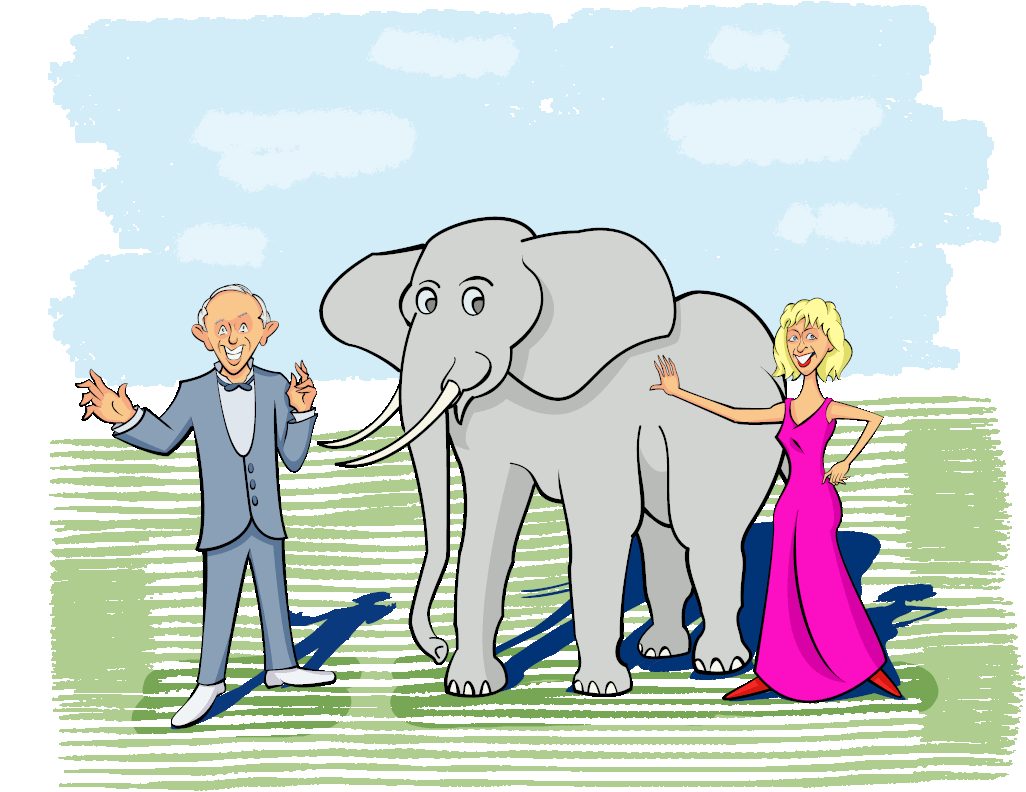
Paul and Debbie
(And Friend)
(Click to zoom in and out).
The tent's sides were canvas and held in place by metal frames which could be lowered leaving only the top of the tent in place. When the walls were down, the audience - that is the television audience - could look through the tent frame to the background. Then because of a high camera placement they could look over the top to see the rest of the playing field which ended with some trees on the horizon. Johnny Morris, the host of the British children's program Animal Magic, was present as an observer as the soldiers stood guard.
Debbie came on the scene riding a rather small elephant which was led by its trainer, Bobby Roberts. The soldiers then raised the tent walls and then Debbie, the elephant, and the trainer entered the tent from the side. A small cannon was fired, the walls fell down, and hey, presto!, the elephant and trainer had vanished leaving Debbie standing inside the tent. Then to show that the elephant was really gone, the top of the tent was whisked away.
It must be emphasized that what follows is a purely hypothetical explanation much as Galileo's explanation of the heliocentric solar system was hypothetical. Robust discussion is after all the lifeblood of democracy.
Explanations given by the general public for this excellent trick range from the tent being built over a pit where the elephant was lowered to having a painted backdrop in the tent to look like the lawn while the elephant and trainer hid behind it.
At this point, it should be remembered that one tenant of performing magic tricks is you never do the trick twice - at least not for the same audience. The second time they know what to look for and may catch the deception.
But .... (And it's a big but).
Once home videos became ubiquitous, televised magical performances could be played again. Not only is this equivalent to doing the same trick twice, but the videos can be viewed many times, slowed down, and the action can be frozen.
So from a careful relook at the video of Paul and Debbie's Disappearing Elephant, it can be seen that:
First, the front and back are each made from two pieces of canvas supported on a metal frame. By dropping the frame to the ground you can see the tent's interior and out the back.
Secondly, when the front is lowered and raised although the middle seam is visible, there is no separation in the two halves of the canvas. So the front wall is essentially a single canvas made by sewing two pieces together.
Thirdly, the two parts of the back canvas are NOT sewn together - at least not completely. This can be discerned at one point when the back is raised and a careful viewer can see the two halves part briefly. This difference in the construction - a single piece in front and a double piece in back - hints that the basic - quote - "vanishing" - unquote - is by having the elephant slip out the back.
Well, OK. But what about when the back and front drop down? There's no elephant, only Debbie McGee. And you can see out the back of the tent to the lawn.
So where's the elephant?
Remember the top of the tent is still in place. Then Paul jokingly tells Johnny Morris that the people may be thinking the elephant is hidden in the top. To prove this is not the case, the top is whisked away using a cable (visible if you look carefully) pulled up from a crane which is out of view. So now the viewers can see the entire background - the football field that stretches back to the tree line on the horizon.
But no elephant.
Again there is a hint on how the trick MIGHT be done. The fact that Paul did not remove the top - which forms a trapezoid in the viewing frame - when he dropped the walls suggests its staying in place is important to do the trick. Otherwise it could have been whisked right away. So this introduces the question that if the elephant does indeed slip out the back, could the top of the tent be big enough to literally hide an elephant?
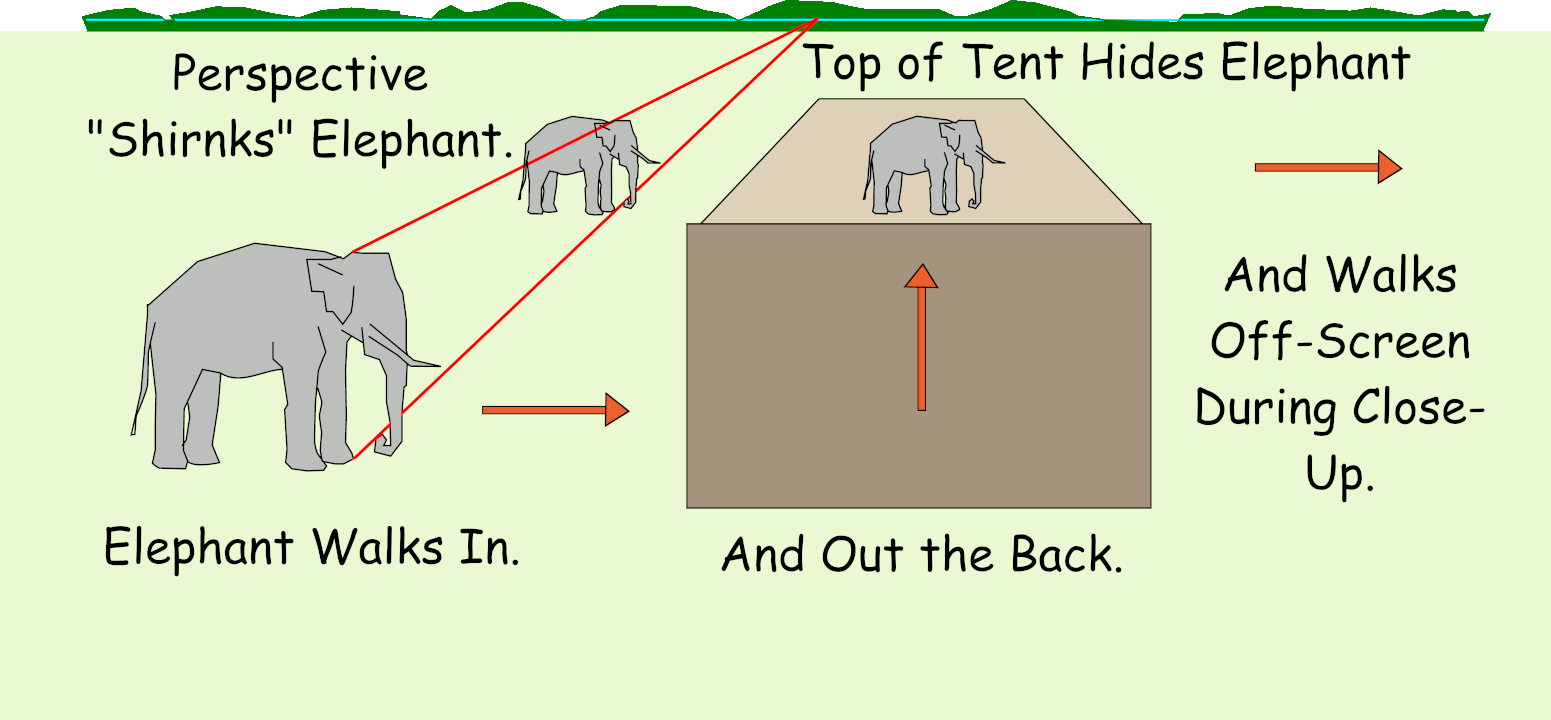
At first glance it might seem no. If you look at the trapezoidal shape of the top when Debbie and the elephant slip inside, it takes up about 17% of the vertical height of the viewing frame. But the elephant - even without Debbie - takes up 25 % of the height. So you might say there is too much elephant to hide.
Weeeeehhhhheeeeelllllll, maybe not. Remember things seem to shrink as they move toward the background. And if you draw perspective lines from the elephant to the horizon you can tell how high the elephant would appear if it was in the background, say about 1/3 of the way up to the trees. A rough estimate is that would be about 20 yards from the back of the tent.
In that case the elephant's apparent size shrinks to only 7% of the vertical height of the frame - less than half of the height of the tent's top. So if the elephant slips out the back and takes her position (the elephant is named Maureen) about 60 feet from the tent, she will easily be obscured by the top of the tent. When the tent walls drop, the camera sees no elephant.
But what about when they whisk the top away? There's no elephant.
One scholar has hypothesized that the top of the frame actually holds a mirror which hides the elephant and reflects the background. So it looks like you're seeing the uninterrupted background. Remember this technique - diagonal mirrors to make it look like an object has disappeared - is well-known to students of magic for making things "disappear".
But the mirrors, though, reflect what's in front of them, not what's behind. So it's not quite clear how a mirror on the top of the frame in front of the viewer would reflect the background. Also if you look carefully the frame does wiggle a bit when the sides are dropped but the background grass doesn't move. If the grass was a reflection, you would expect to see some motion in the reflected image.
Mature cogitation, though, lets us realize there would really be no need for a mirror. Instead here is where this being a television trick may be crucial.
Remember, this trick was recorded on video. When the walls drop to show only Debbie but no elephant, there is a camera cut to a close-up of Paul and Johnny. Johnny is laughing in amazement and after some more comments Paul starts to walk back to the tent. Then the camera cuts back to the long shot where Johnny joins Paul under the roof. Only then do they whisk away the top showing there is no elephant either near or far.
So there was a break in what filmmakers call the continuity. Since there is a cut to a close-up the video was filmed with at least a two camera set up. So what MAY have happened is that during the close-up when Paul moves over to talk with Johnny, the elephant and trainer simply walk away out of the scene.
Here the editor's scissors take over. They just cut out the frames where the elephant walks away. So in the final film, you see the elephant and Debbie go into the tent, and the front and back drop down showing the elephant has disappeared. The camera then cuts to the close-up with Johnny and Paul and then back to the long shot where the top of the tent is whisked away. No elephant anywhere.
A most impressive trick.
A Most Impressive Trick
But what about Johnny's reaction? He was clearly amazed. And Paul mentioned that Johnny had not been present at the rehearsals.
Yes, but remember Johnny was the host of the kids show Animal Magic which ran on the BBC from 1962 to 1983. And most "presenters" on television shows - even on kids' programs - are actors who have also appeared on stage, films, and other television shows.
Indeed, Johnny's career went way back. He was in The Secret Cave in 1953 and in the BBC TV series The Pelicans and the Pirates in 1955. After Animal Magic he was in the TV movie Aladdin and the Forty Thieves. And one thing a good actor can do is laugh and look amazed. And because Johnny wasn't at the rehearsals that doesn't mean he didn't know how the trick was going to be done.
But... but... but... Wouldn't all this mean that the soldiers standing around supposedly to keep things on the up-and-up were also in on the trick? In other words, doesn't all this mean that everyone - that's EVERYONE - on camera were - as they are called politely - "confederates" (which sounds nicer than "stooges").
If so, that seems rather disappointing.
Yes, indeed. But there is one tenant of magical performances. And that's the greater the trick, the more disappointing the explanation.
Paul's Vanishing Elephant is by no means the only trick which may rely primarily on camera effects. Another massive vanishing act was when P. C. Sorcar, Jr., son of the elder P. C. Sorcar, vanished the Victoria Monument in Calcutta. Needless to say, the Victoria Monument is much larger than an elephant and can't move.
In the video, P. C. comes on screen where a man and a woman are sitting on the lawn taking their ease. In the background you see the monument behind a line of trees.
The couple stands up and they hand P. C. a blanket. Everyone holds the blanket up and as the camera zooms in the monument is briefly obscured. Then after a pause, they lower the blanket, the camera pans back, and the monument has vanished!
They then raise the blanket again, the camera zooms in, they lower the blanket, and the camera pulls back. The monument is back!
Here the clue of the modus disapperingandi may - that's MAY be in the background. If you look at the screen when the video starts, there a tall tree that rises above the main treeline next to the left edge of the screen. The shape of the tree is quite distinct and its left side looks a bit like a profile of a face with a sloping forehead, long nose, and a jutting chin.
After the monument disappears and the camera pulls back we see the man is standing on the right of the screen as before. But at one point he moves slightly and a tree just becomes visible to the left of his shoulder. But before the monument disappears there was no tree of that height at that place.
More to the point if the frame is frozen and zoomed in, it can be seen that the tree has the tell-tale "face" appearance - with the characteristic sloping forehead, long nose, and jutting chin. The outline is sharper than in the earlier frames but this is explainable due to the shot being zoomed in.
Furthermore, the outline of the treeline just to the left of the tall tree has a slight dip before the line of trees rise (the shape looks a bit like a turtle). And after the monument disappears this same shape is now just to the left of the tree that is partially obscured by the man. So we see that the trees that were to the left of the monument have shifted quite a distance and now stand to the right of where the monument supposedly stood!
So once more we have a completely hypothetical explanation where the trick is simply having P. C. and his helpers move to the left during the close-up and the camera angle turns to the left. The monument is still there but off screen to the right.
Finally it needs to be noted that when the camera zooms back to show the monument is gone, it does not pull back to the original view but instead covers a more narrow range of the background. So any object - even a massive monument - can be kept conveniently off-camera.
The possible answer, then, is that when the blanket was raised and the camera zoomed in, P. C. and his two helpers edged over to the left and the camera panned and turned with them. They wouldn't have to actually move very far to make the monument "disappear". To make the monument reappear, they simply reversed the movements and camera pulls back. Hey, prestissimo!, the monument is back!

Tommy Cooper
Humor and Magic Together
(Click to zoom in and out.)
Of course, there are many magicians like Tommy Cooper who have combined humor with magic. So perhaps it's only fitting to reveal the following jokes.
What did the audience see when a bald magician made a rabbit disappear by putting it under his hat?
There wasn't a hare on its head.
What happened when a Spanish magician announced that for his final trick he would disappear on the count of two?
He disappeared without a tres.
At what tempo did the magician want for his background music?
Presto!
And of course there's...
Why did an extremely short escape artist in the 1950's come onstage dressed in a suit covered with citrine and aureolin circles?
He wanted to be an itsy bitsy teenie weenie yellow polkadot Houdini.
References and Further Reading
"The Magic of Penn and Teller", David O'Connor Magic Tricks for Kids, February 2, 2016.
Scarne's Magic Tricks, John Scarne, 1951, Crown Publishers
Cyclopedia of Magic: Based on the writings and performances of Annemann, Blackstone, Cardini, De Biere, De Kolta, Devant, Downs, Erdnase, Farelli, Gibson, Goldin, Goldston, Herrmann, Hertz, Hilliard, Hoffmann, Houdini, Hugard, Kellar, Leipzig, The Maskelynes, Mulholland, Lang Neil, Okito, Robert-Houdin, Roterberg, Sachs, Thurston, and Many Others, Henry Hay (editor), (Original Edition: David McKay Company, 1949).
The Amateur Magician's Handbook, Henry Hay and Audre Alley (Introduction by Milbourne Christopher), New American Library, 1982.
Mark Wilson's Complete Course in Magic: 50th Anniversary Edition, Mark Wilson and Walter Gibson, Running Press, 2003.
Blackstone's Book of Magic, Harry Blackstone, Wilshire Book Company, 1930.
Blackstone's Magic: Book of Mysteries, Harry Blackstone, Powers and Leighton Publications, Shade Publishing Company, 1950 (Original Edition: Doubleday, 1929).
"Magicians Don’t Mind Sharing the Secrets Behind Tricks – If They Are Their Own", Gustav Kuhn, Professor of Psychology, University of Plymouth, October 28, 2024.
"Paul Daniels Vanishing Elephant Illusion", Info Ruckus, January 8, 2021.
Hiding the Elephant: How Magicians Invented the Impossible and Learned to Disappear, Jim Steinmeyer, Da Capo Press, 2004.
Ching Ling Foo Outdone, Edison Manufacturing Company, Edison Films Catalog No. 105, 1900, Library of Congress, Film-Video.
Return to CooperToons Caricatures
Return to CooperToons Homepage