Pudge Heffelfinger
(Click to zoom in and out.)
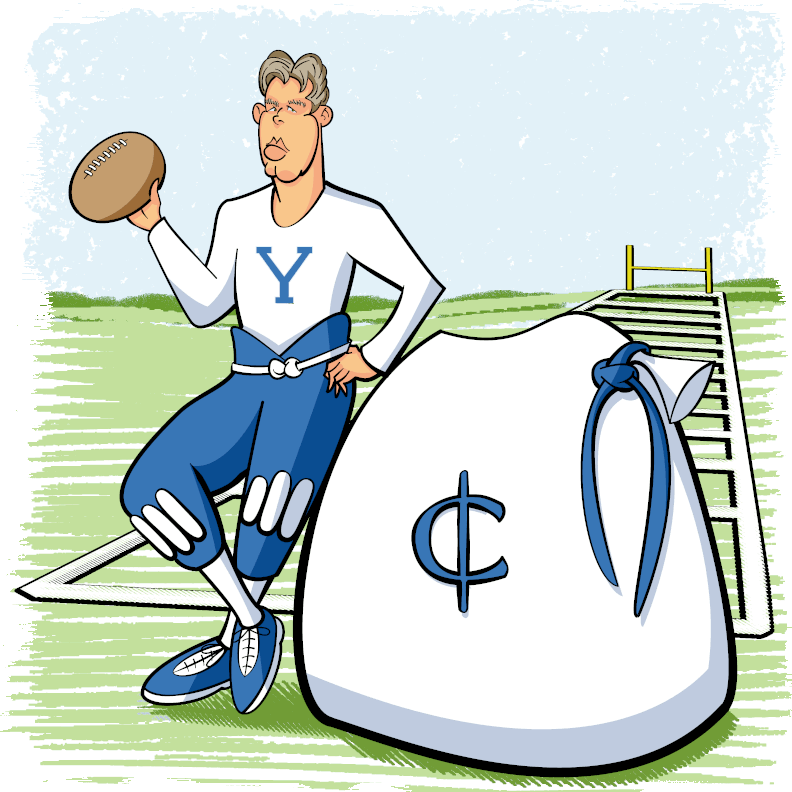
Do not imagine that this illustration is intended to imply that William Walter "Pudge" Heffelfinger accepted money while playing football for Yale. Heaven forfend! But Pudge IS credited with being the first professional football player in history.
That is, Pudge is credited with being the first DOCUMENTED professional football player in history.
Certainly Pudge was one of the early COLLEGE football stars. He was born in Minneapolis, Minnesota, on December 20, 1867. His dad, Christopher, met Mary Ellen Totton in Shippensburg, Pennsylvania (Christopher had been an officer in the Union Army at Gettysburg), and they were married four years to the date before Pudge was born. After the war they moved to Minneapolis where Christopher became a manufacturer and real estate dealer.
In high school Pudge excelled in sports and after he graduated from Minneapolis's Central High School in 1888, he opted for the Yale Bulldogs rather than Minnesota's Golden Gophers (unlike another young Minnesotan named Charles1 who also did pretty well in football).
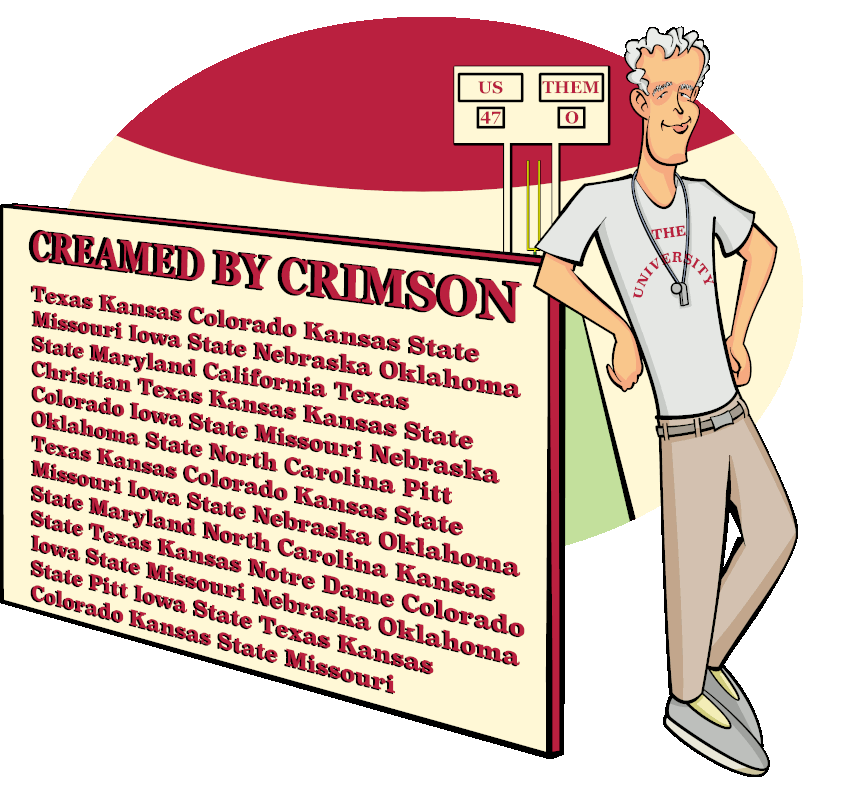
Charles
He did pretty well.
At 6'3" Pudge was comparable in height to today's college guards but at 195 - 210 pounds rather light. But during his Yale years, he was termed "gigantic". Pudge was named All-American in three of his four years, a span which included Yale's unbeaten season of 1891 when they shut out every team.
After leaving Yale Pudge returned home to Minneapolis but soon moved to Chicago. There he joined the Chicago Athletic Association.
The Chicago Athletic Association was one of the athletic and health clubs that became a staple on the American Scene after the Civil War largely due to the increased leisure time enjoyed by the growing middle class. In addition to having gymnasiums where men and women could keep off the flab, the clubs actively sponsored competitive sports.
The teams would not only play against other amateur clubs but would also compete with the local colleges. Sometimes, particularly if the associations sponsored baseball games, they might actually contend with a local professional organization like Chicago's White Stockings.
The Chicago Athletic Association, though, was not simply one of these "health clubs". Instead, it specialized in fielding an amateur football team. What comes as a surprise from viewing the early films of the fledgling gridironsters is how casual the play was. There was less formal "set-up" than today, and there was a noticeable lack of protective gear. Most of the players even eschewed helmets.
Even in Pudge's time and well before the fin de siècle, amateur athletics had fallen under the rather rigid jurisdiction of the Amateur Athletic Union. The AAU not only organized contests but began to regulate the conduct of the players on and off the field. One early rule - actually a defining characteristic of an amateur sport - is that the athletes should not be paid.
Amateur athletics is often seen as going back to Ancient Greece and Rome where the prizes of the Olympic games were laurel wreaths. However, there was no actual prohibition against athletes getting paid on the side. And as Perchik said in The Fiddler on the Roof if it's not forbidden it must be all right. Gaius Appuleius Diocles was a chariot racer, and he ended his career as one of the richest men in Rome.
But although Play-To-Not-Get-Paid was the rule in America, there was considerable ambiguity in determining who was a professional or amateur athlete. Then as now, competitive sports sometimes required travel and lodging and so it was deemed proper that even the amateur athletes could be reimbursed for expenses. And if the credits of the - quote - "reimbursement" - unquote - exceeded the actual debits - sometimes by a factor of two - why, who could object?
There were also team sponsors who would pay for the equipment and uniforms. As these sponsors were often local businessmen, if they wanted to hire some of the players at a particularly agreeable wage for light duties, surely that was their prerogative.
Also since many amateur athletes were yet to achieve their majority, was it breaking the rules to give a little something to their parents? There was a time in a Quaint Town in the American Southwest that some citizens noted that one of the high school stars suddenly began driving a new and particularly nice car after he signed up for one of the colleges. Coincidence? Could be.
There was also the question to what degree and extent the authority of the AAU extended once school was out. After all, if the players couldn't get paid for their amateur sports in college, couldn't they join a local "semi-pro" team in the summer? Particularly gifted athletes could also serve as "player-coaches". So even if they couldn't get paid for being a player, surely it was OK to remunerate them for their coaching.
So began a whack-the-monkey competition between the players and the AAU. A rule would be established prohibiting payment (the AAU quickly scotched the double-expenses schtick), but then the teams would come up with some way around it. New rules would then be put in place and the cycle would begin again. Further complicating the matter was that wages for professional athletes were often so low that the pay barely covered expenses. So even "professionals" had to have more or less normal jobs in the off-season. So the line between professional and amateur remained blurred.
Then came Caspar.
In 1894 the American journalist Caspar Whitney went to England where participation in sports was a major recreational activity. He was impressed by how the sportsmen competed with professional skill and yet without any compensation whatsoever.
There weren't even reimbursements for expenses! In fact, the English athletes considered getting payment a moral weakness of character. That was particularly the case for the sports played at university.2
Footnote
For some reason the English like to drop the indefinite and definite articles. You don't go to a university; you go to university. And you don't go on a vacation; you go on holiday.
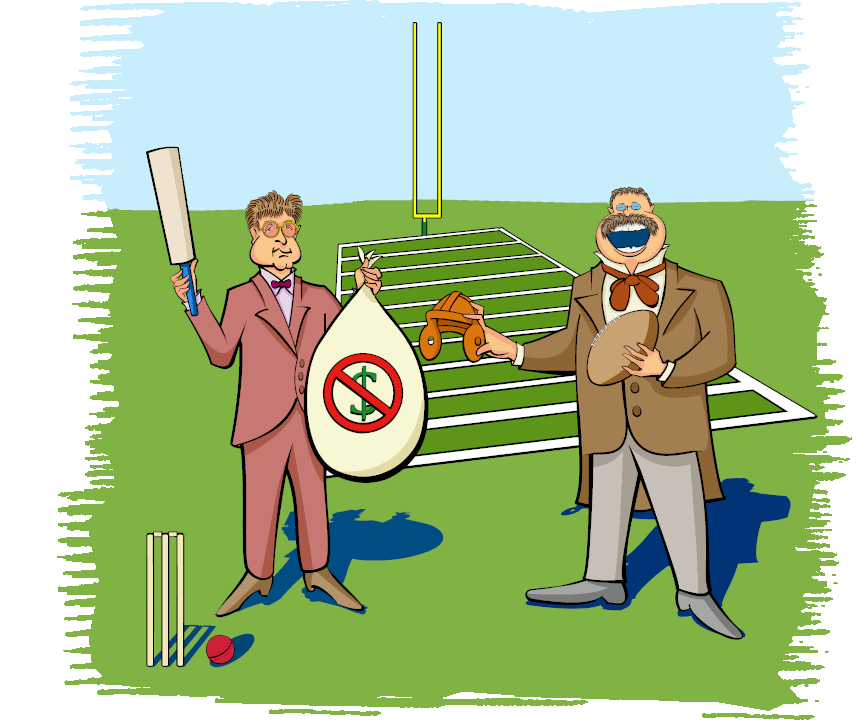
Caspar and Friend
(Click to zoom in and out.)
When Caspar returned to America he began exhorting the virtues of British Amateurism. The fact that he was a friend of soon-to-be President Theodore Roosevelt - a big sports fan - may have given him a leg up in spreading the word. In any case and buoyed up by his experience, Caspar insisted that American amateur athletes, like their English counterparts, should receive no compensation of any kind.
Now some scholars have questioned whether The Amateurism of Caspar might have been prompted by other considerations than the Albionic opinion that sports without pay built strong bodies and character. By pushing the notion that amateur athletes should never get paid, he was ensuring that the best athletes were of the Uppercrust who didn't have to work for a living. In fact, in England no amateur athlete was even permitted to perform manual labor. Caspar was well aware that these standards would deliberately keep lower income kids from mixing with the higher class offspring. But that, Caspar insisted, was a virtue. Otherwise it would be just like the mixing of ....
Well, we'll let that go for now.
Alas, that business model didn't quite work in America. Yes, there were rich folks and poor folks in the Land of the Free but there was no legal class structure and no nobility. You had no titles like King, Duke, Prince, Count, Earl, or Sir unless you were a jazz musician. Instead America was a country where - literally - a poor kid who was born in a log cabin and studied his lessons using a shovel and a piece of charcoal could grow up to be President.
Besides, some poor kids could play sports better than the rich ones. Companies owned by rich fat cats would form sports teams that included their sometimes poorly paid employees. Business owners would get together and form sports leagues that would meet after work and on weekends. Managers and laborers mixed on the playing fields and no one minded as long as their team won.
Finally there's the venerable tradition that American sports fans like laying down a wager on a game. If having lower income but highly skilled team members helped shift the odds, no one was going to complain. But these teams and players were still amateurs. So in principle the players could not be paid.
And Pudge? How did he become the first professional football player?
Chicago was not the only city to host post-university amateur football. In Pittsburgh in Allegheny County Pennsylvania there were two teams commonsensically named the Pittsburgh Athletic Club and the Allegheny Athletic Association. As is true with many inter-regional competitions, the rivalry between the clubs became quite intense.
A game was scheduled in Pittsburgh for November 12, 1892, at Recreation Park, a bit less than three miles west-southwest of where George Washington crossed the Allegheny River. Naturally both teams were looking for some advantage.
Now one time-honored technique to boost the odds is to bring in a ringer. A ringer is a particularly skilled player who is not normally part of the team but who would be slipped surreptitiously into the line-up. Naturally this gives the team an advantage. Substituting ringers extends to all levels of sports and in one high-school game in a Quaint City of the American Southwest, the quarterback of the winning team was 26 years old.
So when the teams came on the field, among the Allegheny Athletic Association players were three gentlemen from Chicago one of whom was the famous Pudge Heffelfinger. The members of the Pittsburgh Club voiced their objections most vehemently. But there was nothing prohibiting a team from recruiting new members however temporarily and the game kicked off as advertised. The game was a 4-0 victory for Allegheny with Pudge scoring the only touchdown after picking up a fumble.3
Footnote
At that time a touchdown counted four points. In 1898 the value was upped to 5 points and it wasn't until 1912 that crossing the goal gave the team the now time-honored 6 points.
OK. But - and pardon if we shout:
HOW DOES THIS MAKE PUDGE HEFFELFINGER THE FIRST PROFESSIONAL FOOTBALL PLAYER?
The truth is that no one knew that Pudge was the first pro football player for seventy years. It wasn't until the 1960's that a scholar was examining the records of the Allegheny Athletic Association and found an entry in the ledger:
balance carried over (account) $468.55
game receipts gross profit (cash) $1,683.50
visitors guarantee expense (check) $428.00
park rental expense (check) $50.00
Donnelly, Malley, Haffelfinger expense (check) $75.00
Schlosser hotel bill for above (check) $9.00
game performance bonus to
 W. Haffelfinger for playing (cash) $500.00
total expenses $1,062.00
net profit $621.00
total balance $1,089.85
OK. Pudge got $500 for playing in ONE GAME. Does this make him a professional?
Well, certainly an out-and-out direct payment and specifically FOR PLAYING is pretty much the definition of a professional athlete. Or at least if the payment had been discovered, Pudge would certainly have lost his amateur standing and could have been prohibited from participating in further amateur games.
On the other hand, DOES a single game a professional make? Or should we consider the first REAL PROFESSIONALS to be those who played on THE FIRST PROFESSIONAL TEAM?.
Complicating this definition is that even up to the 1920's, the papers would sometimes use the term semi-professional for sports where it was acknowledged the players were paid. This term was used even when reporting on the doings of the professional leagues whose teams included stellar athletes like Jim Thorpe and Knute Rockne. The players were paid on a per-game basis and for the average player it wasn't much. Even though the biggest stars might get $250 for each contest - which was actually good money in the Roaring Twenties - less stellar athletes might get a few bucks.4
Footnote
Of course a few bucks in the early 20th century went further than today. In 1920 a worker would typically earn $20 to $30 a week. A wage of $5 per game was in line with the per-diem wages and would easily be enough to buy groceries for a family of four. When Johnny Unitas began playing semi-professional football in the 1950's he started off at $7 a week.
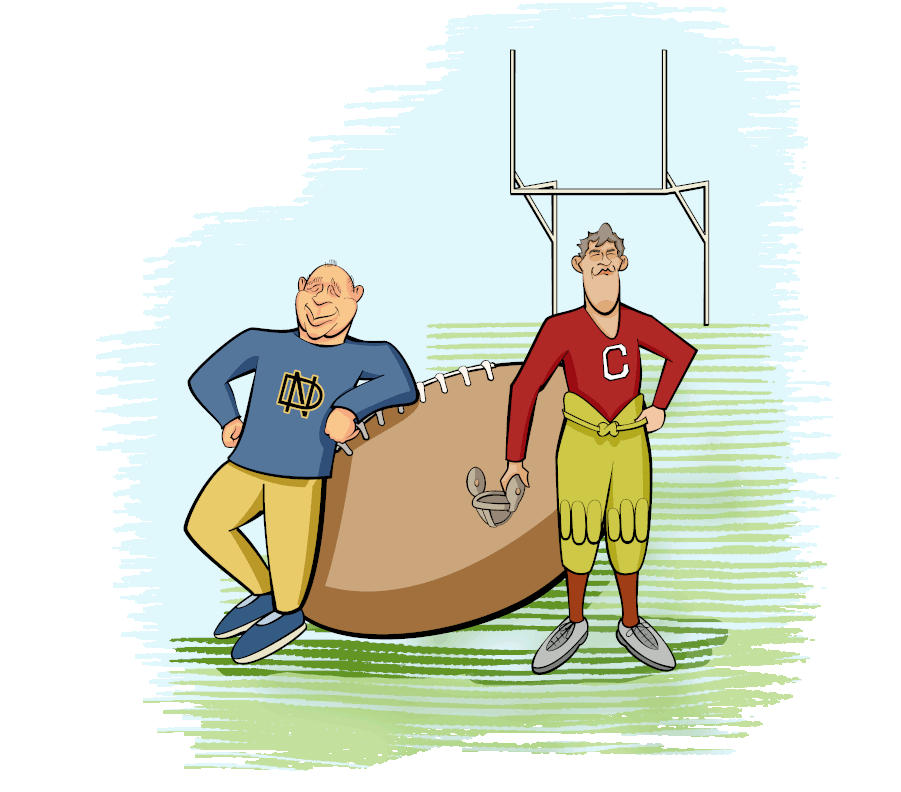
Knute and Jim
Professionals
(Click to zoom in and out.)
The per-game payment system ended in 1926 when Red Grange was paid (perhaps) $100,000 to play 19 games. Of course, you can argue this is a per-game payment at $5263.15 and 3/380¢ per game. But the point is Red was signed to a multi-game contract.
Well, to end any conundrums we'll just ask a new question.
Remember when Pudge accepted the cash and the boodle and the $500, he was NOT a member of a PROFESSIONAL TEAM. So who was the first professional team?
Well, even if you mean the oldest team in the current National Football League or NFL, the answer is still pretty much a matter of definition. If a team stays in the same town and changes their name, are they a new team? Are they a new team if they don't change their name but move? Or if they move and DO change their name?
Well, if you let the team move and keep its identity, then the oldest NFL team is the Arizona Cardinals. In 1899, a young man named Chris O'Brien formed the Morgan Athletic Club in Chicago. Soon the team switched to the less verbose name of the Chicago Normals and then became the Racine Cardinals after the city's Racine Avenue. After expanding their base beyond the neighborhood, in 1920 they then became the Chicago Cardinals.
Excepting a slight hiatus in 1944 with a merger with Pittsburgh and a temporary dubbing as the Card-Pitt team, the Cardinals stayed in Chicago until 1959. The next year they moved to St. Louis where they became the long-tenured St. Louis Cardinals. Then in 1988 the team up and moved to Phoenix and became (what else?) the Phoenix Cardinals. Finally (?) in 1994 and after a slight relocation from downtown Phoenix, they were renamed the Arizona Cardinals.5
Footnote
Of course, the question now becomes what's in a name. Is the football team just the "Cardinals" and so they didn't change their name? Or is it the "[Fill-in-the-Place] Cardinals" and they changed their name four times?
But were there professional teams before the NFL? Well, certainly if you keep a flexible definition of professional. In 1902 a popular informational reference states there was a "loose association" of football clubs who formed the Ohio League. At one time or another the League hosted the Massillon Tigers, the Akron Pros, Cincinnati Celts, Cleveland Panthers, Cleveland Tigers, the Coleman Athletic Club, Columbus Panhandles, the Franklin Athletic Club (in Cleveland), the Ironton Tanks, Lancaster Anchors, Shelby Tigers, Toledo Maroons, Washington Vigilants, Youngstown Patricians, the Portsmouth Spartans, and the Zanesville Mark Greys.
Yet you can consider all these teams to be in the NFL since the Ohio League was the direct predecessor of the NFL and assumed the name in 1921. But even before the League was formed, there were players who signed yearly contracts to play for cash.
The earliest multi-game contract is probably from 1893 where our old friends the Pittsburgh Athletic Club signed up Grant Dibert to a one-year contract (whether he was fullback or halfback seems to be in dispute6). So it seems that Grant is a legitimate contender as the first professional. Regarding the earlier contract with Pudge, the agreement was kept under the table and it wasn't until 1896 that Pittsburgh's rivals, the Allegheny Athletic Association fielded a team for one game where all the members were avowedly professionals and got paid without any subterfuge.
But the era of the true professional team was probably 1897, when the Latrobe Athletic Association in Pennsylvania fielded a team of professionals for the entire season. Unfortunately the scarcity of other professional teams produced an odd schedule where they played mostly college teams. Eventually other professional teams sprouted up and eventually gelled as the Ohio League.
Ironically, the Latrobe Athletic Association began falling on hard times with increasingly sparse spectator turnout, and in 1908 they reverted back to being an amateur team. The next year the team folded.7
Footnote
Today it is possible for a professionals to reclaim amateur standing. This happens most in golf although the change back to amateur does sometimes draw criticism from the ranks of amateur players who have never turned pro. Still about 800 professional golfers apply for reinstatement into the amateur ranks and most requests are granted.
And Pudge?
As you might expect Pudge kept up his interest in football. He took coaching jobs for California's Golden Bears, Lehigh's Mountain Hawks, and Minnesota's Golden Gophers. He was occasionally called in as a consultant for Yale, particularly when they had to go up against the Big Baddies Princeton or Harvard.
As a businessman, Pudge worked for his dad's manufacturing and real estate business. He also published a book about sports equipment, and in the 1920's he dabbled a bit in politics. He was elected a county commissioner in Minneapolis and even tried a run for Congress.
And Pudge kept on playing football. Even in middle age he would sometimes suit up and practice with the Yale team. He returned for a one-game stint as a professional against the Columbus Panhandles, and finally in his sixties he decided to retire. Unusual for a Minnesotan, Pudge moved to Texas and lived until 1954.
By all accounts Pudge was a genial man with a good sense of humor. So surely he wouldn't object to a few football bon mots to wind up this tribute.
Why are NFL ends and tackles sure to use deodorant?
They don't want to be offensive linemen.
Who has millions of eyes on him but can't see a thing?
An NFL referee.
And finally there's:
Why did the NFL quarterback go to art school?
He wanted to learn how to draw.
References
"Considering History: Pudge Heffelfinger - The First Ever Pro Football Player", Saturday Evening Post, January 31, 2019.
"This Week in Pittsburgh History: William Heffelfinger Becomes the First-Known Pro Football Player", Sone Ekukole-Sone, Pittsburgh Magazine, November 13, 2024.
"Who Was William 'Pudge' Heffelfinger", Professional Football Hall of Fame, January 29, 2019.
"Pudge Heffelfinger Explained", Everything Explained.
Pay for Play: A History of Big-time College Athletic Reform, Ronald Smith, University of Illinois Press, 2011.
"Yale is Victorious!", The Cheyenne Daily Leader, November 27, 1891, p. 1.
"November 12: Birth of Pro Football", Pro Football Hall of Fame.
"A Look Back At The First Professional Football Game", Ben Donahue, Pro Football History, March 14, 2025.
"Fitness and Athletic Clubs", Encyclopedia of Chicago.
"The NCAA and the Myth of Amateurism", Jayson Jenks, The New York Times, February 8, 2021.
"How the Pigskin Got Professional", Christopher Mendez, Pennsylvania Center for the Book, Spring 2010.
"Chronology of Professional Football, Pro-Football Hall of Fame.
"Oldest NFL Teams", Somapika Dutta, Oldest.Org, March 18, 2025.
"100 Years of the NFL", Ohio Memory, September 11, 2020.
"Why Touchdowns Are Worth Six Points", Football Archaeology, December 23, 2024.
"How Pro Golfers Actually Regain Amateur Status, Explained by an Expert", Alan Bastable, Golf, October 17, 2025.
"'Pudge' Heffelfinger", Find-a-Grave, John Griffith, Find-a-Grave Memorial ID: 13989501, April 18, 2006.