Rudolph
Valentino
(Click on the image to zoom in.)
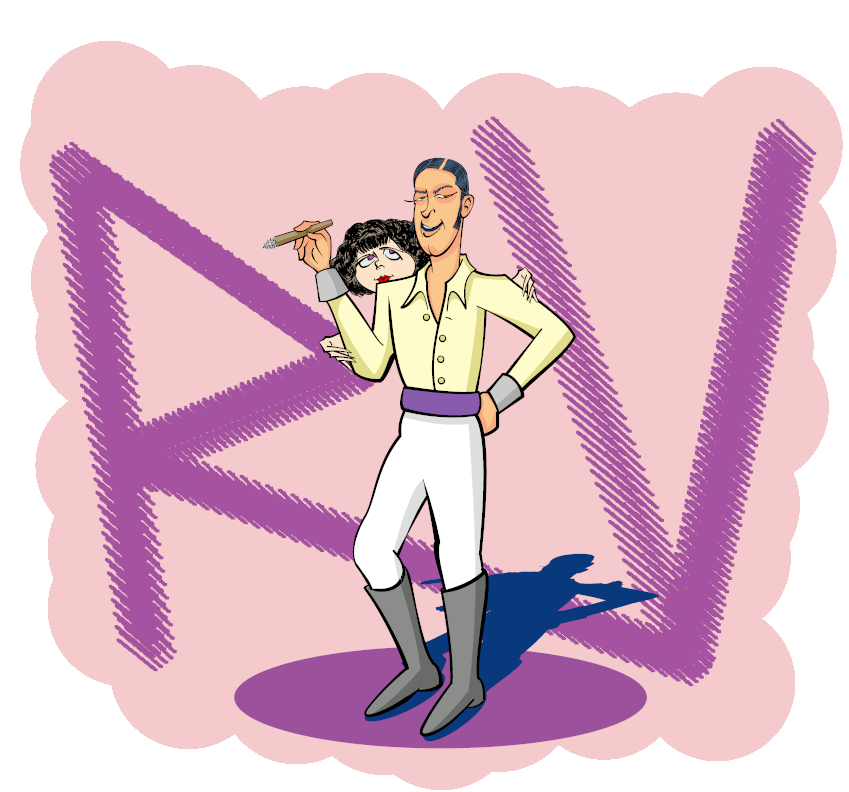
Yes, Sig. Rodolfo Pietro Filiberto Raffaello Guglielmi di Valentina d'Antonguella is the actor that everyone knows as Mr. Rudolph Valentino. In common parlance he was simply Rodolfo Guglielmi (pronounced sort of like roh-DOLF-oh gool-YELL-mi) and was born in 1895 in Castellaneta, Italy, just above the arch of the boot. That's about 140 miles east and a little south of Naples and (for those who know their Roman history) about 20 miles northwest of Taranto, the old Roman town of Tarentum.
The family was comfortably middle class with Rodolfo's dad Giovanni being a veterinarian and his mom Gabriella a fairly typical stay-at-home Italian mama. And of course, Rodolfo adored his mother and was rather nervous around his rather demanding and disciplinarian father.
The young Rodolfo was nicknamed Mercurio (Mercury). The name seems to have come from Rodolfo being a bit irresponsible and with no clear-cut ambition. Certainly he had no ambition to carry on his dad's business. Instead he preferred to spend his time learning to ride and exploring the countryside. He also showed enthusiasm for spelunking and would dive down into the many caves and caverns in the area.
The idyllic existence ended in 1901 when Giovanni died of malaria. Not knowing how to handle Rodolfo without the firm hand of her husband, his mom packed him off to a boarding school. After graduating he entered college, probably with the idea of becoming a veterinarian like his dad.
However, Rudolph (as we'll call him) decided the idea of a life with the animals was not to his liking and so he simply skinned out and went to Paris. His time in the City of Lights was spent learning the new popular dances and generally goofing off. But after a year he returned home and in 1913 at age 18 he decided to try his so far not-too-good luck in the Land of Opportunity. Evidently with his mom's approval and fortified with a $4000 family inheritance he sailed of for New York on board the S. S. Cumberland.
Rudolph found he was not suited for ordinary work any more in America than in Europe. Fortunately, his dashing and elegant looks allowed him to find employment as a taxi dancer. The phrase "taxi dancers" - a now largely vanished occupation - refers to young (usually) men (sometimes) and women (often) employed by dance halls, clubs, cabarets, and restaurants to dance with the customers. In most of the "dives" taxi dancers were paid a set amount per dance. Officially, everything was on the up-and-up and the only activity to take place was supposed to be the dancing.
Some of the dance halls were housed in less than stellar accommodations and the fees were maybe a dime or less. But Rudolph found employment at Maxim's Cabaret, a high class "joint" that would never be so tacky as to require actual cash to pass between the supplied dancer and the clients. So Rudolph and the others would be paid a flat fee by the cabaret although their partners might give them a tip.
Rudolph's partners were (generally) well-to-do and (often) married women. He also gave (wink-wink) private lessons to the ladies who wanted to polish their form (sounds like a euphemism, doesn't it?). Soon Rudolph's skill got him promoted to the job of exhibition dancer. There he would dance with another professional dancer for the entertainment and (hopefully) the admiration of the club's patrons.
It was on the job that Rudolph met Blanca de Saulles, née Errázuriz y Vergara. Blanca, though, was married to a former Yale All-American football hero, John de Saulles. After college Jack became subsequently a football coach and a businessman but Blanca had plenty of money on her own. John and Blanca were married in Paris in 1911 and when Rudolph met them they had a son, John, Jr.
We don't know if it was Rudolph's influence but soon Blanca wanted out of what had turned out to be a most unhappy marriage. But that was not so easy in those days. None of that "incompatibility" stuff. There had to be a real reason.
So Rudolph - who seems to have liked Blanca a lot - volunteered to testify in court. He said he knew Jack had been less than a faithful husband and had been, well, "intimate" with another of the dancers, Joan Sawyer .
Jack naturally was irritated with a young whippersnapper immigrant pushing his way into his private life. So he managed to get Rudolph arrested while the young man was present in what can be described as an establishment directed toward gentlemen's special interests. The charge was that Rudolph was a - well, we won't use coarse descriptions, but the accusation was that Rudolph "assisted" the establishment in finding their clientele. Although the charges were dropped the newspapers were most discourteous to the young foreigner who was not and never did become a US citizen.
Thinking he may have worn out his welcome in New York City, Rudolph decided to get out of town. So he moved about as far away as he could and at the same time remain in the country. So by the end of 1917, Rudolph was living in Los Angeles. Moving from New York was a good decision since Blanca soon decided to settle a custody dispute about their son by shooting Jack five times. She was, though, acquitted even after she admitted she had killed Jack for his refusal to grant her the court-ordered custody of their son. And, she added, she was glad she did.1
Footnote
Such a verdict is sometimes called a "popular verdict" or more technically a verdict from jury nullification. Jury nullification is when a jury decides to acquit the defendant even though it is clear they are actually guilty as charged. Juries rationalize nullifying a verdict for a number of reasons. Often they think that the circumstances were mitigating and sufficient to let the defendant off. Or they might believe the law itself is unjust and so they acquit.
Jury nullification was common before the Civil War in cases of violations of the Federal Fugitive Slave Law. One of the earliest pieces of federal legislation that was signed by George Washington, the law specified that if a slave escaped to the North, then the owner could take action to recover his - quote - "property" - unquote. He could recover a slave even if the slave had reached a northern state which had outlawed slavery.
However, the slaveholders found that when they showed up in the North to claim what they thought was theirs, they got the cold shoulder. So in 1850, the Southern Congressmen pushed through another Fugitive Slave Law that required the Northern States, their governments, and their citizens to actively assist in apprehending the fugitive slaves.
This, we must point out, was a federal law. And - although you might not think it today - Federal laws have precedence over the state laws. Or as stated in the Constitution.
This Constitution, and the Laws of the United States which shall be made in Pursuance thereof; and all Treaties made, or which shall be made, under the Authority of the United States, shall be the supreme Law of the Land; and the Judges in every State shall be bound thereby, any Thing in the Constitution or Laws of any State to the Contrary notwithstanding.
And yet, the Northern States were not only refusing to cooperate with catching the slaves, but were actually passing state laws that made it hard to return the fugitives! One trick was to have a state law requiring that all captured fugitive slaves had to be represented by attorneys in a jury trial, thus virtually guaranteeing acquittal. Or when the federal courts ruled the return of fugitive slaves was a federal matter, the states passed laws that no state resources could be used to that end.
Today jury nullification is a touchy topic and sometimes judges may specifically instruct the jury they must decide the case based on the law as written and not from their personal opinions whether the law is unjust. There also have been cases where people have been arrested for jury tampering if they advised potential jurors about jury nullification. Political commentators will sometimes go into spittle-flinging diatribes shouting "Jury nullification!" if a jury acquits someone they don't like. However, there's nothing they can do since the Fifth Amendment of the US Constitution says a person cannot be retried if acquitted for the same offense. If they acquit, that's about it.
Up to now, Rudolph had been going by his real name Guglielmi. However, whether it was to disavow himself from the scandal or because the name was too hard for Americans to pronounce, he began to call himself Rudolph Valentino.
Although he had been taking a roundabout route to achieve his ambitions, from the first Rudolph had been aiming for the movies, and from 1914, he had already appeared in a number of films in small and uncredited roles. Moving to Hollywood was the right course as the town was beginning to boom and fledgling hopefuls could show up at studios looking for jobs as extras while hoping they'd catch the eye of casting directors. Certainly Rudolph had the looks for a movie star and he began landing parts which increased in importance.
In 1919, Rudolph met the actress Jean Acker and they got married almost immediately. The union was not a success, however, and in fact Jean locked him out of the bedroom on their wedding night. She later said she did so because she learned Rudolph had - well, a "malady" that made affiliation inadvisable. Officially they stayed married until 1922.
Success finally came with The Four Horsemen of the Apocalypse in 1921. Here Rudolph landed a major role, and this was the movie where he had the famous "tango scene" with Beatrice Dominguez. The movie was the hit of the year and brought Rudolph his long sought stardom. His next movie The Sheik solidified Rudolph's image as the Latin Lover even though he played an Arab.
Now a superstar Rudolph began a life of making movies and partying. In 1922 he followed up The Sheik with Blood and Sand, The Young Rajah (1922), Moran of the Lady Letty (1922), A Sainted Devil (1924), Monsieur Beaucaire (1924), The Eagle (1925), Cobra, and (inevitably) The Son of the Sheik (1926).
The ladies went nuts. There were Rudolph Valentino fan clubs and rising mayhem at his personal appearances. By the early 1920's Rudolph was the biggest star in Hollywood and had eclipsed established matinee idols like Francis X. Bushman. Soon slick looking young men who appealed to the young ladies were being called "Valentinos" and "Sheiks".
There was backlash, though, and of course it came from the guys. Before Rudolph hit the Big Time, the He-Men of the Movies had been the likes of Douglas Fairbanks. Displaying considerable athleticism in movies like The Mark of Zorro (1920), The Three Musketeers (1921), and Robin Hood (1922), Douglas was the man that the fellows thought women should admire. Huh! All Rudolph did was look suave and debonair.
It soon got to the point where Rudolph was encouraging men to make retrograde motion away from masculinity like powdering their faces. Why, there were even talcum powder dispensers put in the public men's rooms, for crying out loud! Not just talcum powder but pink talcum powder, for heaven's sake! As the Chicago Tribune editorialized in a spittle-flinging diatribe:
A powder vending machine! In a men’s washroom! Homo Americanus! Why didn’t someone quietly drown Rudolph Guglielmo, alias Valentino, years ago?
Do women like the type of "man" who pats pink powder on his face in a public washroom and arranges his coiffure in a public elevator?
The men began to make jibes and jeers about those who sported "talcum-powdered, stacombed charm" and "slick looking tuxedoed young men with talcum-powdered shaven faces". Such references even found their way into popular novels.

Jack Dempsey
He defended Rudolph.
(Click on the image to zoom in and out).
Others, though, came to Rudolph's defense. One was none other than Mr. Jack Dempsey, the Heavyweight Champion of the World. Jack had been giving Rudolph boxing lessons, and Jack told sportswriter, Frank O'Neill, that Rudolph packed a mean punch.
Frank didn't believe it and he said he'd fight Rudolph anywhere. So along with other reporters he showed up at the Ambassador Hotel in New York where Rudy was staying. So everyone hied on the roof where the two men put on the gloves. Surrounded by reporters and photographers, Frank snapped Rudolph on the chin and Rudy's answering punch landed Frank on the floor. Frank got up and said he was convinced.
It was in the lobby of the Ambassador on August 15, 1926, that Rudolph collapsed. He was rushed to the hospital where it was first thought he had appendicitis, But during surgery it was discovered that he was actually suffering from gastric ulcers. The operation seemed to go well but as often happened in those pre-antibiotic days, peritonoitis set in. Rudolph Valentino died on August 31. He was 31.
Rudolph's funeral mass was held in New York where 100,000 people lined the streets as the hearse wound its way to Saint Malachy's Roman Catholic Church on West 49th Street about half a mile south of Central Park. Then Rudolph was taken to Hollywood where he was buried in Hollywood Memorial Park Cemetery. Now called Hollywood Forever Cemetery many of the late and great of the Golden Days of Cinema lay there with Rudolph. These include Judy Garland, Burt Reynolds, Mickey Rooney, Carl "Alfalfa" Switzer (of "Little Rascals" fame), Don Adams ("Maxwell Smart, Agent 86"), famous director Cecil B. De Mille and his wife Constance, Douglas Fairbanks, Sr. (!), Douglas Fairbanks, Jr., John Hamilton ("Perry White" on the Superman TV series), Darren McGavin (the father on A Christmas Story and TV's first Mike Hammer), Tyrone Power, the Ritz Brothers, Vito Scotti (prolific character actor), Ann Sheridan (co-star with Cary Grant in I Was a Male War Bride), and Fay Wray (star of the original King Kong). There are also some non-movie people with Rudolph including comic artist and Superman creator Jerry Siegel, clarinetist Woody Herman, composer Quincy Jones, and saxophonist Art Pepper. You'll also find some less than savory internees including Benjamin "Bugsy" Siegel.
After Rudolph's funeral there appeared a woman, veiled and clad in black who would visit Rudolph's grave every year. As you can guess, a number of women have claimed that they were the mysterious visitor. But whoever she - or they - were, the visits of the "Lady in Black" ended in 1954.
References and Further Reading
Dark Lover: The Life and Death of Rudolph Valentino, Emily Leider, Farrar Straus and Girou, 2003.
"'Silents Please' – The Legendary 1960 TV Series – Blood and Sand (1922) Starring Rudolph Valentino and Nita Naldi", Old Hollywood in Color, October 5, 2016.
"Unlucky Star: The Brief, Bombastic Life of Rudolph Valentino", Hadley Hall Meares, Vanity Fair, September 14, 2021.
"The Latin Lover and His Enemies", Gilbert King, Smithsonian, Emily Leider, Farrar Straus and Girou, June 2013.
"Sin and Scandal: The de Saulles Murder Case", Evangeline Holland, Edwardian Promenade, September 26, 2013.
"Rudolph Valentino's 'Lady in Black'", UPI Archives, Marci Persky-Hooper, August 31, 1990.
Studs Lonigan, James T. Farrell, Vanguard Press, 1934.
"Rudolph Valentino", Find-a-Grave, Memorial ID: 1053, April 25, 1998.