If articles today mention Texas Guinan (pronounced GUY-nan) they will be about the lady who a popular informational website referred to as a Prohibition era saloon keeper. Above all they tell how Texas Guinan greeted her customers with a hearty "Hello, suckers!" Obviously this article will be no different.
Point of fact, from 1910 Texas Guinan had been headlining theatrical productions and musicals and was the subject of major write-ups in the entertainment sections of nationally circulated newspapers. Then from 1917 to 1933 she appeared in at least 40 motion pictures (some sources claim it may be nearer 200). She not only acted but worked behind the camera, handling jobs as various as casting director, unit supervisor, and even as producer. Among the movies where Texas exercised her influence (and also appeared on screen) were The Stainless Barrier (1917), The Fuel of Life (1917), Two-Gun Girl (1918), The Gun Girl (1918), The Gun Woman (1918), The Love Brokers (1918), Getaway Kate (1918), The Hell Cat (1918), The Spirit of Cabin Mine (1919), The Lady of the Law (1919), The Girl of the Rancho (1919), The Desert Vulture (1919), The Boss of the Rancho (1919), Outwitted (1919), Not Guilty (1919), My Lady Robin Hood (1919), Letters of Fire (1919), Just Bill (1919), Fighting the Vigilantes (1919), The Love Defender (1919), The She Wolf (1919), South of Santa Fe (1919), Malamute Meg (1919), Some Gal (1919), The Girl of Hell's Agony (1919), Little Miss Deputy (1919), The Dangerous Little Devil (1919), The Dead Man's Hand (1919), The Sacrifice (1919), The Call of Bob White (1919), The Heart of Texas (1919), The Wildcat (1920), The White Squaw (1920), The Night Rider (1920), The Night Raider (1920), The Moonshine Feud (1920), Spitfire (1921), Code of the West (1921), Code of Texas Storm (1921), The Stampede (1921), I Am the Woman (1921), Night Life of New York (1925), Queen of the Night Clubs (1929), Glorifying the American Girl (1929), and her last movie, Broadway Through a Keyhole (1933).
From the years it's clear that Texas's movies were necessarily from the Silent Era and most were of the now largely defunct genre called the Western. But Texas did not play the stereotypical rancher's wife or schoolmarm of the later films. Instead she was the gutsy cowgirl - then sometimes called "cowboy girls" - who as one scholar put it, "could tame men as well as horses". Soon she was being called the "female William S. Hart".
So how did a star of the early American theater and one of the pioneering women of cinematography end up being remembered as a saloon keeper? Well, as with most complex phenomena the explanations are themselves complex phenomena arising from shifting culture, tastes, and happenstance.
First of all, her name was most apt and not just a cinematic promotional sobriquet. Mary Louise Cecilia Guinan was indeed born in Waco, Texas, on January 12, 1884, exactly three score and eight years before a most momentous event known only to a few. So she really was a Texas gal and yes, she grew up on a ranch.1
Footnote
Contrast this to the background of William S. Hart, the first cowboy star, who was born and raised in New York. So perhaps we should call William S. Hart "the male Texas Guinan".
Back then people would have called Mary a "tomboy" and she learned to ride and shoot with the best of the guys. Although as a student she was less than stellar, at age 14 her talent for music and singing landed her in studies at a bonafide music school in Chicago. She returned to Texas after two years and she began touring as part of traveling shows, rodeos, and in vaudeville.
In the early 20th Century all roads led to New York, Chicago, or Los Angeles - all entertainment roads, that is. But if you were talking about "night life" entertainment the best road was to New York. By 1906 Texas had moved to the City That Never Sleeps and began landing parts in theater productions and musicals. It was there amongst the Easterners that her background and upbringing inevitably got her dubbed with her famous name.
Texas had been working in New York for about 10 years when she was noticed by a motion picture scout. He persuaded her to relocate to Hollywood and Texas's first movie was The Wildcat in 1917. After the filming she went to France to entertain the troops who had gone "over there" for World War I. She then returned to Hollywood and in 1921 organized her own production company.
The company made a few pictures but none did particularly well. The tastes of Western fans were changing from plots where the gals could hold their own with the guys to the overly costumed masculine heroes like Tom Mix who with Tony the Wonder Horse spent his time on screen saving the dainty ladies from various difficulties.
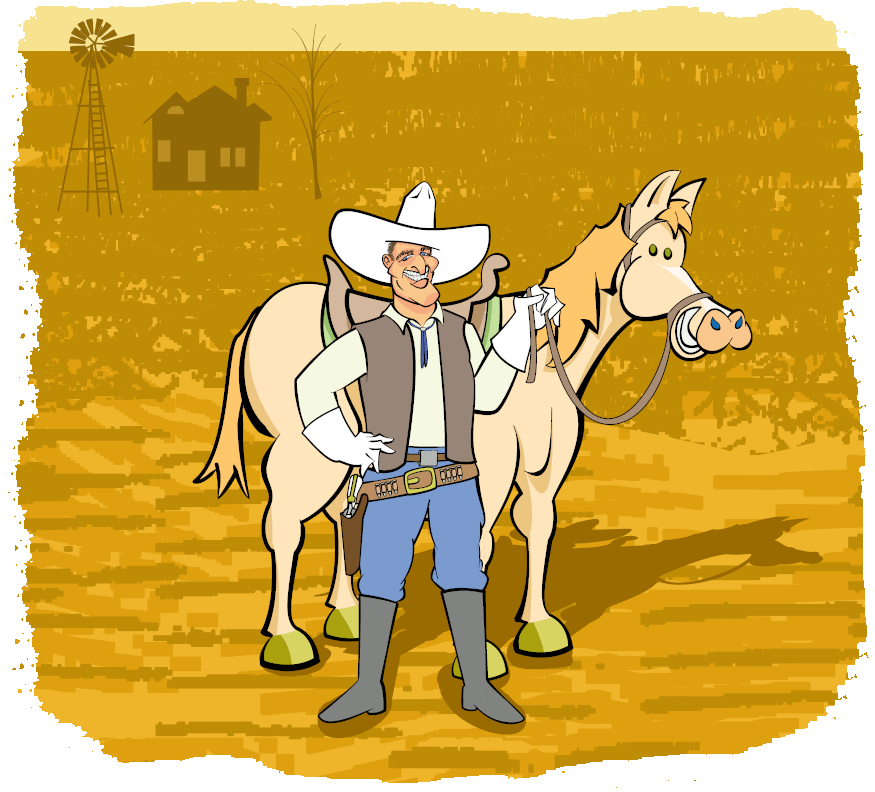
Tom Mix and Tony the Wonder Horse
(Click to zoom in and out)
Here came the fork in her career. Texas could have opted to stay in Hollywood and continued in acting. But she had always been well received as a stage performer and singer and she decided to return to New York.
By now Texas was well-known to the entertainment impresarios and she was hired as a singer at the nightclub attached to New York's Beaux Arts Hotel. But with her outgoing - some call it "brassy" - personality she soon became the emcee, a job that was previously reserved for men. Her style was to banter with the guests and trade barbs and quips not unlike the famous Aristde Bruant, the owner and host of Le Chat Noir in Paris.
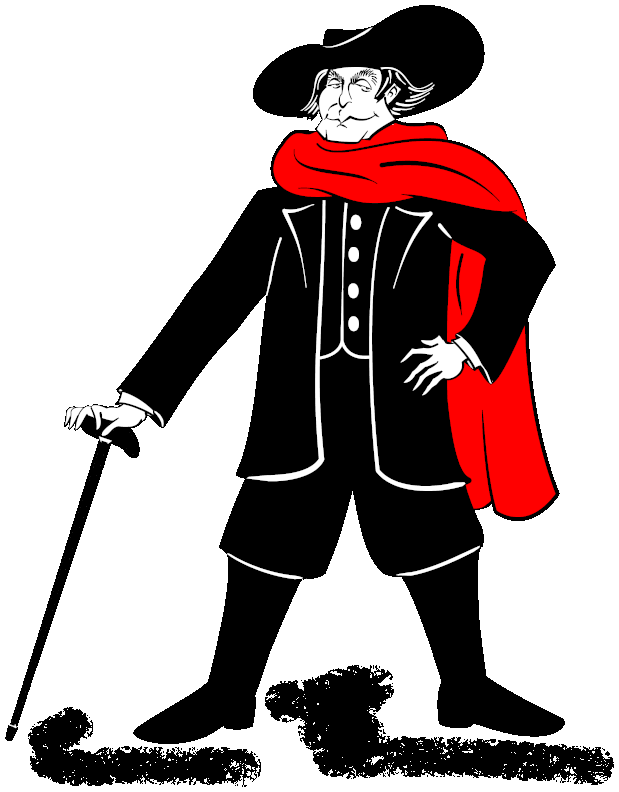
Ariste Bruant
Trading Barbs At Le Chat Noir
Happenstance stepped in to solidify the transition of Texas Guinan, the star of stage and screen, to Texas Guinan the New York saloon keeper. As students of American culture know, when Texas moved from California to New York, Prohibition had just become the law of the land. One famous author who wrote about the era referred to it as the most insane era in American history.
Although the law - specified by the 18th Amendment to the US Constitution and the Volstead Act - did reduce the amount of drinking in the country, it by no means stopped it. Many Americans also developed a disdain for the law and the country saw the rise of the public figure and celebrity mobster. Nightclubs continued serving liquor and it became kind of a joke for ordinary people to wander down to the local "speakeasy", rap on the door, and wait until the attendant slid back the viewing panel before he let you in. Then you and your friends would sit at the tables and order drinks that often came disguised in teacups.
In 1924 Larry Fay - who some called an "entrepreneur" while others referred to him more discourteously but perhaps with more accuracy as a "rumrunner" - hired Texas to host the El Fey club on West 47th Street in Manhattan. It was there she began greeting the patrons with her trademark "Hello, suckers!"
For the next few years Texas worked as emcee at other clubs - news stories say it was dozens - which are sometimes referred to collectively as "The Guinan Club". One of the most famous was The Three Hundred Club on West 54th Street in Manhattan. At one time or another all the clubs were raided and padlocked, only to re-open, sometimes within days of the raid.
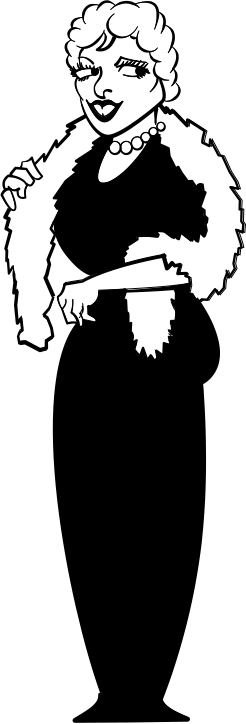
Mae
Goodness!
Scholars have pointed out that in the 1930's Texas had achieved such iconic celebrity that she became the model for the character Mae West played in her first movie Night After Night with George Raft. In one scene Mae was going into a club and the hatcheck girl commented on her jewelry.
| Hatcheck Girl: | Goodness, what beautiful diamonds! |
| Mae: | Goodness had nothing to do with it, dearie. |
It is unfortunate that Texas is now remembered mostly as the host of Manhattan speakeasies and less as a pioneer of American cinema. As for her own habits, she always maintained that she never drank nor did she sell alcohol. Instead she said she was paid purely as a performer.
But hosting the clubs had its own hazards and after the inevitable raid she would occasionally be arrested and might be charged with offenses such as "possessing liquor", "selling liquor", or "keeping a nuisance". But she was - as the papers reported - always able to wisecrack her way out.
The truth is that possessing liquor was not a crime during Prohibition. It was common for people - particularly the more well-to-do - to stock up just before the law went into effect. As a popular song proclaimed:
The lookers ain't got what Mary's got.
A daddy with a cellar full of you know what.
In 1933 Texas appeared in her final motion picture with the somewhat winkable title Broadway Through a Keyhole. Later she organized a traveling revue show and she intended to take it to Europe. However, the authorities in Paris - at least in one telling - wouldn't give the required permission. Naturally Texas took advantage of such good fortune and took the show on tour in America as Too Hot for Paris.
However, later in the year and while performing in Vancouver, British Columbia, Texas contracted an intestinal disorder usually cited as amebiasis. Colitis set in and an operation was deemed necessary. She was just age 49, she never woke up. But at least the members of the troupe reported she was wisecracking to the last.
References and Further Reading
Hello Sucker! The Story of Texas Guinan, Glenn Shirley, Eakin Press, 1989.
"Mary Guinan: The Trailblazing Texas Star of Broadway and Hollywood", Debbie Cottrell, Texas State Historical Society, September 1, 1995.
"Celebrating Texas Guinan", Lynn Yaeger, Vouge, January 12, 2017.
"Texas Guinan", Corey Creekmur, Women Film Pioneers Project, Columbia University.
"The Gibson Girl Review with Texas Guinan",The New Haven Union, October 25, 1908, p.10.
"Miss Guinan Says She's a Lonesome Star from Texas, Walter Anthony", The San Francisco Call, December 11, 1910, p. 39.
"I'm Headin' for the Last Roundup' - 'Tex Guinan Bids Farewell to World", The Indianapolis Times, November 06, 1933, p. 1.
Studs Lonigan: A Trilogy Containing Young Lonigan, The Young Manhood of Studs Lonigan, Judgment Day With a New Introduction by the Author, James T. Farrell, Modern Library, Random House, 1938.
Mr. Capone: The Real - and Complete - Story of Al Capone, Robert Schoenberg, William Morrow Company, 1993.