In the days before there were television comedy shows that could last fifty years and not even be funny, there was The Goon Show. As the weekly greeting proclaimed it was broadcast from the BBC. The Goon Show was produced for ten years from 1951 to 1960 and it was very funny.
The Goon Show was a genre of a now virtually vanished entertainment. That was the radio play. That is, the program that told a story but being on radio, the setting, locations, and action had to be imagined by the listeners. To facilitate the mental visualization, there would be descriptive sound effects as well as an announcer providing voice-overs.
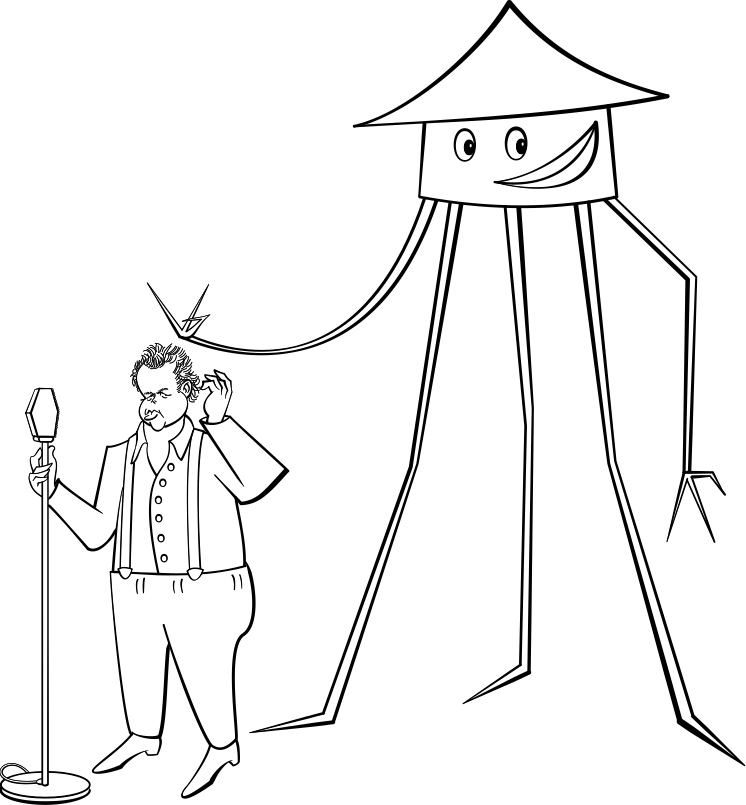
Orson Welles and Friend
Just a Radio Drama
(Click on the image to zoom in and out.)
Because visual special effects in the early days of television were so cheesey, the radio sound effects provided greater realism for the audience. In fact, dramas could be so realistic that they might be mistaken for broadcasts about real events. This happened on October 30, 1935, when Orson Welles's radio play of H. G. Wells's, War of the World sent some of its listeners into a panic.
Being mistaken for reality was never a problem with The Goon Show. Each show began with the announcement: "This is the BBC Home Service." Then Peter Sellers, Terence "Spike" Milligan, and Harry Secombe would launch into 30 minutes of nonpareil wild and crazy stories and skits.
Although virtually all of the characters were voiced by the three stars, Peter, Spike, and Harry, the opening announcer was usually Wallace Greenslade although the first few episodes were announced by Andrew Timothy. Spike would usually take over to narrate the program and other actors would sometimes step in for particular roles. The primary writer was Spike although other co-authors would be listed in the credits.
The BBC Home Service referred to a specific radio station that was located in Broadcasting House in London. Today Broadcasting House remains the center for a number of radio stations as well as for BBC Television. The BBC Home Service became BBC Radio 4 in 1967.
Broadcasting House was the station but not the actual location of the show. That was usually the Camden Theater in London. The show was broadcast from the stage before a live audience.
Scholars of radio history may quibble at the description of The Goon Show as a radio play. Aristotle stated that a play has three main parts: the introduction, the exposition, and the resolution. Such clear cut divisions were not always evident in The Goon Show.
A hint of the a nature of the show can be seen in the titles. Among the episodes were (in no particular order) were "I Was Monty's Treble", "The Mighty Wurlitzer", "The Missing Prime Minister", "The First Albert Memorial to The Moon", "Fred of the Islands", "Ye Bandit of Sherwood Forest", "The Moon Show", "The Collapse of the British Railway Sandwich System", "Operation Bagpipes", "The Fear of Wages", "The Missing Christmas Parcel - Post Early for Christmas", "Foiled by President Fred", "The Great Ink Drought of 1902", "Six Charlies in Search of an Author", "The Seagoon Memoirs", "The Sale of Manhattan", "The Story of the Plymouth Hoe Armada", "The Booted Gorilla", "Ten Thousand Fathoms Down in a Wardrobe", "Through The Sound Barrier in an Airing Cupboard", "The Ink Shortage", "The Nasty Affair at the Burami Oasis", "Shifting Sands", "The Stolen Postman", "Dr. Jekyll and Mr. Crun", "Ned's Atomic Dustbin", "The Childe Harolde Rewarde", "The Kippered Herring Gang", "The Policy", "The Last Smoking Seagoon", "Drums Along The Mersey", "The International Christmas Pudding", "Archie in Goonland", "The Expedition for Toothpaste", "Where Does Santa Claus Go in The Summer?", "The Terrible Revenge of Fred Fu-Manchu", "The Case of the Vanishing Room", "The Dreaded Piano Clubber", "The White Man's Burden Insurance", "The Great Tuscan Salami Scandal", "The Tale of Men's Shirts", "The Toothpaste Expedition", "The Missing Ten Downing Street", "Ten Snowballs that Shook The World", and "Nineteen Eighty-Five".
We said The Goon Show was very funny. Today, though, the scripts might be met with some bewilderment, not from lack of merit but from the one-directional flow of time. One difficulty with humor - particularly topical humor - is that as the years roll on the current events of the time fade from the World's Collective Consciousness. So references to people, places, and things which are necessary for the jokes to come off won't be recognized.
The Goon Show has also been described as absurdist and without the context of the program (and a taste for wild and crazy humor) excerpts may leave the listener scratching their collective heads. One sample of the more straightforward verbal exchanges was from "The Mystery of the Marie Celeste - Solved!" Spike provided narrations about how Hercules Grytpype-Thynne (Peter Sellers) placed an advertisement for a £5000 reward if someone can tell him the fate of the Marie Celeste, which was a real-life ship that was found floating with no crew in the Atlantic Ocean off the Azores on December 4, 1872. Neddie Seagoon (Harry Seacombe) answered the ad and went to the home of Grytpype.
| Neddie: | I just read your offer in the paper about the Marie Celeste. |
| Grytpype: | Little Matalo! That was inserted in 1910, 44 years ago! |
| Neddie: | My paper man has a big round. |
| Grytpype: | Your paper man has a big round what? |
As far as how Neddie fared in his search, learning about the ending was will be left as an exercise for the reader. The radio broadcasts are available.
The British didn't know them.

Johnny Carson
(On The Tonight Show)

Steve Allen
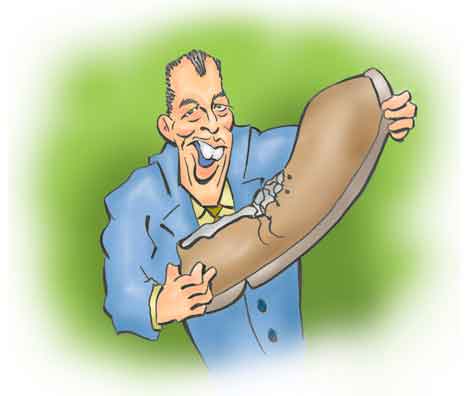
Ed Sullivan
(A Really Big Shew)
Although The Goon Show can be considered the beginning of modern sketch comedy, for years the program itself remained largely unknown to American audiences. This was, of course, before the Era of Instantaneous Communication, and British and American television and radio were disparate entities and rarely did the twain ever meet. Americans never heard of British Television Titans like Huw Wheldon, Peter Dimmock, or even Terry Wogan. Conversely, few British knew of Johnny Carson, Steve Allen, or Ed Sullivan.1
Footnote
For the actors and presenters the lack of reciprocal fame between British and American television and radio stars, although not a surprise, took some getting used to if shows were being made in the other country. The impressionist Rich Little remembered when he was making a TV program in England with Ed Sullivan . Even though The Ed Sullivan Show was one of the most watched variety programs in America no one from England knew who Ed was. One of the British production staff after watching Ed came up to Rich and asked "Who's the guy with no neck who can't talk?"
Of course if the actor starred in motion pictures with international distribution they were likely known by viewers on both sides of the Atlantic. Peter Sellers began appearing in motion pictures even before he joined The Goon Show and he was the one cast member to achieve international celebrity particularly as the bumbling Inspector Clouseau in The Pink Panther series and for playing multiple characters in Dr. Strangelove or How I Learned to Stop Worrying and Love the Bomb. But even today many an American will scratch their heads in bewilderment if asked about Spike Milligan or Harry Secombe.

The British Invasion
Four Lads from Liverpool
But the times - as a Nobel Prize winner wrote - were a-changing. With the British Invasion of 1964 - initiated by Four Lads from Liverpool - things British became the rage. By the time the Swinging Sixties morphed into the Synthetic Seventies, some programs that had been limited to the BBC began finding their way across The Pond. Although The Goon Show was broadcast live, it was recorded on tape and American university radio stations began broadcasting the show where the irreverent humor found a welcome amongst the American students. Then in 1972, Spike, Peter, and Harry got together for the last Goon Show in (what else?) The Last Goon Show.
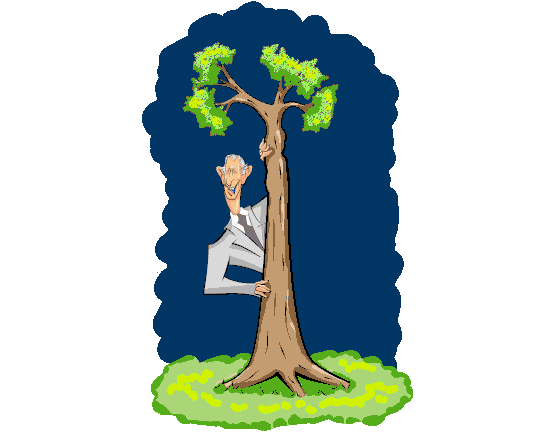
A Young Man Named Charles
A Fervent Fan
(Click to zoom in and out.)
The Goon Show was widely popular across all economic and social classes. Whether you were born within the sound of the St. Mary-le-Bow Bells or tread the stately lawns of Balmoral, you would tune in. In fact one of the most fervent fans was a young man named Charles.
References
The Goon Show Scripts, Spike Milligan, Sphere Books, London, 1973.
The Goon Show, https://goonshow.org/, The Goon Show Preservation Society.