In which a tale is told how a product more valuable than gold was replaced by an industrial revolution which served the average citizen by adding beauty and color to the world.
If you were to read that a river in London once ran purple, you might think you were reading one of Shakespeare's plays about a medieval contestation. But what you'd really be reading about was when in 1856 William Henry Perkin was making a batch of his mauveine dye. Now called something like aniline purple, amethystine, lilacine, purpleine, violetine, lavenderine, grapeine, orchidine, mulberryine, periwinkleine, plumine, mauvaniline, or Perkin's Mauve, this was the first synthetic dye ever produced.
But what, you ask, is wrong with dyes from natural sources? Why not seek beauty from nature's own bounty?
Weeeeehhhhhheeeeeelllll, you see back in Victorian times - just like today - a lot of choices were dictated by cost. It took a lot of work to produce natural dyes and many of the best natural colors had to be imported into Britain from distant parts of the globe. Naturally this drove the prices up.
For instance, one of the best yellow dyes was from the tumeric plant which came from India. Red came from the cochineal insect Dactylopius coccus, which lives in the Americas although some people don't like dyes from squashed bugs.
Mauveine
Indigo
Cochineal Red
Tumeric Yellow
Sometimes, though, the advantages of the imported dyes overcame the use of domestic colorants. The first blue dyes used in England were originally from the woad plant. But because the indigo plant from India contained more of the actual dye, indigo soon replaced the use of woad blue. Today, though, most indigo is produced synthetically.
Royal Purple
But before William began cranking out his dye, one of the rarest (and so most expensive) dyes was purple. Purple was so expensive that in Ancient Rome it was worn only by the upper classes. Senators could put purple stripes on their togas, but only the emperor could wear all purple (hence the name "Royal Purple"). Although it might seem that all you needed to do was to mix a bit of indigo with cochineal, artists have long known that really good purples come from native purple pigments not blends of red and blue.
But the natural dye that was called Tyrian Purple was not cheap. In the ancient times, one pound of Tyrian Purple cost about three pounds of gold. Today it's even worse! With gold running around $150 a gram, you can buy 25 milligrams (0.025 grams) of Tyrian Purple crystals for $75. That's $3000 per gram and - get this - 20 times the current price of gold! Still you don't see people trading cash for Tyrian Purple.
The process for making Tyrian Purple hasn't changed over the millennia. Instead of squashing insects as in making cochineal, you have to remove what Pliny the Elder called a "vein" in the head of snails from the Muricidae family. Actually what you need is the liquid secretion from the snails' hypobranchial gland. Murcid snails are from the Mediterranean although there are snails that can produce similar dyes throughout the world. It is possible to get the secretion without harming the snails but most people don't bother with such niceties.
Christopher and Robert
What must have seemed strange (and still does) is that the liquid starts off colorless to yellow but it turns purple on exposure to air and light. So by the time you get through the process the liquid is the deep dark purple that makes a nice stable dye. But it takes an awful lot of snails. No less a personage than the British chemist Christopher Ingold wrote about isolating the dye. Christopher (whose fellow chemist Robert Robinson also worked with highly colored compounds) reported that the German chemist Paul Friedländer needed 12,000 snails to get 1/20th of an ounce of the purple dye. If that's not enough of a problem, the process for making the dye stinks to high heaven.
Quinine For William's Summer Vacation
So here's where William Henry Perkin steps in. You see, in the summer of 1856, William was an 18 year-old chemistry student studying at the University of London. His teacher, the formidable August Wilhelm von Hofmann, suggested he spend his vacation to make quinine from coal tar. Coal tar was the black sticky stuff left over as a by-product of producing coal gas. Coal gas (also called illuminating gas) was used for fuel as well as for gas lighting which began replacing candles and oil lamps in the mid-1800's. So being a large scale industrial waste product, coal tar was abundant and cheap.
Quinine, of course, was used for treating malaria which in the 19th Century was endemic throughout the world. The drug is found in the bark of the Cinchona plant from South America. If there were disruptions in supply lines - which happened during the various wars - many victims of the disease had no effective treatment. So making quinine from coal tar was the Holy Grail of chemical synthesis.
William wrote that he started off not with coal tar itself but with with a liquid obtained from heating the coal tar component called aniline. He carefully mixed the aniline with dilute sulfuric acid (to make it soluble in water) and then treated the mixture with potassium dichromate which is a pretty stiff oxidizing agent.
Instead of the nice white crystals of quinine, William made what chemists call "gunk" (among other names). That is, he got a black sticky mess which didn't wash out of the test tube with water. But when he tried to clean the tube with alcohol, lo and behold!, he ended up with a nice purple solution.
Knowing that purple dye was expensive William tried dying a bit of cloth. The color seemed to hold and he sent a sample to some actual garment producers. They found the dye stuck to the fabrics and it could indeed be used as a commercial dye.
Of course, scientists have to eat and William went to his dad and brother and they agreed to finance a factory for producing the dye. The Perkins set up their factory on the Grand Union Canal near Greenford in the west part of London. And at times the canal did run purple - or red or green or blue or just about any other color that was suited for dyeing cloth. In a short time the Perkins were rich and famous.
Naturally as a chemist, William wondered what exactly was making the purple color. But in the 1850's although chemists had developed criteria to tell if you had a pure compound rather than a mixture and they could even accurately calculate molecular formulas, procedures for determining actual molecular structures were just beginning.
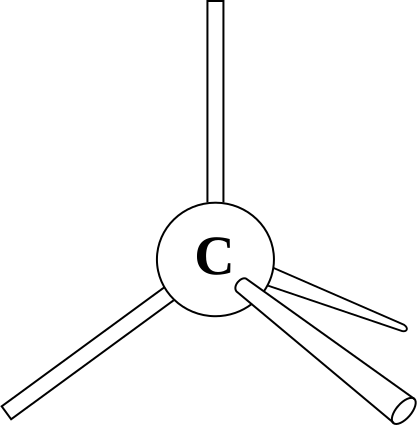
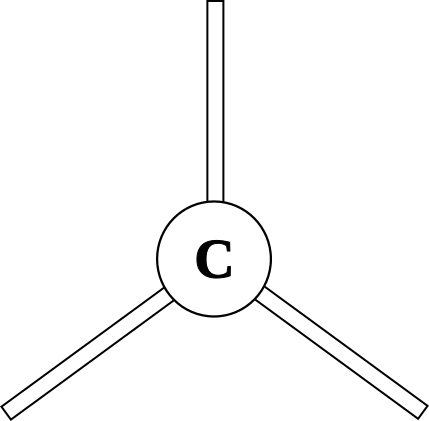
Tetrahedral Carbon
Trigonal Carbon
In fact, it was only in 1857 - the year William got his first patent for making mauveine - that the German chemist August Kekulé figured out that the carbon atom took on different geometries. In many compounds - such as diamond - carbon formed tetrahedral links with neighboring atoms. But sometimes the carbons oriented to other shapes including trigonal planar configurations. Then in 1865 August published the idea that the benzene molecule was a six-member ring with identical planar trigonal carbon atoms arranged in a hexagon with a hydrogen atom sticking off of each carbon.
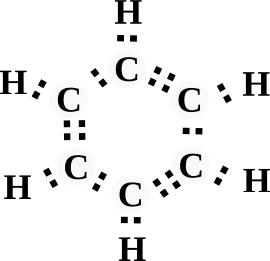
Benzene and Electrons
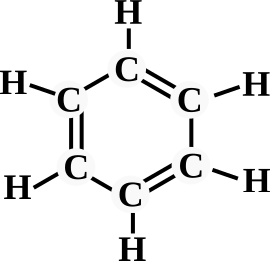
Benzene Electron Pairs as Lines
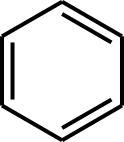
Benzene Textbook Structure
For those whose organic chemistry is a bit rusty, structures are usually represented by lines which represent two electrons that hold atoms together. The atoms themselves are shown by the letters of the atomic symbols. But to avoid making unwieldy structures, carbon atoms are represented simply by the intersection of the lines. If there's no letter, it's a carbon. Hydrogens are left off altogether unless needed for clarity. This is how the common textbook structure of benzene is drawn.
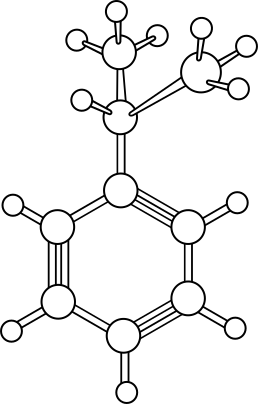
Isopropyl Benzene (Stick Model)
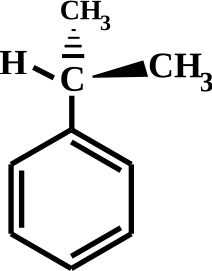
Isopropyl Benzene Wedges and Dashes
A lot of the molecules of the dyes are flat like benzene. That is the atoms are in a plane. But if necessary there are ways to represent non-planar three dimensional structures on a two-dimensional diagram. Long solid wedges represent a bond coming upward from the plane of the page and dashed wedges show a bond directed toward the underside of the page. Still there's a lot of dyes that can be shown as 2-dimensional structures and keep pretty much to reality.
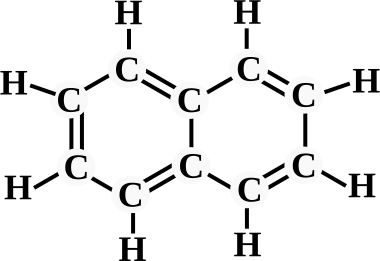
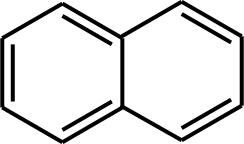
But to get a handle on the structure of the dyes, you needed more than one ring than benzene. No one knew about such structures until 1866 when Emil Erlenmeyer (yes, the same Erlenmeyer as the flask) suggested that naphthalene (the chemical then used to make mothballs) was two "fused" benzene rings. Then in 1869, Carl Gräbe used what are called classical degradation and synthetic methods to prove the structure to most everyone's satisfaction.
Napthalene
Napthalene Fused Rings
So things went along until 1879 when another British chemist named Edward Schunck (chemists sometimes have funny names) took 400 Purpura Capilhis snails and removed the veins that had the colorless colorant. Unlike today where personal feelings are rarely put into journal articles, Edward wrote "After working up the veins of 400 animals of various sizes in the way described, my patience was exhausted, and I therefore contented myself with the quantity of substance, minute as it was, I had obtained." Edward's snails, by the way, were not the Mediterranean Murcids (sounds like a singing group, doesn't it?) but were from the coast near Hastings in England. It was this extract from the 400 snails that gave Edward about 7 milligrams or 1/4000th of an ounce of a substance he called punicin.
Punicin Crystals - 1879 Drawn by Edward
By this time there were methods available to determine some structures. The problem was with only 7 milligrams there wasn't much Edward could do. But at least he was able to put some on a microscope slide which when heated produced some crystals which "sublimed" onto the cover slip. He could then take note of the crystals' shapes and try some other tests (largely checking their solubility in different solvents). Admittedly by today's standards, Edward's drawings left a bit to be desired, but he was able to conclude correctly that he had a new compound which was similar to but not identical to both indigo dye and the related compound indorubin.
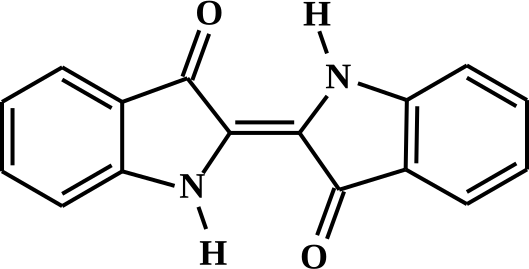
Indigo
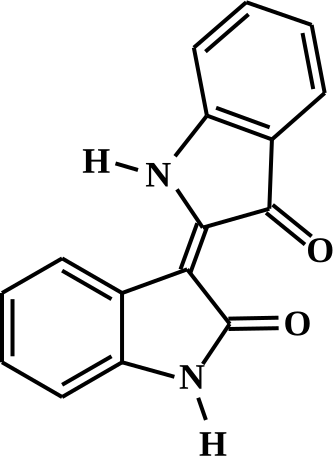
Indirubin
Edward knew that he might or might not have the actual compound that made up Tyrian Purple. So he decided to extract some dye from a cloth that had been colored with the authentic Tyrian. Using a mere 24 grams of cloth he ended up with a whopping 10 milligrams of a dark purple solid. Tests showed this substance had the same properties as the punicin that he had isolated earlier.
Here things get a bit strange. The usual pathway for natural products chemists is to first get a sample of the product and then you determine the structure. In the olden days structures were figured out by breaking the molecule down - usually by oxidation or hydrolysis (reacting with water). If you were lucky you came up with new molecules whose structures you already knew. From the pieces you then made a guess about what the original molecule was.
The next step was to confirm the guess. For that you would take a simple molecule that you already knew the structure of and by using well-known chemical reactions you would transform it to what you thought would be your molecule. You then looked at the elemental analysis of the product and the physical properties. If the properties of the synthetic molecule matched those of the natural product you were pretty sure you had the correct structure.
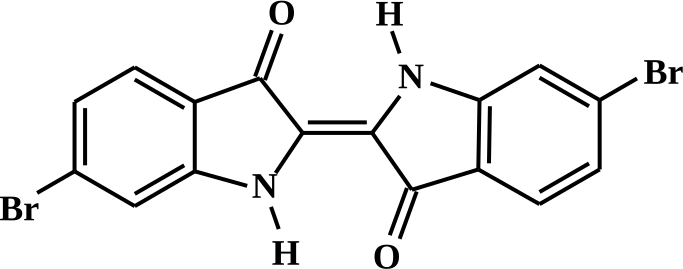
6,6'-Dibromoidigo It was made first.
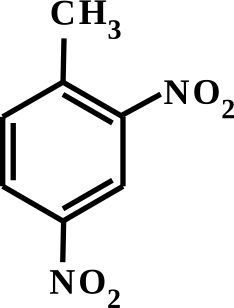
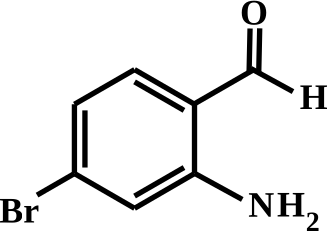
But things worked backwards here. In 1903 a German chemist named Franz Sachs - Germans have always been big in chemistry - synthesized a new compound. He began with 2,4-dinitrotoluene (which is one step away from TNT) and then carried out seven well-known reactions. Since Franz knew what he started with and knew what the reactions did, he was able to deduce he had made the basic indigo structure but with two bromine atoms to form what chemists call 6,6'-dibromoindigo. If he had started off with 4-bromo-2-nitro-benzeldehyde and he could have gotten the 6,6'-dibromoindigo in two steps.
2,4-Dinitrobenzene
↓ [Seven Well Defined Steps]
6,6'-Dibromoindigo
4-Bromo-2-amino-benzaldehyde Two Steps Away
Franz saw that the 6,6'-dibromoindigo crystals had a nice dark purple color. But it wasn't until 1909 - six years later - that Paul Friedländer was able to prove that Franz's compound was in fact the same as the dye he got from the 12,000 snails. Like many chemicals the compound's "formal" name is fairly hefty, (2E)-6-Bromo-2-(6-bromo-1,3-dihydro-3-oxo-2H-indol-2-ylidene)-1,2-dihydro-3H-indol-3-one. But despite its jaw-cracking appellation, the structure is fairly simple as molecules go.
At this point we have to be honest and say that chemists today know that the Tyrian dye is not just 6,6'-dibromoindigo. There are a number of other compounds in the purple liquid although most are related in structure. Investigations into these compounds are still ongoing particularly since some of them have properties that may make them suitable as building blocks for semi-conductors and field-effect transistors. One scholar pointed out that it's good news for the snails that the electronic applications require the highly pure compounds that are best prepared synthetically.
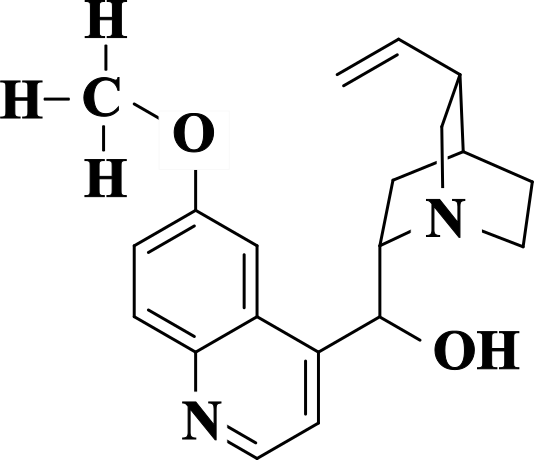
Quinine
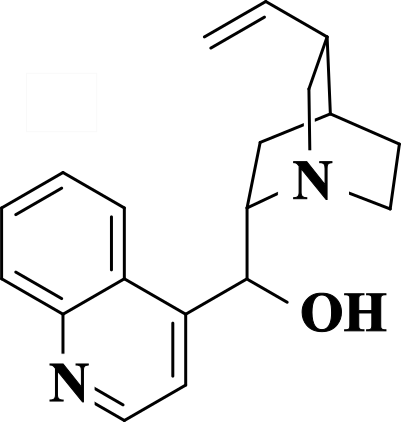
Cinchonine
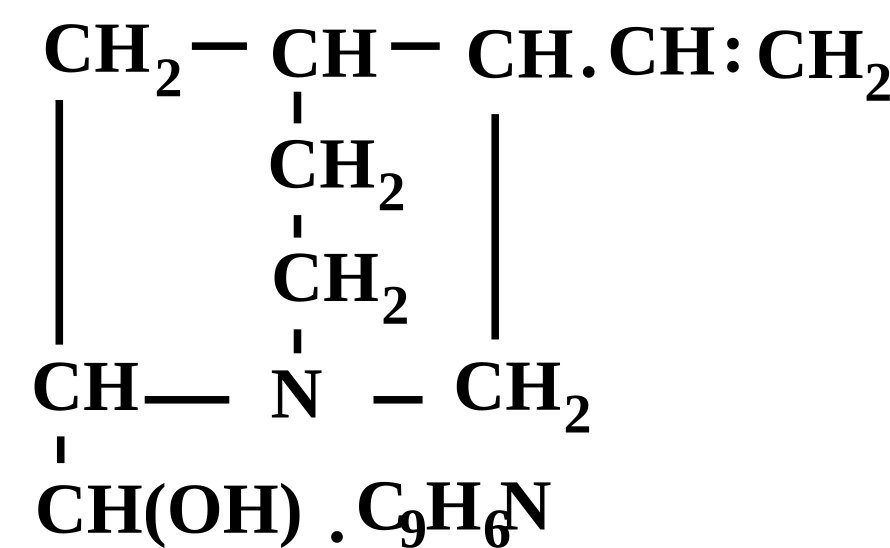
Cinchonine à la Rabe A Bit Strange
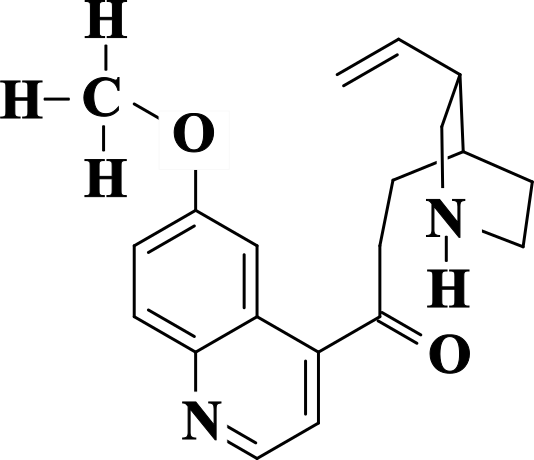
Of course, we know now that William was hampered because no one really knew what the molecular structure of quinine was. In fact it wasn't until 1820 that anyone even knew the correct chemical formula. The actual "connectivity" of the atoms (as fancy pants chemist say) was only established in 1908 by Paul Rabe when he figured out the structure of an almost-quinine compound called cinchonine. His drawings, though, do look a bit strange to modern readers.
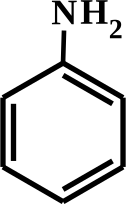
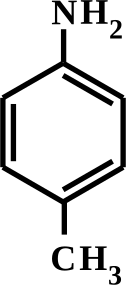
We mentioned that William did not start with coal tar itself but a compound obtained from coal tar. He said the compound was aniline which is (as students of chemistry know) a benzene molecule where one hydrogen atom on the ring is replaced by an amino (-NH2) group.
Aniline
Today, though, chemists don't think William was using pure aniline. The - quote - "aniline" - unquote - he used was from distilling the coal tar and taking the liquid that came off around 180 Centigrade. But lots of compounds have similar boiling points and so in a material as complex as coal tar you can get a lot of co-distillation.
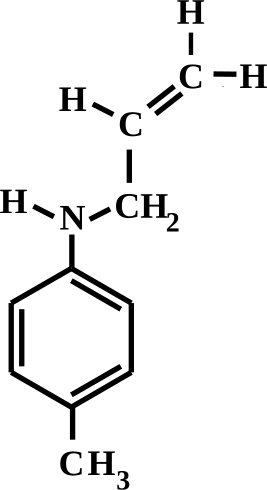
N-Allyl-para-toluidine
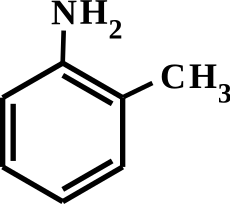
ortho-Toluidine
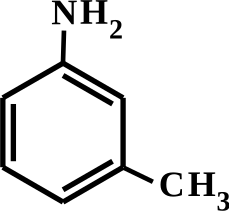
meta-Toluidine
para-Toluidine
In fact some chemists of ability have said that William may have actually started with N-allyltoluidine while others of equal ability say he probably had a mixture of aniline and a goodly amount of ortho-toluidine and para-toluidine. The Toluidines (which sounds like a family from a sitcom) are aniline derivatives with methyl groups 2, 3, and 4 carbons removed down the ring from the amino group. More recently the consensus seems to be pointing to William starting off with a mixture of aniline and ortho- and para-toluidine with more of the toluidines than aniline.
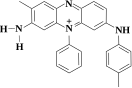
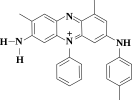
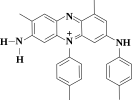
So William's dye, like the original Tyrian purple, was not a single compound. It wasn't until the mid-1990's that most of the components were identified. Among the most important compounds in mauveine are 3-methyl-8-N-(4-methylphenyl)-10-phenylphenazin-10-ium-2,8-diamine, 3,6-dimethyl-8-N-(4-methylphenyl)-10-phenylphenazin-10-ium-2,8-diamine, and 3,6-dimethyl-8-N,10-bis(4-methylphenyl)phenazin-10-ium-2,8-diamine. Mercifully these are identified a bit more taciturnly as Mauveine A, Mauveine B, and Mauveine C. If you're talking about William's dye, you can just say mauveine.
Mauveine A
Mauveine B
Mauveine C
William's dyes not only made him rich and famous they transformed the world. William continued to develop new dyes of all colors and by the time the Victorian Era was reaching its midpoint ladies' and gentlemen's fashions were no long the white, grays, tans, and black apparel of the earlier years but had taken on the colors of whatever dyes the factories could crank out. Gowns, waistcoats, trousers, and even shoes assumed bright hues of yellow, red, blue, green, and of course, purple.
For some reason William's oldest dye, the purple, stayed in fashion. So many people were wearing mauveine tinted clothes that the 1890's were retroactively dubbed the Mauve Decade by the now rarely read author Thomas Beer. Americans, though, usually referred to the time as the Gay Nineties.
William is now credited as the founder of the modern chemical manufacturing industry which in turn led to the productions of new types of fibers and fabrics, paints, fertilizers, insecticides, polymers, plastics, high strength non-metallic materials, and pharmaceuticals. Of course, the fact that the waters near his factory took on the color of his products also shows there were negative sides to the discoveries, drawbacks which eventually began to be handled with at least some effectiveness.
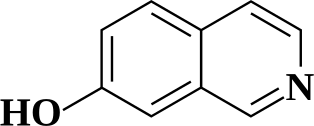
But William never did make his quinine. Today you'll read that the first "total" synthesis of quinine wasn't until 1944. This was when Harvard chemist Robert Burns Woodward and his post-doctoral student William Doering took some 7-hydroxyisoquinoline (whose parent compound quinoline is in coal tar) and after considerable effort ended up with quinine.
Well, that's sort of what happened. Actually in their article "The Total Synthesis of Quinine" R. B. and William didn't synthesize quinine but stopped once they had a compound called quinotoxine. They stopped there because in 1918 two German chemists, Paul Rabe and Karl Kindler, took quinotoxine and in just three steps made quinine. So since Paul and Karl had already done the last part, Robert and William figured they didn't have to. In the world of chemistry this type of synthesis - where you don't do all the steps yourself if someone else has already done the ones you didn't - is quite legitimate and is called a "formal" synthesis.
7-Hydroxyisoquinoline Considerable Effort To Quinine
R. B. Woodward
Well, that's all well and good. But where did Paul and Karl get their quinotoxine?
Simple. They made it from quinine.
Ha? (To quote Shakespeare.) So to make quinine you start with quinine?
Yep. It was no less a personage than Louis Pasteur who showed how you could take quinine and simply react it with water and acetic acid to make quinotoxine.
So does this mean that to make quinine you start with quinine, break it apart, and then put it back together again?
Well, not exactly. R. B. and William still made quinotoxine by starting with small molecules and the quinotoxine can then be taken on to quinine. Such a synthesis where a chemist makes a compound by going through an intermediate that has an alternate and more convenient source is called a "relay" synthesis. You can read more about the Woodward and Doering synthesis by clicking here. But to this day if you want a lot of quinine you can get it best by extracting it from the Cinchona plant. Sometimes the natural way is still the best way.
How to Make Quinine
Quinine
↓ Acetic Acid, Water
Quinotoxine
Three Steps:
↓ HBr, NaOBr
↓ NaOEt in Ethanol
↓ Aluminum Metal in Ethanol
Quinine
So now we know with reasonable clarity how William made mauveine, what it is, and we also know how you can find and make Tyrian Purple. The last question left, then, is why does the purple color of Tyrian Purple form only after the liquid is exposed to air and light? And also why the heck does making the stuff stink so bad?
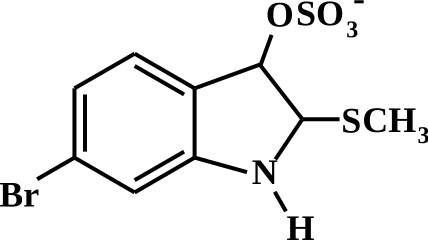
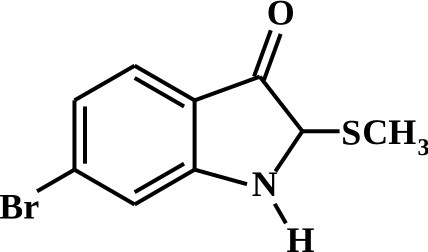
The answer is quite simple. It's just that the snail doesn't have the purple compound itself. Instead what is present is tyrindoxyl sulfate, a fairly simply but colorless molecule.
Tyrindoxyl Sulfate
Tyrindoxyl Sulfate - obviously named after the dye - reacts with enzymes in the snail to form a similar compound called tyrindoxyl.
→
Tryindoxylsulfalte to Tyrindoxyl
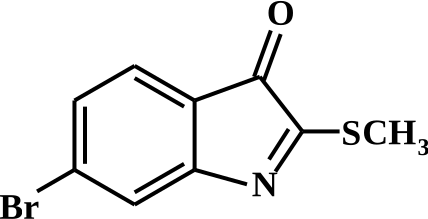
Then the Tyrindoxyl - upon exposure to air - that is, oxygen - forms tyrindoleninone.
→
Tyrindoxyl to Tyrindoleninone
All that happens here is that the nitrogen in the five membered ring looses its hydrogen and another hydrogen in the ring next to the sulfur atom gets pulled off as well. But tyrindoleninone has a nice orange color and this gives the yellow tinge to the liquid from the snail.
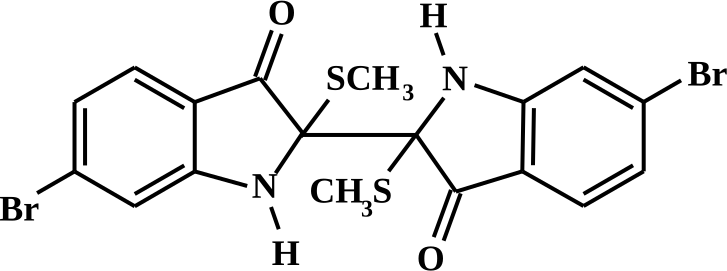
Here the oxidation continues and two of the tyrindoleninone molecules link together to form tyriverdin.
Tyrindoleninone
↓ [Oxidation]
Tyriverdin
At this point light - sunlight - induces a photochemical reaction (shown in chemical reaction diagrams by the symbol hν). The product is not just the 6,6'-dibromoindigo but also methyl disulfide. This is what causes the notorious odor of the process. According to one popular informational reference, the smell of methyl disulfide is "garlic-like" and unpleasant. Actually that description doesn't do justice to an odor that makes strong men quail, not to mention retch, gag, and puke.
Tyriverdin
↓ hν
6,6'-Dibromoindigo Tyrian Purple
+
CH3S-SCH3 ↙ Stinks
Methyl Disulfide
Methyl disulfide and the related compounds methylsulfide (CH3SH) and dimethyl sulfide (CH3SCH3) have been in the news since its possible they might be present in the atmosphere of other planets. On Earth all of these compounds arise from biological processes and so their presence could be a "marker" that there's life on these other planets as well. However, under the harsh conditions on other planets plus exposure to ultraviolet light, a planet with a methane atmosphere could conceivably produce methyl sulfide compounds by non-biological routes.
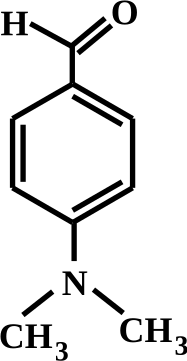
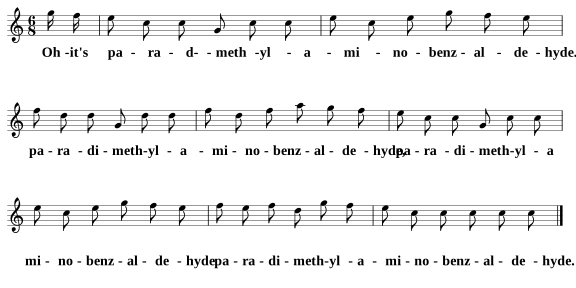
p(ara)-Dimethyl-amino-benzaldehyde It practically sings.
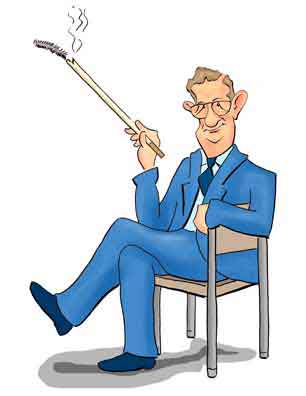
Figuring out the various structures may be a bit of a challenge for those not versed in chemistry. But pronouncing the names can be even more formidable. However, Isaac Asimov once came up with a solution to aid in the memory and the enunciation. He found that sometimes you can sing the names. For instance, anyone can easily pronounce para-dimethyl-amino-benzaldehyde - which Isaac wanted to use to test if glucosamine was present in a solution - by singing the name to a popular folk song. To play the tune to sing along just click here.
Of course a great aide to the memory is to cast a story into verse. So it seems only proper to end this tribute to William Henry Perkin with an appropriate cinquain.
There once was a chemist named Perkin
Who was proper English, not Amerkin'.
He walked straight without hirple.
And if his canal had turned purple.
You knew his factory was a-workin'.
References and Further Reading
Bright Colours from the Past: The History, Chemistry, Characterisation and Application of Synthetic Dyes Between 1856 and 1914, Maarten R. van Bommel and Matthijs de Keijzer, Cultural Heritage Science, Springer, 2025.
Tyrian Purple: 6,6’-Dibromoindigo and Related Compounds, Christopher Cooksey, Molecules, Vol. 6, Issue 9, 2001, pp. 736-736.
Classical Methods in Structure Elucidation of Natural Products, Roald Hoffman, Wiley, 2018.
"Purple (Dye, Textile)", The Encyclopedia of Ancient History, Béatrice Caseau, Wiley, 2012.
"Preparation of Tyrian Purple (6,6'-Dibromoindigo): Past and Present", Joel Wolk and Aryeh Frimer, Molecules, Vol. 15, Issue 8, 2010, pp. 5473-5508.
"Bromination of Deactivated Aromatics: A Simple and Efficient Method", K. Rajesh, M. Somasundaram, R. Saiganesh, and K. K. Balasubramanian, Journal of Organic Chemistry, Vol. 72, Issue 15, pp. 5867-5869.
"A Simple, Safe and Efficient Synthesis of Tyrian Purple (6,6'-Dibromoindigo)", Joel Wolk and Aryeh Frimer, Molecules, Vol. 15, Issue 8, 2010, pp. 5561-5580.
"Novel Functionalized Indigo Derivatives for Organic Electronics", Irina Klimovich, Alexander Zhilenkov, Lidiya Кuznetsova, Lubov Frolova, Olga Yamilova, Sergey Troyanov, Konstantin Lyssenko, and Pavel Troshin, Dyes and Pigments, Vol. 186, p. 108966.
"Novel Functionalized Indigo Derivatives for Production of Tyrian Purple Indigoid Dye From Tryptophan in Escherichia coli, Jeongchan Lee, Joonwon Kim, Ji Eun Song, Won-Suk Song, Eun-Jung Kim, Yun-Gon Kim, Hee-Jin Jeong, Hye Rim Kim, Kwon-Young Choi and Byung-Gee Kim, Nature Chemical Biology, Vol. 17, 2021.
"Reconstructing the Historical Synthesis of Mauveine From Perkin and Caro: Procedure and Details", Tânia Cova, Alberto Pais, J. Sérgio Seixas de Melo, Scientific Reports, pp. 1-9, July 29, 2017.
"A Microscale Synthesis of Mauve", Rhonda Scaccia, David Coughlin, and David Ball, Journal of Chemical Education, Vol, 75, Issue 6, p. 769, 1998.
"Bacteria Brew Prized Purple Pigment", Bethany Halford, Chemical and Engineering News,Volume 98, Issue 43, November 8, 2020.
"The Quinine Odyssey: A Barometer of the State of Organic Synthesis Over Centuries", Alex Bissember, Chemistry - A European Journal, Vol. 30, Issue 69, 2024.
"Über den Farbstoff des Antiken Purpurs aus murex brandaris", Berichte der Deutschen Chemischen Gesellschaft, Vol. 42, 765-770, 1909.
Synthetic Colouring Matters: Vat Dyes, Joceylyn Thorpe and Christopher Ingold C.K.Longmans, Green and Company, 1923.
"K2-18 B Could Have Dimethyl Sulfide in Its Air. But is It a Sign of Life?" Mark Zastrow, Astronomy, April 17, 2025.
"The Total Synthesis of Quinine", R. B. Woodward and W. E. Doering, Journal of the American Chemical Society, Vol. 67, Issue 5, pp. 860–874, 1945.
"You Too Can Speak Gaelic", Isaac Asimov, Magazine of Fantasy and Science Fiction, March, 1963, p. 72-81.