Ducks at Dinner
(Or Mallards at Mealtime)
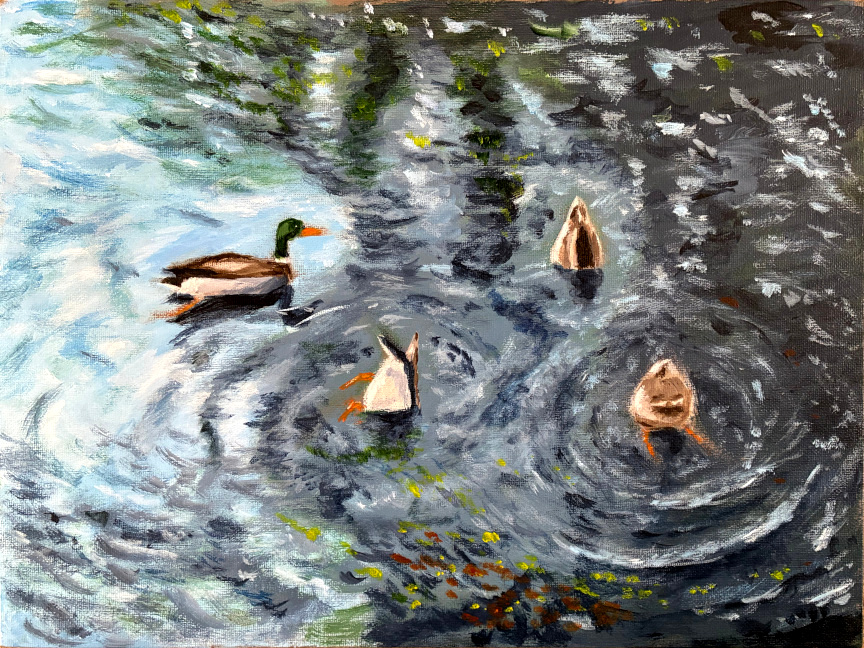
If you see a duck in the United States the odds are about 20% it's a mallard. So if someone offers you even money that the next duck you see will be a mallard, that's a sucker bet. They should pay you 4 to 1.1
Footnote
Worldwide, though, it's even more of a sucker bet. There are about 1 billion ducks in the world (with about 690 million in China) and maybe 100 million mallards. So the odds of seeing a mallard are about 10%. The payoff should be 9 to 1.
Of course the picture is complicated because the mallards often interbreed with other albeit similar species. So if you simply say "mallard" you may be talking about the subspecies the Wild Mallard, Domestic Mallard, Rouen Duck, Call Duck, Welsh Harlequin, Cayuga Duck, Pekin Duck, Swedish Blue Duck, Khaki Campbell, Mallard/American Black Duck Hybrid, Mallard/Mexican Duck Hybrid, Manky Mallard, or the Greenland Mallard.
However, if you see a DOMESTIC DUCK THAT IS DESCENDED FROM THE WILD EURASIAN MALLARD the bet's almost a sure thing. Virtually ALL domestic ducks - such as the Pekin Duck - are descended from the wild mallard.
Ducks are not the most common birds in the world - that honor is bestowed on the chicken - but they are in the top ten. Of course, as far as domestic ducks in addition to the mallard there are the Magpie, Khaki Campbell, Pekin, Cayuga Duck, Welsh Harlequin, Muscovy, Ancona, Mallard, Saxony, Crested Duck, Indian Runner, Orpington, Swedish Blue, Silver Appleyard, Golden Cascade, and the Black East Indian Duck.
Although the mallards have been increasing overall there are regions where the population has dropped by over 80%. There are, though, a number of species that are listed as endangered by International Union for Conservation of Nature. Some ducks are so rare it's not certain if they have become extinct or not. The pink-headed duck ((Rhodonessa caryophyllacea) is listed as probable extinct and the last confirmed sighting was in India in 1935.
There are many unusual facts about the mallard and other ducks. One of the most surprising is that only the females give the familiar quacking sound. Males tend to make a softer raspy sound more like a whistle. Ducks also shed their flight feathers and for about 3-4 weeks a year, they are unable to fly.
Mallards are sometimes referred to as "fiddling ducks", a term that appears to have no definition in any authoritative sources. A fiddling duck, though, seems to be the term applied to "dabbling ducks". In fact, the picture above shows the "dabbling". Dabbling ducks feed in the water by tipping forward and looking for the goodies with their heads underwater with their tails pointing upwards. There are diving ducks like the cansvasback that actually descend below the water.
Mallards are so much a part of world culture that naturally there's considerable humor associated with the subfamily Anatinae. Among some of the quackers are:
Why was the mallard arrested?
He was caught safe-quacking.
What did the mallards serve for hors d'oeuvres?
Cheese and quackers.
Why are mallards so bad at being baseball umpires?
They always say the batters hit fowl.
And finally there's:
What do mallards like to watch on television?
Duckumentaries.
References and Further Reading
"Mallards", Scot Nielsen, 1992.
"Mallards", Animalia.
"2025 Waterfowl Population Survey Results", Ducks Unlimited
"Global Waterfowl Production", Mohamed El Sabry and Obaida Almasri, Tropical Animal Health and Production, Volume 55, Issue 6, p. 419.
"Duck Population by Country (2025 Data)", WorldoStats.
"Population Genetics and Geographic Origins of Mallards Harvested in Northwestern Ohio", Michael Schummer, John Simpson, Brendan Shirkey, Samuel R Kucia, Philip Lavretsky3, Douglas Tozer. PLoS One, Vol. 18. No. 3, March 15 2023.
"13 Types of Mallard Ducks: Identification With Name & Picture", Petdemy.
"The 17 Best Pet Duck Breeds For Backyards", Chickens and Morek.
"Mallards", All About Birds.