B. B. King
(Click on the image to zoom in.)
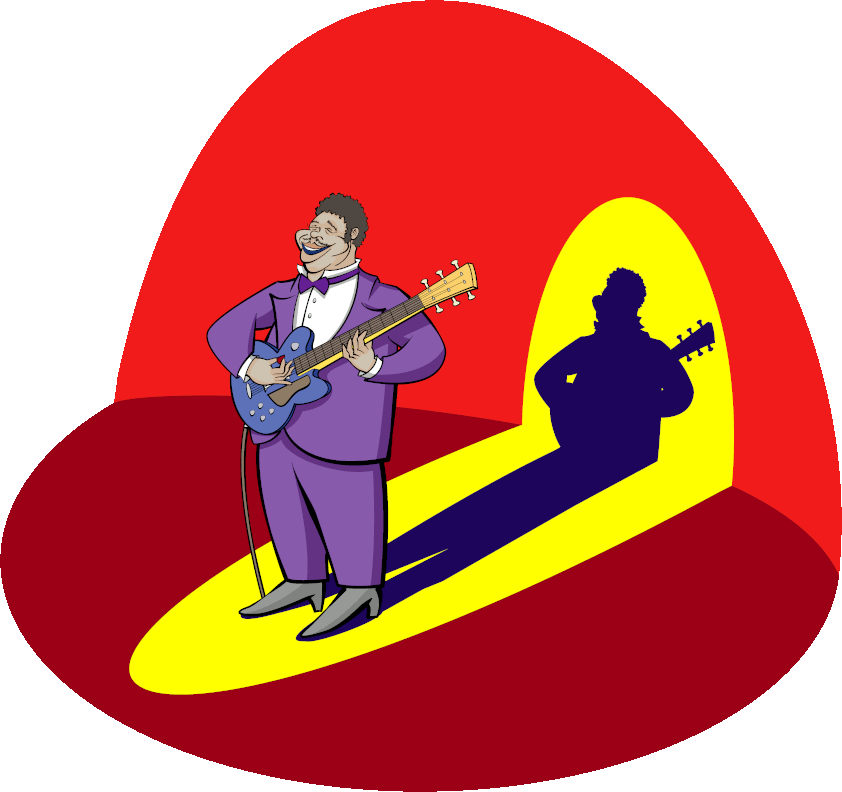
When you see a performer named "King", you naturally assume his real name is something like Akerregi, Drinkwater, Bidelspach, or Smith. Nope, B. B. King's last name was King.
As to why a man named R. B. became B. B., the usual telling is that as a kid, he picked up the name "The Beale Street Blues Boy". But rather than use the name B. S. B. B. King, he just picked the last two letters and became "B. B." It's as good an explanation as any.
Riley B. King - evidently the "B." is just an initial and doesn't stand for any name - was born in 1925 near Itta Bena, Mississippi, about 120 miles south of Memphis. His parents, Albert and Nora, were tenant farmers and if they wanted good music it not only had to be live music but they had to make it themselves. The first music B. B. heard was both church music and the blues.
Due to family difficulties, young Riley went to live with his grandmother near Kilmichael. Like all kids of his time and place he spent more time in the cotton fields than in school. But he learned to sing in the church and the preacher actually gave him his first lessons on guitar. But mostly Riley taught himself.
Most sources state that B. B. - as we'll call him - was inducted into the Army but that he was released after finishing basic training. The reason - again according to the sources - is because he could drive a tractor he was deemed essential to the war effort. Another source says B. B. did not serve in the army at all but got a deferment. But at least after the war his ability to drive a tractor did get him out of the lowest level jobs and landed him steady employment from the local farm owners.
It was in the 40's that B. B. formed his first group. It specialized in Gospel, not Blues, and they were good enough to land some time on the local radio station. B. B. began seriously thinking about going to the city to pursue a music career. The final impetus toward this goal came - at least according to one story - when he accidentally broke a plow and was afraid his boss would be displeased. So in 1946 off he went to Memphis.
In Memphis he met Bukka White - even then a famous bluesman and a distant relative - and Bukka helped B. B. hone his playing. But his big break came in 1948 when he appeared on the radio show hosted by Alex Miller (known better as Sonny Boy Williams II). The show got enough notice that B. B. began to get regular work in the local bars and he soon landed his own radio program. Here we get yet another story for his doubly initialed name in that he soon became known as "Blues Boy" - or B. B. - King.
Memphis was, of course, a center of the recording industry and with his local fame B. B. began cutting some records. His first platter was "Miss Martha King 1949" which was produced by none other than Sam Phillips. Sam as scholars of popular culture know later went on to establish Sun Records which had some success distributing the songs of a local truck driver.
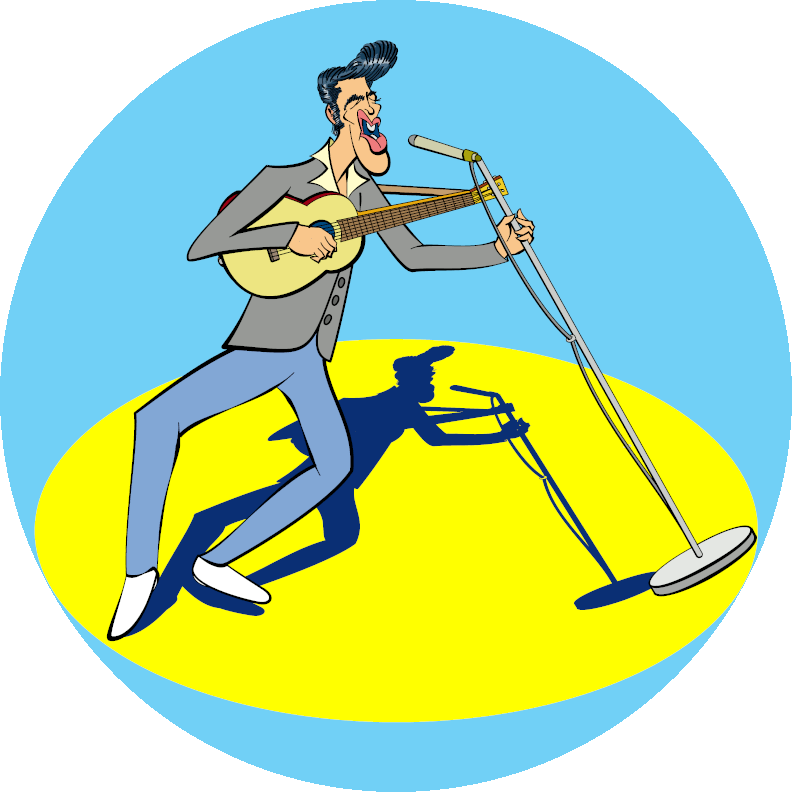
A Local Truck Driver
But it was in 1951 that B. B. released "Three O'Clock Blues" with "That Ain't the Way to Do It" on the flip side. "That Ain't the Way To Do It" not only has good guitar playing but it gives us B. B. singing at its best. "Three O'Clock Blues" jumped to #1 on the Rhythm and Blues Charts and suddenly Mr. King the Memphis disc jockey was B. B. King the Blues Star.
B. B. kept touring and recording for more than fifty years. Admittedly electric blues isn't everyone's cup of chicory, but B. B.'s songs are a bit more accessible to the general audiences than a lot of others. His songs aren't as wild and boisterous as the tunes of other bluesmen such as Bo Diddley. Instead B. B. played his guitar - affectionately named "Lucille" - with a laid back quality where he doesn't try to cram in as many notes as possible. Like Django Reinhardt, he specialized in improvised single note technique as he admitted he had never really learned how to play chords.
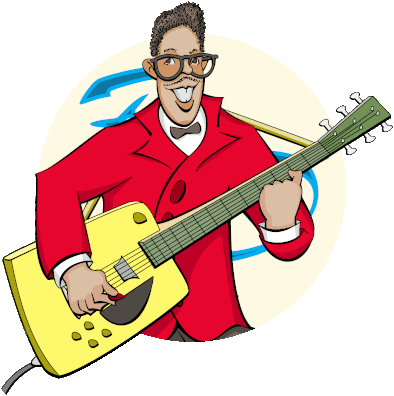
Bo Diddley
Wild
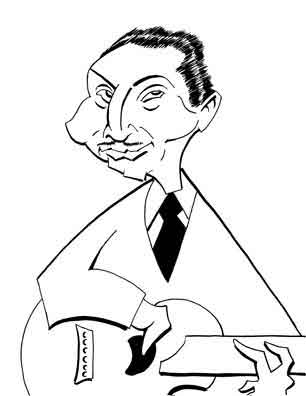
Django
Because what you heard on his records is pretty much what B. B. played without unnecessary overdubbing, reverb, and feedback his live performances were as good if not better than his recordings. Live at Cook County Jail is one of B. B.'s better albums and has one of the best introductions to a concert. It was delivered by a woman prison official although she was never named.

Johnny Carson
Naturally B. B. didn't just sing the blues. He also appeared in movies and on television. Most of these are personal appearances where he is just himself. Of course he was on The Tonight Show with Johnny Carson and he once even hosted the kids pop music show The Midnight Special. One program that seems to be left out of some of the various filmographies was in 1977 where B. B. plays himself on the Sanford and Son episode "Fred Sings the Blues".
A film with a plot where he again appears as himself was Blues Brothers 2000. The picture did not fare particularly well at the box-office or with the critics and naturally there's the question why B. B. wasn't in the original Blues Brothers in 1980 which did much better.
B. B. didn't just play to American audiences. Yes, he might perform in Newkirk, Oklahoma, (pop. 2200) but he'd also bring his show to the Royal Albert Hall in London. B. B. is usually cited as playing at least 200 concerts a year and his last performance was October 3, 2014. That was in Chicago, and if B. B. didn't keep performing to the end, it was pretty nearly to the end.
B. B.'s performances were noted for their humor even when singing the Blues. So hopefully he wouldn't mind closing with a few blues jestaculars.
What do ghosts do when times get tough and things go wrong?
They start singing the boos.
How many blues guitarists does it take to tune a guitar?
None. Why bother?
And of course there's ...
Three musicians walked into a bar. The first walked up to the bartender and said, "I'd like a crème de menthe frappé - as smooth and light as Haydn's Serenade for Strings.
The bartender looked at him.
"I'm a classical violinist," the man explained.
The second musician walked up and said, "I'd like a Manhattan - with all the bounce of Dizzy Gillespie's Groovin' High".
Again the bartender looked at him.
"I'm a jazz trumpet player," the man said.
The third man walked up and said, "I'd like a beer, and they're paying."
The bartender nodded and said:
"You must be a blues guitarist."
References and Further Reading
King of the Blues: The Life and Times of B. B. King, Daniel de Vise, Grove/Atlantic, 2021.
The Land Where the Blues Began, Alan Lomax, Pantheon, 1993.
"B. B. King", Hollywood Bowl.
"B. B. King", Concert Archives.