Harold Lloyd
and
Robyna Ralston
(Click on the image to zoom in and out.)
Harold Lloyd
and
Robyna Ralston
(Click on the image to zoom in and out.)
One of the first comedic cinematic celebrities was Harold Clayton Lloyd. One well-known scholar of cinema has even stated that the most famous scene in the history of silent movies was in one of Harold's films.1
Footnote
As older technology recedes into history and new terms replace the old, it should be remembered that motion pictures which are now produced using digital technology were once recorded on actual strips of transparent film. The action was viewed by placing the spools of film in a projector where the film passed behind a lens where light projected the moving image onto a screen.
Because there were practical limits to the length of the reels, there were typically more than one projector in the booth. So as soon as the spool of one projector ran out the other was started immediately and so producing continuous viewing. While one reel was showing the other was rewound.
Sometimes the film strip would break, interrupting the picture. This could produce hoots and hollers from the audience until the action was restored.
So it's all the more strange that even long after the onset of the digital era, not many people had actually seen Harold's films. Years after the Millennium2 one of the most famous film critics stated that he had only recently seen his first film that starred Harold Loyd.
Footnote
Today references to the Millennium may be so obscure as to require considerable explanation. But at one time the word was so familiar as to require no explanation.
In the decades from the year 1990 to 2000, the Millennium - the word is usually capitalized - commonly referred to the year 2001 which was the beginning of the 21st Century (some definitions say the Millennium began in the year 2000 which was actually the last year of the 20th Century). There was considerable concern among those who worry a lot that there would be all sorts of catastrophic events, especially the collapse of computer systems that relied on the current date and year. The word also gave rise as a reference to kids born from 1990 to 2010 or at least close enough to that range that they adopted the lifestyles and mores of the decades around the turn.
Today discussions of the Millennium seem rather quaint and the word is used less and less in the popular literature. "Millennials" are now more and more referred to as Gen-X'ers or Gen-Y'ers.
Harold was born in Nebraska in 1893 and like many kids growing up at the Dawn of American cinema, he dreamed of making it big in Hollywood. At that time people could audition as "extras" simply by showing up at the studio gates and hope they'd be picked.
As usual for fledgling movie stars, Harold's first film appearances were uncredited bit parts. But he quickly began getting named roles although these were in "shorts" - that is, films lasting typically 15 - 30 minutes and which were often shown before the feature film.
What helped propel Harold to actual stardom was that one of the aspiring actors he met while vying for roles was a young man from New York named Hal Roach. Hal, though, soon decided to move into work behind-the-camera and in 1914 he organized his own production company. Naturally, he remembered his friend Harold and began featuring him in starring roles in his "two-reelers". By 1915 Harold had made over 40 films.
Harold kept moving up and in five years he was considered one of the Big Three of Silent Film Comedy. The others in the Titantic Trio were (of course) Charlie Chaplin in his Little Trap Character and Buster Keaton, known as The Great Stone Face. In fact, in the 1920's Harold's films were more successful than either Charlie's and Buster's, at least in a monetary sense. Admittedly part of Harold's success was that he simply made more films than Charlie or Buster and Harold's count is usually given as 200 or more.
Buster Keaton
The Great Stone Face
But if people do know of Harold's films, they know at least two: Safety Last, which was released in 1923, and The Freshman in 1925. Safety Last is probably the most famous of the two, largely because of the scene where Harold is hanging onto the hands of a huge clock on the wall of a skyscraper - the shot that the scholar said is the most famous in the history of silent movies. From this image it's natural to think the entire picture will be a series of mis-adventures where Harold finds himself teetering on the edge of disaster every few scenes.
Actually the "safety last" stunts were all toward the end of the film where Harold's character was trying to get publicity for the department store where he works. The managers figured that if a "human fly" scaled the wall of the building it would attract a large crowd to the store. It was Harold's taking on the task that produced the series of misadventures where the most remembered is the clock scene.
In Safety Last Harold plays a never-named, bespectacled, and naive young man from a small town who is trying to make it big in the city. He says good-by to his girlfriend - also never named and played by Mildred Davis. He promises her that when he saves enough money she can join him in the city and they'll get married.
Of course, The Boy - as Harold is listed in the credits - ends up only with a low-level job at a department store. He proves so inept at everything that he has no hope of moving up on the staff. But he still writes home to his family and girlfriend that he has become one of the upper-level management.
So things go until his girlfriend shows up unannounced. She figured that with Harold's success, they can now get married. His trying to fool his girlfriend that he's a bigwig leads to scenes of chaos that culminates with the final sequence with the clock. Of course, at the end of the film, Harold gets to the top of the building and we presume he gets promoted and can marry his girlfriend.
In The Freshman Harold again plays a naive and credulous (and bespectacled) small town boy who is leaving home to go to college. But at least this time the character has a name, Harold Lamb.
Before Harold heads off to the fictional Tate University, he watches a film about university life which he takes as a how-to manual. Among the scripted (and fictional) college practices that Harold feels obliged to emulate is doing some fancy dance steps before shaking hands with a new acquaintance. Naturally he becomes an object of ridicule from the other students who like to set him up in embarrassing situations. Because he's getting so much attention Harold believes he's one of the most popular students on campus when everyone really thinks of him as the school doofus.
Rather than living in a college dorm, Harold stays in a boarding house where he falls for the landlady's daughter Peggy (played by Jobyna Ralston). The feeling is mutual although she realizes that the other students are mocking Harold. But she keeps mum.
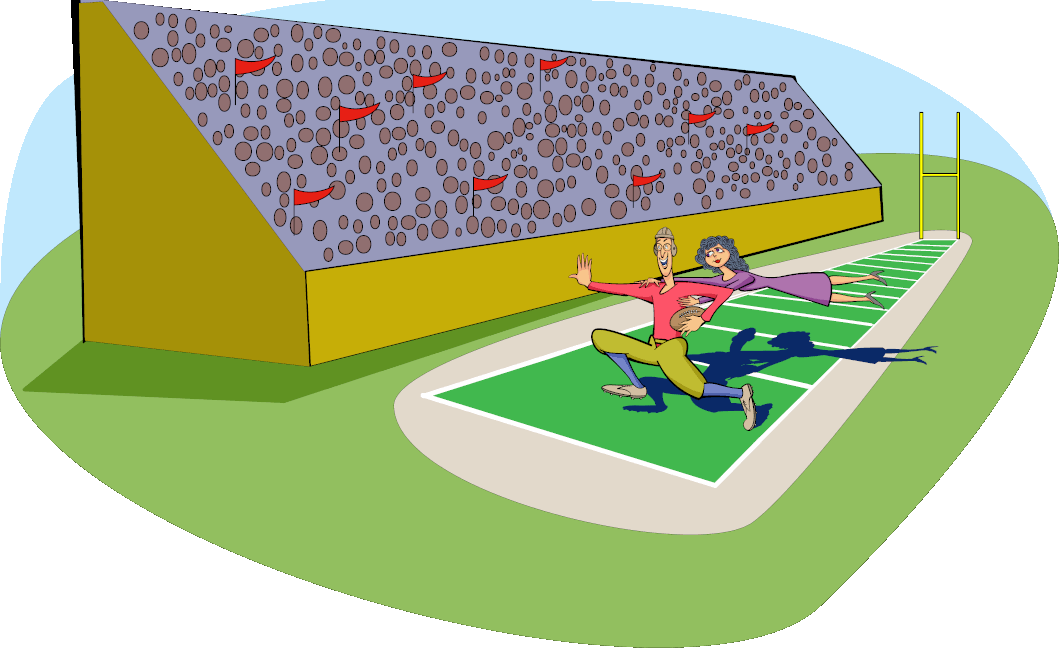
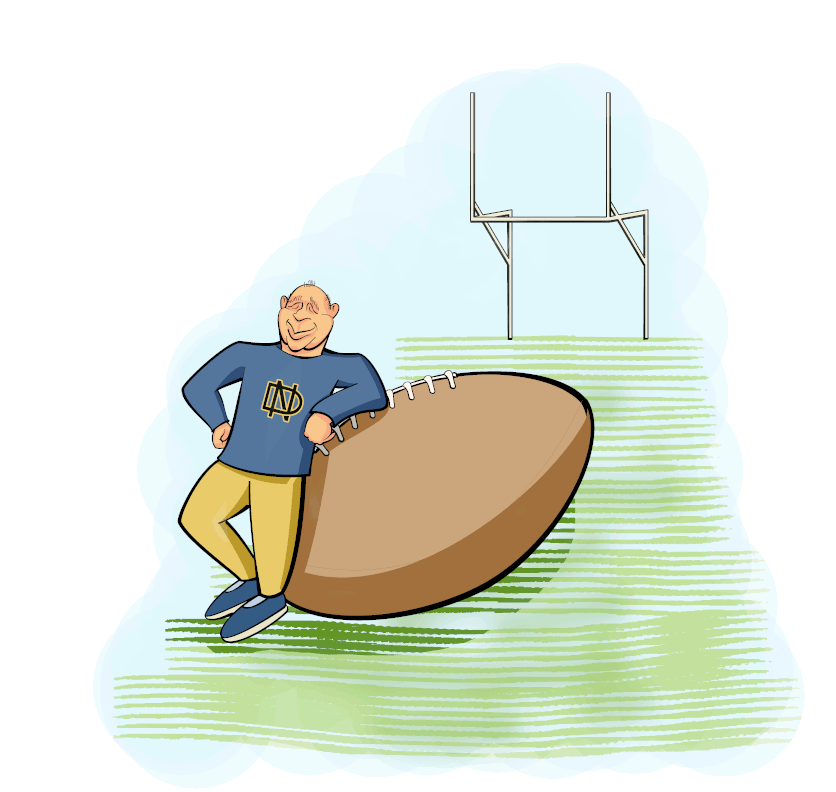
In 1925 when the movie was released, the quintessential college activity was football largely thanks to the achievements of the legendary Notre Dame head coach Knute Rockne. Of course in the 1920's football pretty much meant college football as professional football was practically a non-entity. You really couldn't have a motion picture about college without having something about football.
Knute Rockne
Legendary
(Click to zoom in and out)
So naturally Harold decides to try out for the team. As before he becomes the object of ridicule. After the coach has Harold take the place of the tackle dummy - leaving Harold rather the worse for wear - the team captain tells the coach to let Harold stay on as the water boy but let him think he made the team.
Finally while he's at a dance Harold takes exception with a student who is getting too familiar with Peggy. The student then sneers and tells Harold the truth - he's not the most popular student on campus. In fact everyone thinks he's a jerk. Harold is devastated but Peggy tells Harold to just be himself and not try to be the Big Man on Campus.
But Harold is still the water boy on the football team and at the big game the other team is so tough that players keep getting knocked out of the game. Soon the coach ends up with one too few players to field a team. The referee says that means Tate will forfeit the game.
So Harold tells the coach to let him into the game. With no options left the coach agrees and as expected Harold's inept maladroitness carries onto the field. Tate is sure to loose, but in the end and unexpectedly Harold takes the ball in for the final touchdown. So finally Harold really does become the college hero and of course he gets the girl.
Today when the principal actors often use stunt doubles just for jumping off a chair and harrowing special effects are computer generated, in Harold's day the stars of the shows might do a lot of the stunts themselves. In Steamboat Bill, Jr. (1928), the front of a house falls over Buster Keaton but he luckily is standing just where the open window frame lands. There was no trick here, just careful planning and placing of Buster.
On the other hand some stunts did have tricks completed in post production. In Modern Times where Charlie Chaplin's Little Tramp character appears for the last time, Charlie roller skates near the edge of a three story drop.3 However, the edge of the building was what is called a matte shot - that is it was a painting made to look like the precipice. Matte shots could be made by painting the image on a glass plate and arranging the camera so the painting appeared to be part of the background. Alternatively the matte could be added during the printing of the final film.
Footnote
Modern Times was released in 1936 which was ten years after the talkies began with The Jazz Singer. Originally Modern Times was planned as a talkie, but Charlie realized the Little Tramp character was only suited as a silent character. So he produced what is largely regarded as the last of the great silent pictures even though is a little dialogue.
As anyone might expect, accidents during filming were common. But Harold's most serious injury came in 1919 for a publicity shot. He was supposed to pose while lighting a bomb - the typical black round "movie" bomb with the long sputtering fuse - with a cigarette. As Harold told the story himself:
I put a cigarette in my mouth, struck a sassy attitude and held the bomb in my right hand, the fuse to the cigarette. The smoke blew across my face, so clouding the expression that the photographer, whose head was buried under the black cloth, delayed squeezing the bulb.4 As he continued to wait and the fuse grew shorter and shorter, I raised the bomb nearer and nearer to my face, until, the fuse all but gone, I dropped the hand and was saying that we must insert a new fuse, when the thing exploded.
Footnote
Although hand held cameras were around as early as 1888, in the early 20th century professional photographers preferred the larger bellows lens cameras steadied on a tripod. The photographers often covered their head with a black cloth for a clearer view of the shot and the picture was taken using air pressure from a rubber bulb attached to the shutter by a hose. Although now seen as incredibly bulking and cumbersome this basic design continued to be used well into the 1960's.
The bomb was actually a paper-maché prop but why it had been filled with powder was never explained. But the explosion was powerful enough that Harold lost his thumb and index finger. In his later films he had to wear a special glove to hide the injury.
Although the wall-climb in Safety Last employed a double for the long and most dangerous shots, sometimes it's clear it is Harold hanging dangling off the wall. But in addition to the famous clock shot there is a still photograph where the camera was set up for a wider angle shot than what appeared on screen.
There we see that Harold is not really hanging on the sheer wall high above the sidewalk. Instead, part of the building's roof is directly below the clock. The total drop for Harold would be about 14 feet but for extra protection the crew constructed a platform so Harold's fall would be perhaps ten feet and onto some mattresses. Certainly he could still get injured if he slipped but clearly there were provisions made for Harold's safety. He was, after all, the star.
They (and others) ventured into talkies.
Stan and Ollie
Mickey Rooney
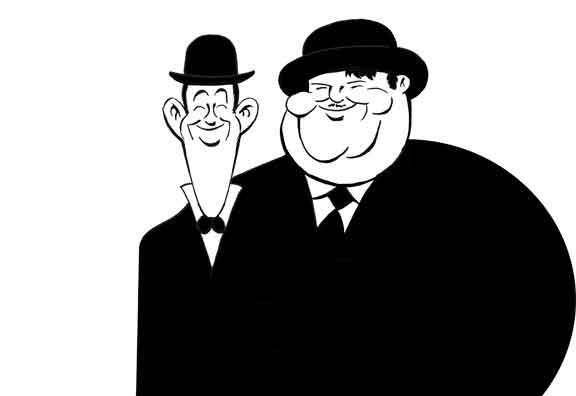
Like other silent film stars - Laurel and Hardy, Gloria Swanson, Mickey Rooney - Harold ventured into "talkies" after Al Jolson and The Jazz Singer up-ended the film industry. Harold's first talkie was in 1929 with Welcome Danger which also had an all-silent version.
In Welcome Danger Harold plays his usual bespectacled and naive young man, this time a botany student turned detective. In general Harold's performance received good reviews and the film did well financially. However by 1938 interest in seeing essentially the same character had begun to fade. But by 1947 he was still making movies with The Sin of Harold Diddlebock.
The Sin of Harold Diddlebock was a continuation of The Freshman. He plays the same but now older character who had inexplicably undergone a surname change. Also somehow his earlier girlfriend has vanished from his life and he keeps getting engaged but never married to the secretaries in the company where he works.
The film did not do well and was re-released in 1950 after considerable re-shoots and editing which lopped 10 minutes off it's original's 90 minute duration. At some point - it's not quite clear when - the title was changed to Mad Wednesday as it was thought the original title might be misconstrued as to the nature of the film. But the changes did not improve either the reviews or the box-office and although Harold was nominated for a Golden Globe Award, The Sin of Harold Diddlebock/Mad Wednesday ended up as Harold's last film.
Harold had invested his money wisely and after his retirement from films, he had no real need to enter into new ventures. But he wasn't forgotten. In 1953 he was awarded an honorary Academy Award for his comedic achievements. Then a month later he was the mystery guest on What's My Line and Dorothy Kilgallen guessed his identity.
At this point, it would seem appropriate to end up this tribute with some jokes about the films of Harold Lloyd. But given his example, it's best just to remain silent.
References and Further Reading
Harold Lloyd: The Man on the Clock, Tom Dardis, Viking, 1983.
"The Third Genius of Silent Film", Roger Ebert, RogerEbert.com, July 3, 2005.
Chronicling America, Library of Congress.