Campbell was still playing Chung Ling Soo in 1918, when he was accidentally shot to death while doing a bullet-catching trick.
- Famous and Authoritative Reference Work.
So we can see that even famous and authoritative reference works can get it wrong - at least about the famous magician Chung Ling Soo and his beautiful assistant Suee Seen. Point of fact, Chung Ling Soo was an American named Billy Robinson and his wife and assistant was Olive "Dot" Path. There was no Campbell.
Ching Ling Foo - Jīn Lín Fú in actual Chinese (金林福, "Gold-Forest-Blessing") - became a hit when he first appeared at the Trans-Mississippi Exhibition in Omaha, Nebraska in 1890. His act was impressive. He produced long streamers from between his lips and pulled a six-foot pole from his mouth. His speciality was to show the audience both sides of a large cloth to prove that there was nothing hidden. Then he would lower it to the stage and whisk it up to show a huge porcelain container filled with water and floating apples. He would then lift the bowl to show there was enough water to fill three buckets. He continued producing items from underneath the cloth which ran from live ducks to his young daughter.
But hold on there, magic fans! You just said Ching Ling Foo. But if you're talking about Billy you said his stage name was Chung Ling Soo. These names - although tongue twisters in English are easily distinguished by the Chinese with Chung Ling Soo being properly pronounced as Chéng Lián Sū, and spelled 程連稣 ("Procedure-Repeatedly-Revive").1
Surely there must be a mistake.
Footnote
The vowel in Chinese that the Pinyin Transliteration renders as é is pronounced more like a short English u - that is sort of like an "uh" sound, not as an "eh" sound as it might seem. So Chéng (程) is pronounced something like "Chung".
Weeeeehhhhheeeeeeelllllll, not necessarily. Yes, Billie and Dot performed as Chung Ling Soo and Suee Seen. But Ching Ling Foo was a bonafide magician from China who toured Europe and America. He even billed himself as "The Court Conjurer of the Empress of China".
The truth is that Billy Robinson appearing as Chung Ling Soo was a direct and deliberate imitation of Ching Ling Foo. Today such an act might rise the dander of those who see Billy cashing in by cultural appropriation. So it seems that since his performance couldn't attract an audience on its own merits, Billy had to pretend to be what he wasn't - even to the point of stealing another magician's tricks, looks, and nearly his name.
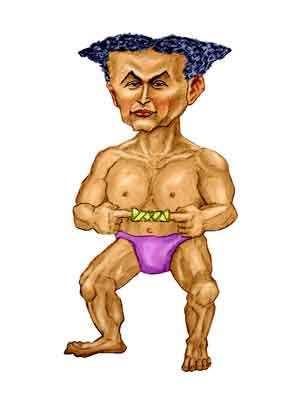
Harry
There were Oudinis, Boudinis, Undinas, and Hardeens.

But magician's - ah - "borrowing" - from fellow conjurers was not the exception. Harry Houdini took his stage name (which he later adopted legally) from the French magician Jean-Robert Houdin. And after Harry became famous there suddenly appeared various Oudinis, Boudinis, Udinas, and then there was The Great Hardeen.2
Footnote
That other magicians borrowed from his name was a constant source of irritation to Houdini. The one exception was The Great Hardeen. The Great Hardeen was the name taken by Theodore Weisz who also performed as an escape artist. Harry's ire was ameliorated because Hardeen was none other than Harry's brother, Theodore, and the two had performed earlier as The Brothers Houdini. When Harry married Bess Rahner and she became part of the act, Theodore - called Dash by his friends and family - split off on his own. Dash is not well known today but at the time he was a successful performer and outlived his brother by nearly 20 years.
As far as magicians adopting foreign stage personalties, that was common. Magicians are after all actors. And in Billy's time the "Orient" - the Middle and Far East - was considered exotic and was viewed in a positive light as a source of mysterious and secret wisdom and knowledge. Certainly, no one has ever criticized Tommy Cooper for wearing his famous fez.

Tommy Cooper
Not Criticized
(Click to zoom in an out.)
On the other hand it is easy to think that Billy went a bit further than necessary. He copied Ching's appearance so exactly that in photographs it's often difficult to tell if it's Ching or Chung. He never spoke on stage and in interviews he would speak fake Chinese with an interpreter to "translate" for the reporters.3
Footnote
Of course, what Billy said was just gibberish. The translator was usually his business manager who was Japanese.

Alexander and Adelaide Herrmann
(Click to zoom in and out.)

Alexander and Adelaide Herrmann
(Click to zoom in and out.)
Lest modern mores come down too harshly on Billy, others were quick to cash in on the Oriental craze. A German magician named Sigmund Neuberger who toured as The Great Lafayette4 also developed a Ching Ling Foo act. However, Lafayette didn't pretend to be Chinese. One of his skills was as a quick change artist and his imitations as Ching was just one of the guises he took during an evening's performance. He would start off as The Great Lafayette, then change to his Ching Ling Foo costume, and after some of those tricks, he would disappear behind a screen to immediately appear as the American March King John Phillip Sousa.

Philip or Layfayette?
(Click to zoom in and out.)
A brief study of a typical performance of The Great Lafayette illustrates how standards of acceptability and propriety have changed. One of his most famous tricks started off with what was clearly a real lion in a cage. A woman came on stage and entered the cage. The lion roared and seemed about to pounce when suddenly the lion's skin was thrown aside to reveal Lafayette.
The trick was rather involved. When the woman came on stage, the lion was real. Then the action of the assistants diverted the audience's attention from the cage. As the audience looked away and after the lion roared, other assistants temporarily blocked the view of the lion. Then a rotating panel switched the lion for Lafayette in a lion's skin. His appearance was so quick that the audience didn't notice the switch.
Of course having a live lion on stage did have its dangers. To make sure the lion would roar on cue it was given an electric shock from a plate at the bottom of the cage. This would certainly not be acceptable today and in fact the technique once landed Lafayette a fine for animal cruelty. There was also one time when the lion came close to eating one of Lafayette's pet dogs. When Lafayette came to the rescue, the lion turned on him, inflicting claw wounds in the shoulder and stomach5.
Footnote
Lafayette was actually quite the dog fancier and one of his dogs was a present from none other than Harry Houdini!
William Ellsworth Robinson was born on April 2, 1861 in rural New York to James Campbell Robinson and his wife Sarah. James was himself a stage magician who toured under the name James Campbell. That's where the "Campbell" came from in the Famous and Authoritative Reference Work. But Billy never used the name.
The Famous and Authoritative Reference Work stated that Chung Ling Soo "was an American conjurer" who gained fame in England by impersonating a Chinese magician and "began performing in the United States using the stage name William E. ('Billy') Robinson." Strictly read, this is exactly the wrong way around. William E. Robinson was Billy's real name and Chung Ling Soo was his stage name. It seems that Famous and Authoritative Reference Works ain't what they used to be.
Young Billy learned conjuring from his father and took to the vaudeville circuit while still a teenager. He was no mean performer but as he had also learned mechanical and technical skills he was able to create and maintain the equipment needed for large stage illusions. He soon found steady employment with the leading magicians of the day including Alexander Herrmann and his wife Adelaide, Harry Keller, and none other than the great Howard Thurston.
But Billy wanted to be a performer on his own and he went through a number of incarnations. These did tend to move from West to East. At first he performed as Robinson the Man of Mystery, then he became Achmed Ben Ali. Then he found an impresario in Paris who wanted a Chinese magician and so he became Hop Ling Soo.
It was while working on the vaudeville circuit that Billy met Olive Path. Despite some complications6 Billy and Olive were married in a civil ceremony. Olive - called Dot - was a tiny girl - less than five feet - and so was a perfect magician's assistant. She assumed the "Chinese name" (note quotes) Suee Seen.
Footnote
Like there being another Mrs. Robinson. When he was a young man Billy had married a lady named Bessie Smith and they had one son. Bessie, though, found the life of a traveling magician was not something she wanted particularly since Billy seems to have had, well, an "association" with another woman that - as the historians say - "produced issue". But their religious beliefs forbade legal separations and so officially Bessie and Billy remained married.
Dot and Billy put off any formal nuptials until 1906 when they were married in a civil ceremony. But they had always represented themselves as man and wife. Such a representation did make make getting hotel and traveling accommodations easier.
Later Billy seems to have yet strayed again from the path of American Magician's Family Values by keeping company with a lady named Janet Louise Blatchford. He kept company indeed and Billy became the father of three kids. Dot, though, continued to perform with Billy.
As a performer on the vaudeville circuit, Billy was often one act out of many where he might spend twenty minutes on stage but appeared as many as six times a day. But he later became the star of the show and even if there were warm up acts before him, his performance would stretch out to nearly an hour. Because Billy didn't speak during the shows he could cram in twice as many tricks as the more talkative magicians who filled up their act with patter. Thirty-eight tricks was typical for Billy - a large number even by today's rapid fire standards.
By all accounts Billy was one of the most skilled magicians on the circuit. As Chung Ling Soo, he began the act with some sleight of hands such as tearing as sheet of paper into parts and restoring them, changing a bottle of ink to clear water, and performing intricate handkerchief tricks. He then moved to bigger illusions. He would stack large boxes on top of each other only to make them disappear to be replaced by a huge bottle. Then when he opened the bottle Suee Seen stepped out!
By far Billy's most famous trick was "Condemned to Death by the Boxers" or more commonly the Bullet Catch Trick. Chung would stand before two of his assistants also dressed in Chinese garb and each holding a rifle. The rifles were then loaded; one with a marked bullet. Then Billy held a plate up in front of his chest. The assistants would then aim their guns and fire. But rather than fall to the ground instead after making appropriate theatrical flourishes Billy would show he had caught the bullet in the plate.
There was, of course, a trick to it. The gun was designed to be a typical muzzle loader and the powder and bullet were placed down the barrel. But a threaded plug had been inserted to block off the passageway connecting the percussion cap to the breech. So the powder in the barrel would not ignite and the bullet would stay in the gun.
But to make it look like the gun had been fired, the ramrod tube had been modified to hold a small powder charge where there was an open path to the percussion cap The ramrod tube was too small to hold a bullet so an accidental loading wasn't possible. But when the assistants pulled their triggers, there was enough smoke and noise to make it look like the gun had been fired. A palm switch made it look as if Chung had caught the bullet on the plate.
It's not clear if Ching Ling Foo - that is the real Chinese magician - ever performed the Bullet Catch. Some sources say yes but Melbourne Christopher, the famous magician and historian of magic, said that Ching never did.
One thing that is not in dispute is Ching Ling Foo was quite irritated with Billy assuming a Chinese name and persona that was virtually his spitting image. Finally Ching issued a challenge to Billy that was picked up by the papers:
I offer £1,000 if Chung Ling Soo, now appearing at the Hippodrome, can do ten out of my twenty tricks, or if I fail to do any one of his feats.
Billy - as Chung - replied that he as "Conjurer to the Dowager Empress of China," would not "stoop to compete with a lowly street performer." Outraged, Ching then replied that Chung was not a Conjurer to Any Chinese Empress. In fact, Ching said, Chung was not only a phony but he was worse. He was an American!
Phony or not, there were soon other - quote - "Conjuring Chinese" - unquote - on the circuit. Just as there were various Oudinis, Boudinis, and Udinas aspirants to Houdini, there were Chung Ling Sens, Chung Ling Hees, Ching Ling Fees, and Li Sing Foos setting up as imitations of Ching Ling Foo. But none were as popular as Billy performing as Chung Ling Soo.
By the end of the first decade of the 20th Century Billy - or rather Chung - was one of the most successful magicians on stage. He began putting on a performance of two hours of uninterrupted magic and - as always - without speaking.
Then in 1916 even though there was a war on - the First World War that is - Billy took off on what he announced would be a five year worldwide tour. Starting on January 5, 1917 he toured India and China (!) and by early 1918 was back in England.
On March 23, 1918, Billy appeared at the Empire Theatre in the Wood Green section of London. He did his show and it came time for the Bullet Catch. The firing squad lined up and Chung Ling Soo stood resolute holding the plate before his chest. The rifles spoke.
Billy immediately fell to the floor. "Oh my God!", he called out in perfect English, "Something's happened! Lower the curtain!"
Something had happened indeed. As reported two weeks later:
CHING LING SOO'S SECRET
Loose Screw in "Trick" Gun
That Caused His Death
The secret of Chung Ling Soo's (W. F. Robinson's) "defying the bullets" trick which caused his death on the stage at Wood Green Empire, was disclosed at the inquest.
The coroner said the gun used in the trick had been examined by an expert, and he thought the jury would be satisfied that there was no possibility of foul play.
Robert Churchill, a gun expert, who had examined the two muzzle-loading guns used in the trick, said the muzzle of one gun had been sealed up, so that the bullet marked by the audience would remain in the gun. A charge was fired through the ramrod tube which had been "faked."
The bullet used could not be placed in the lower tube as they were too large. One of the screws used to seal the plug in the gun with the empty barrel had worn loose, and this was no doubt the cause of the bullet being projected on this occasion. In consequence of the looseness of the screw, the constant loading of the gun would cause powder to dribble through and the flash of the percussion cap must have fired both charges.
The jury returned a verdict of death by misadventure.
What happened was that over the years the screw that had plugged the percussion cap tunnel had become corroded and an open path from the cap to the breech had formed. So the flame was able to reach the powder in the barrel. The bullet hit Billy in the chest, and although he was taken to the hospital he died the next day.
There were rumors - and some persist to this day - that Billy's death was no accident and due to mounting personal problems he himself may have planned his own demise. However, the finding of the investigation makes that highly unlikely. The rifle had shown corrosion, not evidence of tampering. So there's really no reason to question the misadventure verdict.
The Bullet Catch was and is one of the most dangerous tricks in professional magicians' repertory. Harry Houdini was once planning to do the trick, but Harry Keller, Billy's former boss, personally wrote Harry not to try the trick. Due to his respect for Keller, Houdini agreed to cut the trick from the act.
Bullet Catchers
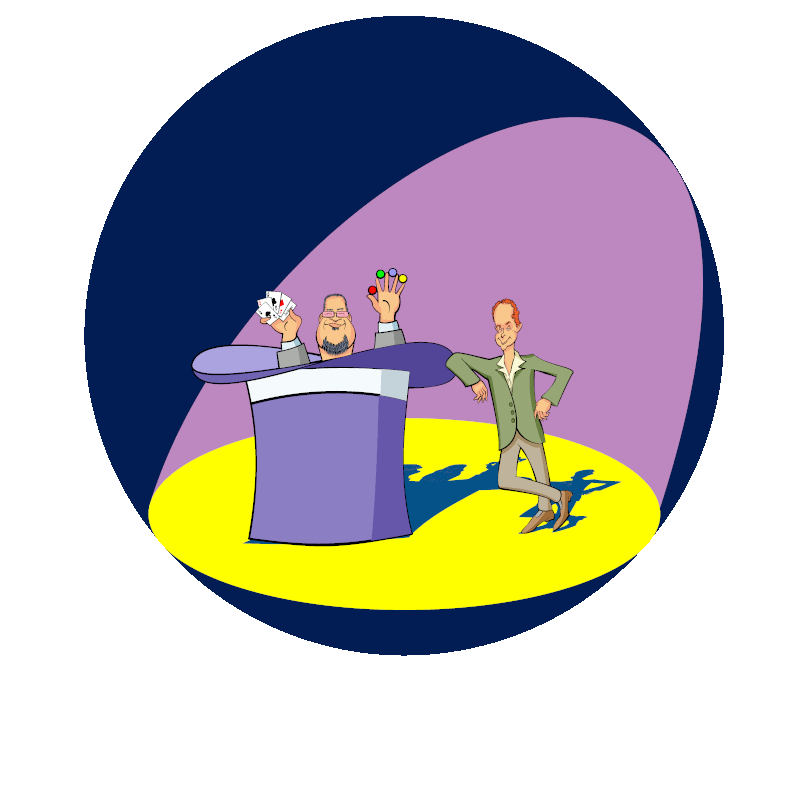
Penn and Teller
(Click to zoom in an out.)
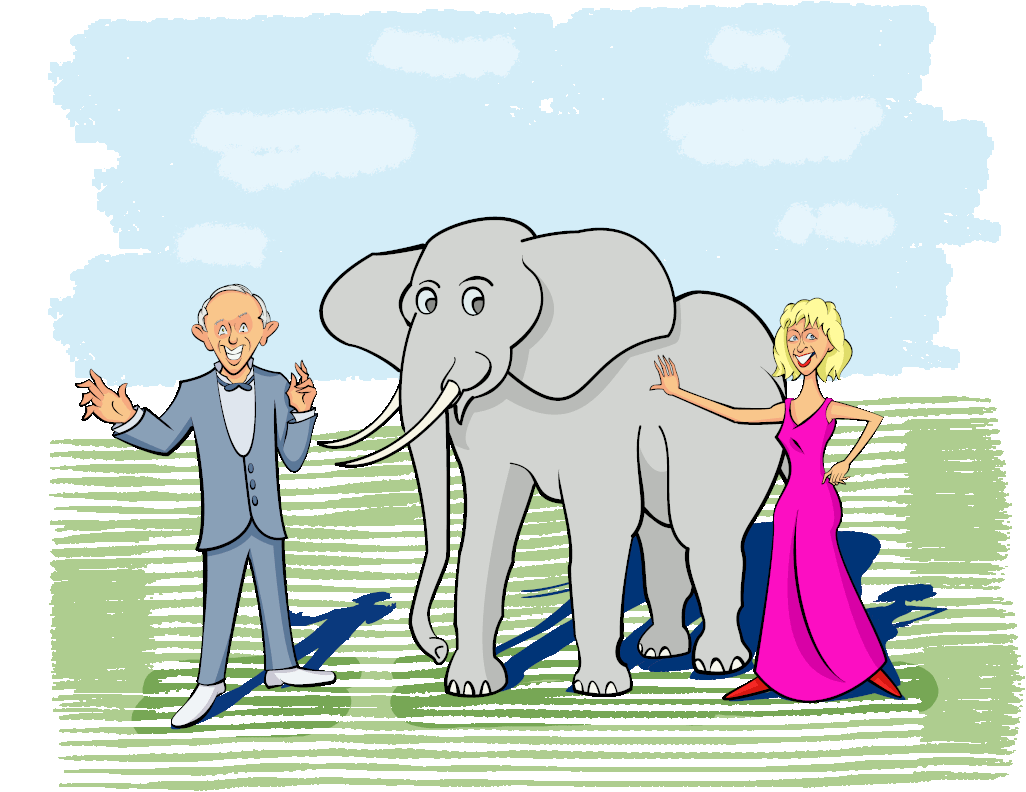
Paul Daniels
(With Debbie And Friend)
(Click to zoom in an out.)
Despite the dangers, the trick is still performed by some magicians. Among the modern stagings have been by Milbourne Christopher, Dorothy Dietrich, and Penn and Teller.
One particular performance of note was on Paul Daniel's Magic Show starring Paul and the Lovely Debbie McGee. What made this performance noteworthy was one of the assistants who lined up with the rifles was an elderly man named Jack Grossman. Jack, it turns out, was one of the "Boxers" who was on stage with Chung Ling Soo on March 23, 1918. In this case with Paul, the trick went without a hitch.
References and Further Reading
The Glorious Deception: The Double Life of William Robinson, aka Chung Ling Soo, the "Marvelous Chinese Conjurer", Jim Steinmeyer, Carroll and Graf, 2005.
Spirit Slate Writing and Kindred Phenomena, Chung Ling Soo and Harry Houdini, Munn and Company, 1898.
"Chung Ling Soo: The Magician Who Led a Double Life And Got Shot on Stage", Kaushik Patowary, Amusing Planet, September 29, 2022.
The Illustrated History of Magic, Milbourne Christopher and Maurine Brooks, Heinemann, 1996.
"The Perjured: Ching Ling Foo and Chung Ling Soo", Maosheng Hu, Shakespeare Birthplace Trust, VApril 8, 2016.
Empire of Enchantment: The Story of Indian Magic, John Zubrzycki, Oxford University Press, 2018.
"Conjuror Describes Danger of Magic", [The Philadelphia], Evening Public Ledger, April 6, 1918, p. 13.
"Chung Ling Soo's Secret", [The Philadelphia], Wilmington [Delaware] Daily Commercial, November 20, 1918, p. 11.
The Paul Daniels Magic Show, Paul Daniels (actor/magician), Debbie McGee (actor/assistant), Jack Grossman (guest), BBC, Nov 6, 1982.
"William Ellsworth Robinson", Find-a-Grave, Find-a-Grave Memorial ID: 33086825, January 20, 2009.
"Olive 'Dot' Robinson", Find-a-Grave, Find-a-Grave Memorial ID: 204174165, October 26, 2019.