Greg Norman
(And Friend)
And Duffing Down Under
(Click on the image to zoom in and out.)
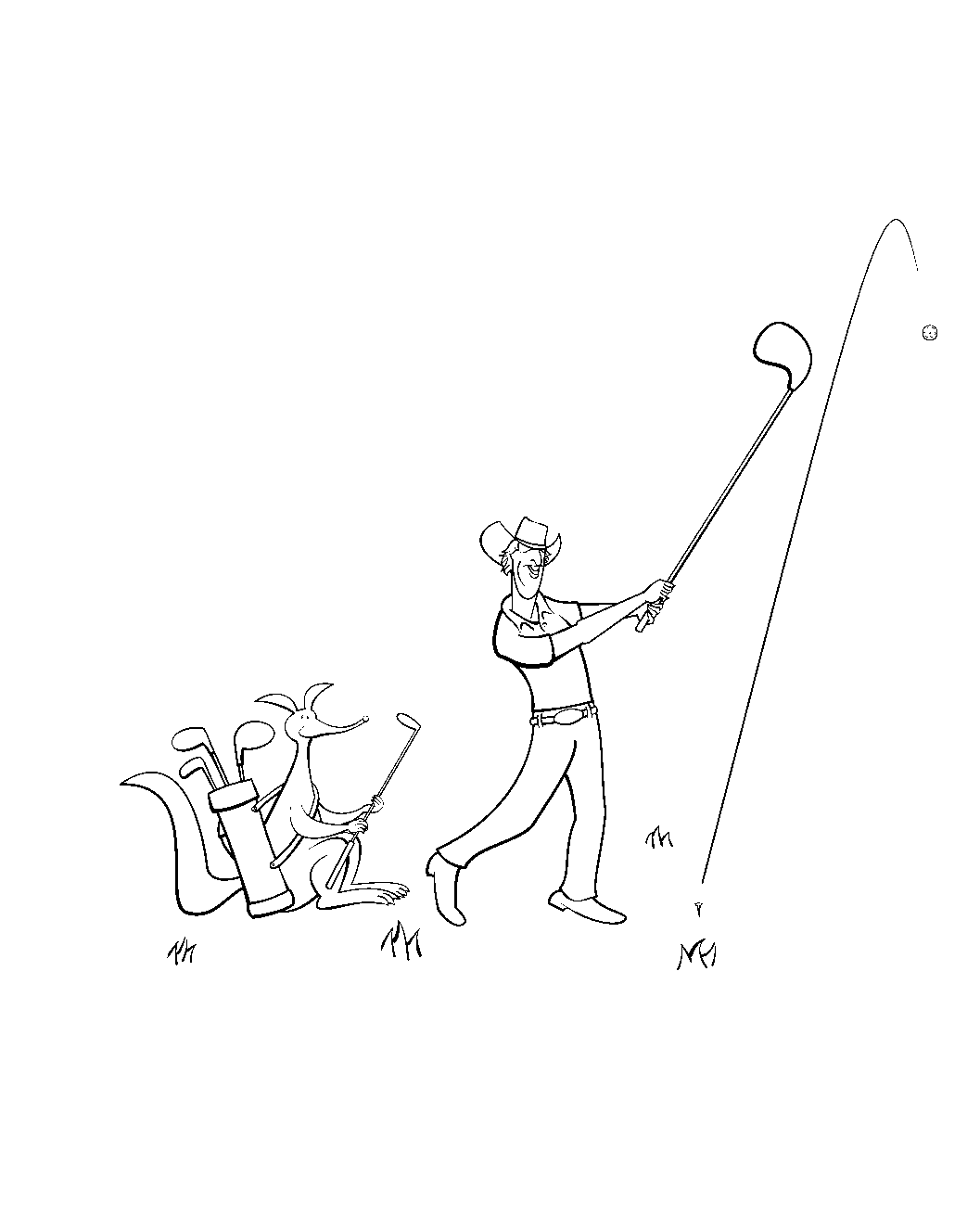
Today it takes about 20 hours to fly from Europe or America to Australia. So if a non-resident wants to enter one of the many golf tournaments in the Land Down Under, they need to make allowance for what even with today's amenities can be an experience requiring some rest and recuperation before hitting the links.
But imagine if you wanted to enter the Australian Open in its inaugural tournament in 1904. The steamship trip alone from London to Australia took about two months, although if you could take the trip via the Suez Canal you might whittle the time down to six weeks. All that to spend two days playing four rounds of golf.
Logistics notwithstanding, top notch golfers have by no means stayed away. Jack Nicklaus and Gary Player won the Australian Open six and seven times and the third of the Triumvirate, Arnold Palmer, won the tournament in 1966. One name conspicuously absent from either the winners or the tournament is Bobby Jones. Of course Bobby - despite his impressive wins in the US Open and British Open Championships - never turned professional and during his playing years all the travel to Australia had to be by boat.
The tournament arose because in 1903 the Australian Golf Union who had established the New South Wales Amateur Tournament decided that professionals could also play. The tournament - like many of the earlier bouts - was a two round match (36 holes). The next year, though, the Union organized a true open tournament as a two-day four round (72 holes) stroke play.
Bobby Jones
Conspicuously Absent
(Click to zoom in and out.)
The winner of the first Australian Open was an English amateur, Michael Scott. Yes, Michael was an amateur and he finished the tournament with 315 strokes. If the par then was the same as now, this would have been 7 over. Michael, by the way, never turned pro and he won the Australian Open again in 1907. In 1933, at age 55, he won the British Amateur making him the oldest winner of that tournament to date.
Scotland, of course, is where most people think of as the Land Where the Links Began. Sadly, though, determining the origins of this most venerable of games isn't that easy. Games in which sticks were used to direct the motion of balls have been legion and the origins and locations are lost to history. There was a Chinese game called Chui Wan, 捶丸, which means something like "thump the ball" where the goal seem to have been to knock a ball into a hole in the fewest strokes. There are possible references to the game as long ago as the Song Dynasty (960-1279) but the game was definitely played during the time of the Ming rulers between 1368 and 1644. As far as scholars can put together the rules, Chui Wan seems to have been something like the "pitch and putt" of today.
Although the Netherlands also lay a claim to the game and point out that in Dutch "kolf" means "club", it does seem that the Scots were the ones to bring the game from a simple pastime played in the heathers and fields where the livestock kept the grounds conveniently cropped and transformed it to a true competitive sport. One of the earliest golfers was none other than the Scottish King James IV (1473-1513). In fact, there's the possibility that King James is buried under the fairway of a famous golf course in London
But what may raise the ire of the Albannach residents of the Empire Upon Which the Sun Used To Never Set is that the Colonials claimed that the modern game arose from Yankee ingenuity - yes, we're talking about Colonials in the United States of America. References to the game can be found in the mid-1600's in upstate New York although admittedly the game was mostly played in the British and Scottish communities. But the game was also popular in the South particularly in the Carolinas and Georgia.
However, in the 18th Century the game definitely picked up steam in the British Isles. Rules were finally written down for a tournament at Leith Links in Edinburgh in 1744. There were a total of 13 rules, and among the regulations were:
- Your tee must be on the ground.
- If a Ball be stopp'd by any person, Horse, Dog or anything else, the Ball so stopp'd must be play'd where it lyes.
- At Holing, you are to play your Ball honestly for the Hole, and not play upon your Adversary's Ball, not lying in your way upon to the Hole.
- If you draw your Club, in order to strike and proceed so far in the Stroke, as to bringing down the Club: If then your Club shall break, in any way, it is to be Accounted a Stroke.
Back in America the game faded after the War of 1812 - possibly because the Invasion by the British brought about aversion to All Things from Blighty - and didn't really come back into vogue until the 1880's. Things got really serious in 1894 with the formation of the United States Golf Association whose goal was to regulate and standardize the game. Not coincidentally the next year, 1895, saw the beginning of the U.S. Open, the U.S. Amateur, and the U.S. Women’s Amateur (yes, the ladies were playing the game quite early). In 1899 and back in Scotland the Royal and Ancient Golf Club of St. Andrews also codified their rules.
So it was only after the Fin de Siècle that the game really began to take off. In 1916 the Professional Golfers' Association of America - the PGA - was founded to promote the professional game. Today the PGA Tour is independent of the PGA of America and there are PGA events spread out over the globe. All in all the PGA organizes over 700 tournaments a year and four - the Masters Tournament, the PGA Championship, the US Open, and the Open Championship (in England) - are designated as the PGA majors.
Although the Australian Open is an official PGA event it wasn't until 1947 that an Australian actually won a major. That was when Jim Ferrier took the PGA Championship at the Plum Hollow Country Club in Southfield, Michigan, just outside of Detroit. Jim, though, had been living in the United States since 1940 and even served in the US Army during World War II.
Jim went on to win 36 tournaments - a quite respectable record even by today's standards - and Jim also has the distinction of being the only golf pro to have traded barbs with Groucho Marx when he was a contestant on You Bet Your Life in 1955.
| Groucho: | I play golf, too, you know. What is your handicap, Jim? |
| Jim: | Well, as a pro, I don't have a handicap. |
| Groucho: | Well, congratulations. How is it a tall, handsome man like you isn't married? |
| Jim: | Oh, I'm married. I have a wife. |
| Groucho: | You just said you didn't have a handicap. Haven't you got the same handicap that fifty million other men have? |
| Jim: | Well, I don't consider my wife a handicap. | Groucho: | Well, you had a bad lie, Jim, but you recovered very nicely. |
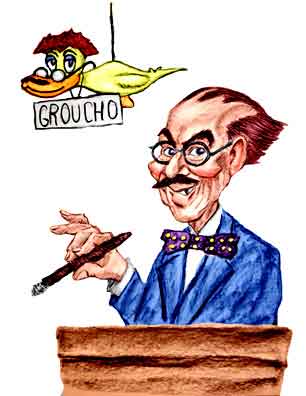
Jim, by the way, won the Australian Open twice: 1938 and 1939. But he did so when he was still an amateur.
Today, though, a recent ranking lists Gregory John Norman as the #1 Australian golfer of all time even though some point out that he has"only" won two major tournaments. Those were the 1986 and 1993 Open Championships in Britain. On the other hand, Greg's fans point out that he has chocked up a total of 88 tournament wins and these include the Australian Open in 1980, 1985, 1987, 1995, and 1996. Twenty of Greg's 88 wins were on the PGA circuit.

But more to the point Greg has amassed 331 total weeks as the #1 World Ranked Golfer. This is second only to a gentleman named Eldrick Tont Woods who was ranked #1 for 683 weeks.
Before Greg came on the Golf Scene, the most famous and successful Australian golfer was undoubtedly Peter Thomson. Peter was most active during the 1950's and 60's but continued playing well past the Millennium. During his career he racked up a total of 104 tournament wins with five majors, winning the Open Championship in England in 1954, 1955, 1956, 1958, and 1965. But Peter was never ranked #1 since at that time there was no official #1 ranking. Today's Official World Golf Ranking or OWGR only started up in 1986.
Of course, Abigail Adams admonished her husband John not to forget the ladies1, and Australia boasts many women who ably play the rounds. We can mention Margie Masters, Wendy Doolan, Katherine Kirk, Hannah Green, Karen Lunn, Corinne Dibnah, Rachel Hetherington, Minjee Lee, and Jan Stephenson.
Footnote
What Abigail wrote was:
I long to hear that you have declared an independency - and by the way in the new Code of Laws which I suppose it will be necessary for you to make I desire you would Remember the Ladies, and be more generous and favourable to them than your ancestors. Do not put such unlimited power into the hands of the Husbands. Remember all Men would be tyrants if they could. If perticuliar care and attention is not paid to the Laidies we are determined to foment a Rebelion, and will not hold ourselves bound by any Laws in which we have no voice, or Representation.
That your Sex are Naturally Tyrannical is a Truth so thoroughly established as to admit of no dispute, but such of you as wish to be happy willingly give up the harsh title of Master for the more tender and endearing one of Friend. Why then, not put it out of the power of the vicious and the Lawless to use us with cruelty and indignity. Men of Sense in all Ages abhor those customs which treat us only as the vassals of your Sex. Regard us then as Beings placed by providence under your protection and in immitation of the Supreem Being make use of that power only for our happiness.
John, it must be pointed out, quickly replied:
As to your extraordinary Code of Laws, I cannot but laugh. We have been told that our Struggle has loosened the bands of Government every where. That Children and Apprentices were disobedient - that schools and Colledges [John didn't always spell so good] were grown turbulent - that Indians slighted their Guardians and Negroes grew insolent to their Masters. But your Letter was the first Intimation that another Tribe more numerous and powerfull than all the rest were grown discontented. - This is rather too coarse a Compliment but you are so saucy, I wont blot it out.
Depend upon it, We know better than to repeal our Masculine systems. Altho they are in full Force, you know they are little more than Theory. We dare not exert our Power in its full Latitude. We are obliged to go fair, and softly, and in Practice you know We are the subjects. We have only the Name of Masters, and rather than give up this, which would compleatly subject Us to the Despotism of the Peticoat.
There is, of course, the great Karrie Webb. At this writing Karrie has amassed a total of 74 tournament wins which include the British Women's Open, the PGA Women's Championship, and the US Women's Open. She began winning tournaments from the start and was eligible for the Ladies Professional Golf Association Hall of Fame at age 25. However, according to the rules she had to wait until she had been touring for 10 years.
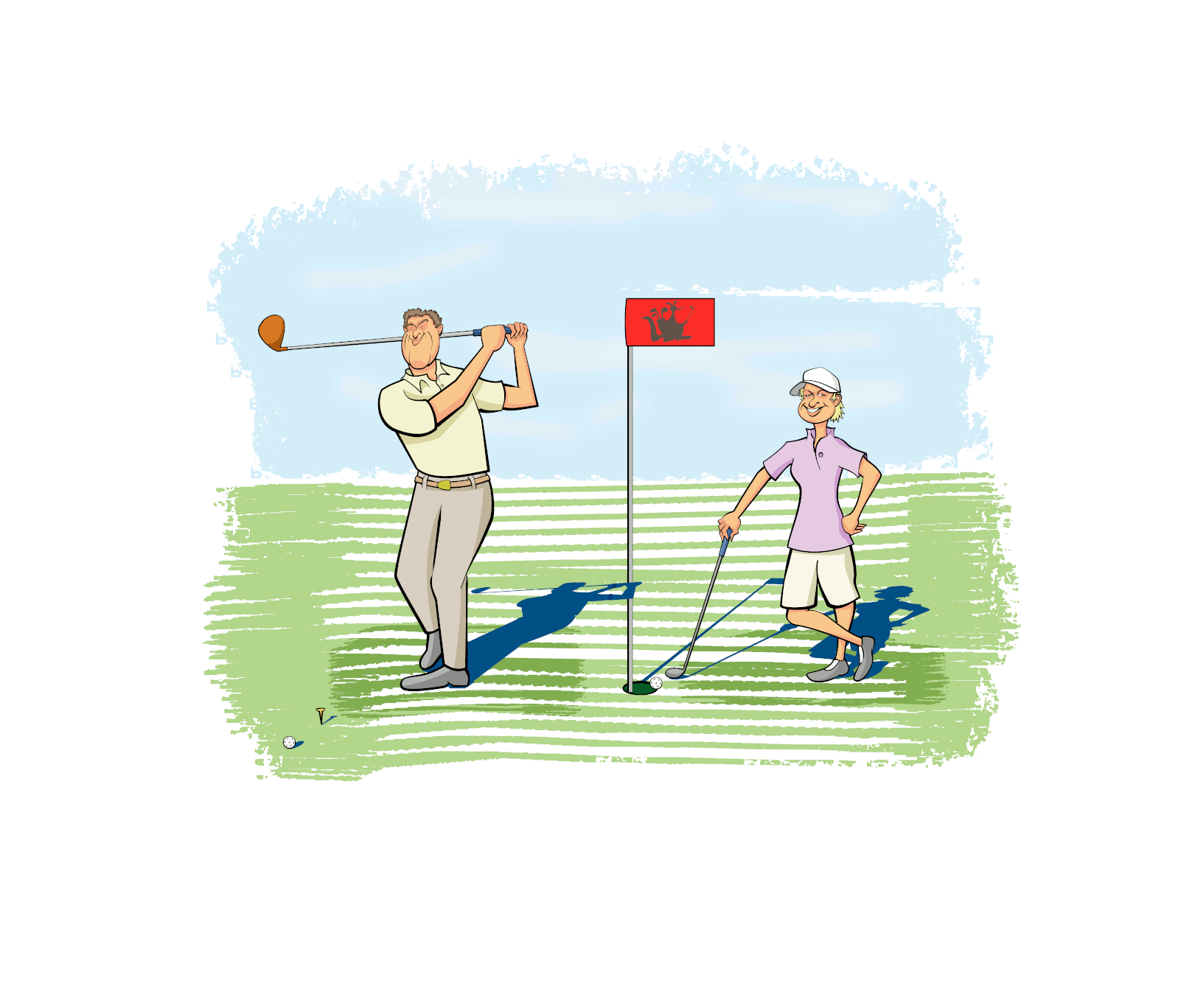
Peter and Karrie
Top of the Down Unders
(Click to zoom in and out)
Scholars of sports are quick to point out that trying to compare the ability of sports figures over the decades is nigh on an impossible task. Changes in the rules and technology make a comparison even spanning a few years questionable.
Before golfing became big time the professional golfer, like professional bowlers, often had to have secondary employment. Although the second job might be as a club pro, that did mean a good deal of the time was spent in the shop and in instructing the members and guests. So there was a limited amount of time they could dedicate to practice. The prizes, too, were often not that great with winnings that sometimes barely covered expenses. Of course, today the pros have more time to hit the practice tees, and club professionals play in tournaments. It need not be mentioned that the prize money has also creeped upward with today's winner of a major picking up perhaps $4 million. Back in 1930 the winner of the US Open won $1000 and so the winners today enjoy a 399,900 % increase in compensation Even correcting for inflation that's still a comfortable 98 % increase.
Rules and customs also change. Par was not even part of golf's metrics until 1911 and wasn't considered a reference point in many championship scores until the late 30's or early 40's. So golfers only thought about the number of strokes they played rather than the number of strokes they should play.
However, the definition of the word should can sometimes be as ambiguous as the definition of the word is. And by the actual definition, shooting par requires quite exacting skills.
Par was (and is) defined as the number of strokes to cover the course by an expert player. Yes, by an expert player. There are some general rules that establish the strokes, but usually there is the tee shot, one or two fairway shots to reach the green, and sinking the putt in two. Depending on the terrain and the individual hazards for specific holes the designated strokes for par can be adjusted higher or lower. Par also assumes the games are played in good weather.
A surprise to many golf fans - and a good trivia question - is the original meaning of making a "bogey". The term originated in England where the golfers imagined they were playing against a perfect player who never dropped any shots. They called this perfect player Mr. Bogey.
So playing bogey originally meant shooting par. The United Services Golf Club then adopted the term. But instead of Mr. Bogey, Americans played against Colonel Bogey.
The word "par" though had long been used to refer to stocks and bonds that were performing as expected. Possibly because many stock brokers in America were avid golfers, playing golf as expected became playing par. The word became official in 1925 and the British soon adopted the word. Now everyone talks about shooting par although in the 1960's you could still find golf courses outside of the United States that still posted "bogey" for the hole rather than par.
So those who find themselves bemoaning their golf scores can find some comfort that par is the score expected of the expert player who makes no mistakes and encounters no unusual hazards. That is you get to the green in two to three strokes and never three-putt.2
Footnote
Of course, there are par three holes and par sixes. The most famous par 3 hole is probably the 16th hole at the Cypress Points Golf Club. To make par you hit the tee shot across a leg of the ocean - yes, you tee off across water - and land on the green more than 200 yards from the tee. Many a ball - even hit by professionals - ends up in the Pacific.
A safer shot is to drive to the left of the green about 100 yards and land on the nearer part of the fairway. The golfer can be guided by hitting toward an old weather-blown tree - now propped up by a metal bar. Then to make par you only have two shots to hit to the green and then sink the putt.
Of course, making an eagle requires a hole-in-one (which has happened). The beginner will probably hit the tee shot and then after it falls into the ocean take a penalty stroke. One criticism of the design is that shooting toward the near fairway is actually the shot the golfer should make and so the hole should be a par 4.
The Cypress Point Course was designed by Alister Mackenzie, a British surgeon turned golf course architect. At first he did think that the hole should be par 4. But Marion Hollins who was an expert woman amateur player disagreed. To prove her point she teed up her ball and whacked a drive across the water to the green and then two-putted for a 3.
Unfortunately not everyone can play the 16th at Cypress Point as it is a quite exclusive private club. At one point it was one of the courses of Bing Crosby's famous Pro-Am tournament which later became the AT&T Pro-Am but it was dropped from the circuit in 1990. Of course, it still hosts other tournaments, most recently the Walker Cup.
The difficulty of shooting par can be understood by looking at the scores of the top professionals - that is, by looking at their scores for all their tournaments and not just those they win. If you tally up the scores for some of the famous pros you might loudly and teemingly express surprise that they actually average above par.
The concept of shooting par is also useful in understanding why one golfer may win a tournament by 12 strokes and lose by 10 strokes a week later. It's simply a matter of cumulative effects of near equal players.
For instance, in one of the most famous tournaments ever, the winner - who we mentioned above - won with 270 strokes during the four rounds of the 72-par course. That was 18 under par and 8 strokes better than the runner up who actually shot six-under. The last place finisher shot 303 and so was 33 strokes behind the leader.
But if put on a par performance per hole things show that the players were all still quite capable. The winner was shooting -0.25 strokes per hole while the loser was +0.46 strokes per hole. Compare this to George Plimpton - the writer who was a "professional amateur" - averaged +1 per hole. When he played in the Bing Crosby Pro-Am and was paired with professional Bob Bruno, George ended up "picking-up" on a good proportion of his holes..
OK. Par is par, but what happened to "bogey"? Well, once par became the word of choice for the play of an expert, bogey became to mean the score of a "recreational" player. Now of course bogey means one over par for the hole and so this would imply a recreational player should have an 18 handicap - like George.
Of course the skilled golfer can shoot better than par by holing a birdie or even an eagle. And you can go the other way and make a bogey, double bogey, and in one prestigious tournament one of the greatest golfers in the world shot a twelve on a par 5 for a septuple bogey. The septupling bogier was none other than Arnold Palmer.
But the record for a championship golfer reported for a single hole was during the 1927 Shawnee Open at the Shawnee Inn and Golf Resort in Shawnee-on-Delaware, Pennsylvania. This was when Tommy Armour - who was Scottish - where the story gleefully tells of how he took 23 strokes on a hole by repeatedly hitting the ball out of bounds. Although at that time scores weren't often rated by pars this is often cited as 15 over for a quindecuple bogey.
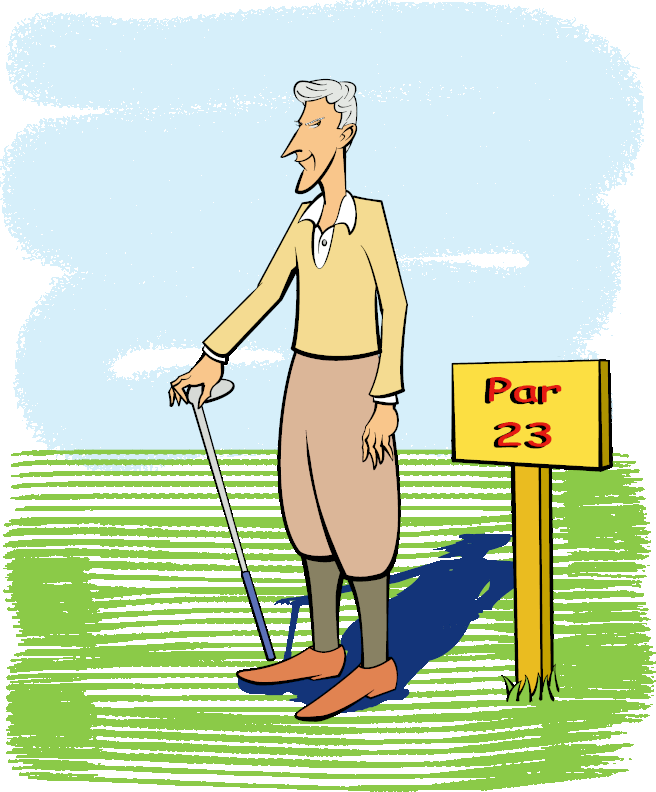
We said that was the highest score reported. After many years a scholar finally pointed out that the records show Tommy really hit an 11 on the par-5 17th and ended up with a 312 for all 72 holes. So Arnold actually has a higher single-hole score.
But the winner, Jim Farrell, had a stellar day winning with a 279 which was 10 strokes better than the runner up. Tommy ended up 33 strokes behind Jim and a number of writers pointed out - people sometimes liked to trash Tommy - that only the week before Tommy had won the US Open where he beat Jim by 7 strokes. Tommy closed out the tournaments with 301 strokes which was 13 over par. This was also the last time the tournament was won by more than 300 strokes.
[Note: At this writing a breaking news story reported that the American golfer John Daly - winner of the PGA Championship in 1991 and the British Open Championship in 1995 - hit a 14 over on the par 5 Hole #12 for a total of 19 strokes at the Sioux Falls, Minnesota, Minnehaha Country Club during the Sanford International Tournament on the PGA Tour Champions (formerly the PGA Seniors Tour). His first shot was from the tee into the rough and most of the others were from the rough into the rough. He had to take seven penalty shots and ended up with an 88 for the 18 holes. That was 18 over par. Of course, this was a "seniors" tournament and so a few extra strokes are expected.]
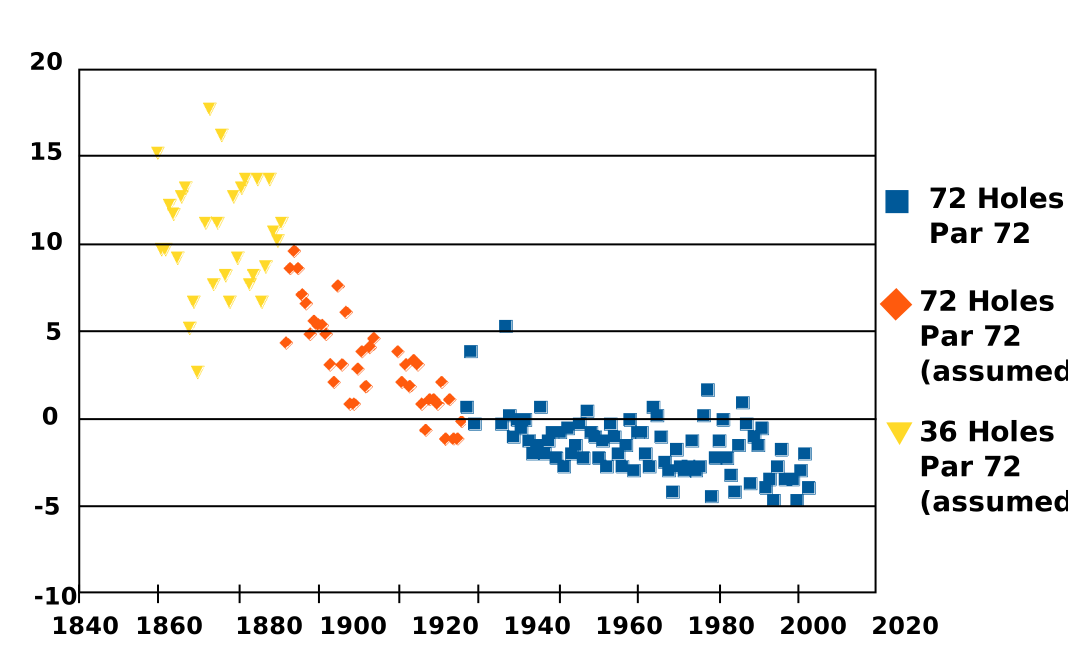
Tommy, we should point out, played in an era where the scores were high. Today winners of the professional tournaments consistently shoot below the expectation - sometimes impressively so. But this wasn't always the case. A look at the winning scores of the British Open is most instructive. Certainly the scores - adjusted for par even when par didn't exist - illustrates the impossibility of comparing players whose heydays were only a few years apart, much less decades. (To open the graph in a new window, click here.)
Winning Scores |
|
| Score Above Par |
 |
The Dutch word "kolf" notwithstanding, the origin of the name of the game still elicits discussion. Fans of The Hobbit remember the story about the orcs of Mount Gram who were led by their King Golfimbul when they invaded the Shire in 1147 Shire Reckoning. Bandobras Took - known as the Bullroarer - met the orcs with a force of hobbits at the Battle of Greenfields in the Northfarthing. Bandobras led the charge and with his club knocked the head off of Golfimbul. It sailed 100 yards and went down a rabbit hole. So Bandobras not only won the battle but invented the game of golf at the same time.
Hobbit scholars have debated the apparent etymology of the name "Golfimbul" and its relation to the sport. "Golfimbul" may be of Scandinavian origin, a combination of gol ("wind") and fimbul ("mighty" or "great") and so it could mean something like "powerful wind". Another scholar pointed out that the name could be an English translation of the hobbit language. Of course, such discussions are done in good spirits as The Hobbit is, after all, a work of fiction and the whole thing is just a joke.3
Footnote
Hobbit scholars have pointed out that J. R. R. Tolkien was planning a revision of the Hobbit to make it more serious. The original book was a fairly light hearted tale which contrasted with the more serious style of the later books of the The Lord of the Ring. So Ronald may have been planning to drop the name Golfimbul and remove its connection to the game of golf. Fortunately for Hobbit fans everywhere, this revision was never completed.
However, there was a revision to The Hobbit made after the publication of The Lord of the Rings. In the first edition, Gollum bets his Ring on the Riddle Game when he meets Bilbo. That is he was going to give Bilbo a present if he won. But this did not fit the story as told in The Lord of the Rings. So Ronald revised The Hobbit to where if Bilbo won Gollum would show him the way out of the caves.
References and Further Reading
"Ranking: Australia's 50 Greatest Golfers of All Time", Australian Golf Digest, October 31, 2020.
"1904 Australian Open, The Australian Golf Club, 2-3 September, 1904, Golf Archive Australia.
"History 2017 Nuggets", History Nuggets, Australian Golf Heritage.
"Golf Questions You're Afraid to Ask: Who Invented Golf, and How Did It Become So Popular?", Jackson Wald, Golf, September 26, 2020
"Earliest Recorded Rules Of Golf at Leith", Leith Rules Golf Society 1744.
"The Highest Score Ever Recorded on One Hole on the PGA Tour History and How It Happened", Sam Stone, Golfing Gazette, November 29, 2024.
"The Real Story of Tommy Armour's Single-Hole Score of 23", Golf Compendium.
"The Most Historically Significant Golf Tournaments Ever Played", Michael Fitzpatrick, Bleacher Report, June 4, 2018.
"Our Tournaments", The Progressional Golfers Association.
"The Sad Tale of James IV’s Body", Tony Pollard, BBC, September 9, 2013.
"Green", Qi, Stephen Fry (host), Alan Davies (permanent panelist), Bill Bailey (guest panelist), Danny Baker (guest panelist), Jeremy Clarkson (guest panelist), Ian Lorimer (director), John Lloyd (creator), BBC, March 2, 2010.
"The Spatial Organization of Transportation and Mobility Maritime Journey From Britain to Australia, 1788-1960", Jean-Paul Rodrigue, The Geography of Transport SystemsThe Geography of Transport Systems, November 11, 2017, (Updated: January 20, 2022).
My Dearest Friend: Letters of Abigail and John Adams, John Adams, 2007.
You Bet Your Life, Groucho Marx (presenter/host), George Fenneman (announcer), Jim Ferrier (guest), NBC, Jan 6, 1955.
"Bill Casper vs. Harry Bradshaw", Shell's Wonderful World of Golf, Gene Sarazan (host), Billy Casper (player), Harry Bradsaw (player), 1963.
"Golfimbul", Tolkien Gateway.
"John Daly Records the Highest Score in PGA Tour Champions History with Crazy 19 (!)", Alex Myers, Golf Digest, September 12, 2025
Golf Compendium