Satchel Paige
(Click on the image to zoom in.)
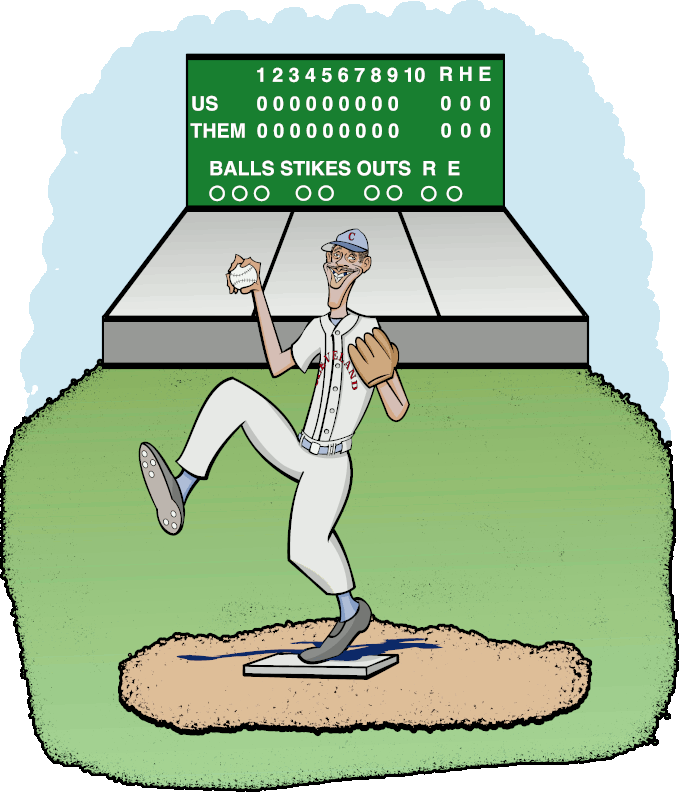
Baseball fans everywhere know Satchel Paige. In 1948 he became the oldest rookie in Major League Baseball when he joined the Cleveland Indians. But more to the point he was the first Black American to pitch in a Major League Baseball game.
Satchel was born in Mobile, Alabama, in a year which remains in dispute. Contemporary scholarship, though, seems to have converged to July 7, 1906, although there seems to be a three-to-five year margin of error. His birth name was Leroy Robert Page without the "i". His mother, Lulu, later added the extra letter to make the name more distinctive.
Young Leroy grew up with seven, eight, nine, ten, eleven, or twelve brothers and sisters in what can only be called abject poverty. He worked at various odd jobs including being a porter at the local railway station. Satchel said by using a cord tied around his waist, he rigged himself up to carry multiple valises, suitcases, and satchels. Someone said he looked like "a walking satchel tree". So the name stuck.
Here it must be admitted that stories about Satchel show considerable variability. Another story is his nickname was derived from Louis Armstrong's nickname "Satchelmouth". Louis, of course, was better known by the abbreviated rendering of "Satchmo".1
Footnote
As to how "Satchelmouth" morphed to "Satchmo", Louis himself said it was when he and his group were on tour in England.
You know, musicians in my day had nicknames. My name was "Satchelmouth," like a doctor’s satchel. When I went to England this fellow was strictly English, and he was editor of the newspaper there. He shook my hand after I got off the train and said, "Hello, Satchmo." So right away my trombone player said, "Mmm, the man thinks you have more mouth than Satchelmouth." So I was stuck with it, and it turned out all right.

Louis Armstrong
(Click to zoom in and out.)
Among these variable accounts is the manner in which Satchel was introduced to America's pastime. One story is that he started off playing on a grade school team. Satchel had shown no particular ability but during one game the team was doing so rotten that the coach sent him to the mound even though he had never pitched before. Satchel won the game easily and so became the team hurler.
Although Satchel picked up some extra cash with his jobs, he also supplemented his income by minor but irregular acquisitions. At age 12 (some sources say 13) this practice landed him a spot in what is now called juvenile detention but at the time was officially the Alabama Reform School for Juvenile Negro Law-Breakers. This was just outside of Mobile, and in 1947 the name was changed to the more positive sounding Alabama Industrial School for Negro Children. Today the institution is still functioning as the Mount Meigs Campus.
Although at the school the regimen of rigorous vocational training for Satchel was supposed to "straighten him out" (as the follicularly hindered in Quaint American locations often say) there was some time set aside for recreation. Of course at that time recreation was synonymous with outdoor recreation and that for all intents and purposes that meant baseball. There Young Satchel soon demonstrated his prowess for pitching.
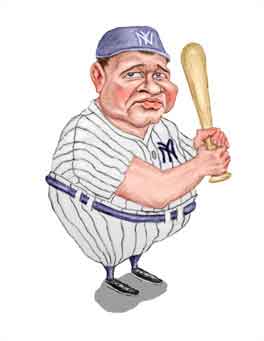
A Young Waif
Of course, school baseball teams played against each other but sometimes they got good enough to compete against the local civic leagues. It was also common for baseball scouts to attend the games to look for exceptional players for the professional teams. This was how a young "waif" with a similar background to Satchel's named George Herman Ruth got his start.2
Footnote
In 1902 Babe was seven years old and had become such a, well, such a "handful" that his parents had him declared incorrigible, vicious, and beyond their control. They placed him in the St. Mary's Industrial School for Boys and he became the responsibility of the Baltimore's Congregation of the Brothers of Saint Francis Xavier.
Babe became the star pitcher on the school's team and after he graduated he joined the Baltimore Orioles of the International League. Later he was signed up by the Boston Red Sox who in 1919 and what some believed was a most ill-advised decision traded the Babe to the New York Yankees.
Out on his own Satchel began playing for a local semi-professional team and it soon became evident that he was capable of full-time pitching. His first true professional job was playing for the Chattanooga White Sox which was the farm club for the famous Pittsburgh Homestead Grays. But rather than move up to the Grays, Satchel was traded to the Birmingham Black Barons which was a major league team in the Negro Leagues.
At first Satchel's play seemed capable but erratic and he moved around the league (even playing for some time in Cuba). In fact from 1927 to 1943 he played for at least eight teams, spending only a year or two with any given organization. Then in 1944 he moved to the top-notched Kansas City Monarchs where he played for three seasons.
Then in 1946 Branch Rickey who was the General Manager of the Brooklyn Dodgers signed Jackie Robinson to play for the Dodger's farm club, the Montreal Royals. Then in 1947 Jackie began playing for the Dodgers, and it was the next year that Satchel went to Cleveland.
When Satchel joined the Majors he was 42 years old but he nevertheless played a respectable five years. But as before his tenures on any given team were brief and he played for Cleveland for two years and and the St. Louis Browns for three. He retired in 1953.
So the question always comes up. Just how good was Satchel?
In his later years, Satchel said that his fastball had been over 90 miles an hour. True, 100 mph fastballs are fairly common today, but even as late as the turn of the Millennium, 90 mph was the average for major league pitchers. Nowadays the fastball speeds have inched up to average 94 mph but some MLB fastballs are only in the 80's. So if Satchel's number is correct, then he pitched hard.
It has to be admitted that Satchel's style was a bit unorthodox and some of his more creative pitches wouldn't be allowed today. One of his favorites was the "Hesitation Pitch" where he would pause briefly in the middle of the windup. Joe DiMaggio once referred to it as a "change-up" but today it would likely be ruled a balk. In fact, when Satchel was pitching in the World Series in 1948, umpire George Barr ruled the Hesitation Pitch as such.3
Footnote
In baseball there are limits on the way the pitcher can move while on the mound. Specifically the pitcher can not move in a way that can deceive the baserunners as to what he, the pitcher, intends to do. Otherwise the runners might be unfairly kept from advancing to another base, particularly via a stolen base. So if a pitcher is ruled to have balked, all runners can advance.
In it's earliest conception in 1898, a balk was any motion the picture made to deliver the ball but he fails to throw it. But because the moves the pitchers make are legion, the balk rule has grown since its inception. Today it is considered a balk if the pitcher:
- Makes any type of pitching motion without a foot touching the pitching plate (ergo, the pitching "rubber").
- Starts pitching but doesn't throw.
- Pretends to throw to first base.
- Throws to a base but does not step toward the base.
- Throws or pretends to throw to an unoccupied base.
- Makes an illegal pitch.
- Pitches the ball without facing the batter.
- Delays the game.
- Stands over or on the pitching plate without holding the ball.
- Does not come to a complete stop before the wind-up or set-up.
- Takes a hand off the ball after the set-up or wind-up before releasing the pitch.
- Drops the ball while touching the pitching plate.
- Pitches without the catcher being in position.
- Fakes a throw to third base but follows by a real throw to first.
What caused much consternation among pitchers is the last rule - the fake to third and the throw to first - used to be perfectly legal. The idea was that the runner on first would think the ball was going to third and so would try to steal second. So he would jump off first at the fake throw but the pitcher would then swing around and toss to first. So the first baseman would then pick the runner off if he dived back to first or the first and second basemen would trap the runner between them.
The rationale was that the fake-to-third-throw-to-first so rarely resulted in the runner being called out that the move just wasted time. One pitcher said that out of 100 tries he maybe picked off the runner twice. However, it is still legal for the pitcher to fake a pitch to second base and then throw to first.
But to fully judge Satchel's capabilities you have to look at all of Satchel's career, not just his years in Cleveland and St. Louis. And most of his career was spent in the Negro Leagues. True in some sports the teams outside of mainstream professionals harbor players of lesser ability. This, though, was not true of the Negro Leagues. A typical player in the Negro Leagues could have held his own with the white players of the Majors. And the stars could, and often did, equal or exceed the ability of their MLB counterparts.
In fact, recently Major League Baseball has begun including the records of the Negro Leagues and Satchel's statistics are very interesting. Although the official MLB wins of Satchel were - originally - only 28 which included 7 complete wins together with 476 innings pitched and 147 strikeouts. But adding the totals from his time in the Negro Leagues, the numbers jump to a respectable 124, 82, 1751, and 1501.
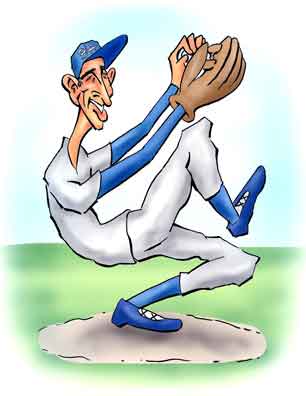
Sandy Koufax

Preacher Roe
(Click to zoom in and out.)
Good ERA's
(But Satchel's was better.)
As far as his pitching, Satchel had a career earned run average (ERA) of 2.73. This is definitely better than average where MLB ERA's between 3 and 4 are considered good. So Satchel's ERA was better than Tom Seaver (!), Whitey Ford (!!), Nolan Ryan (!!!), and Sandy Koufax (!!!!). Satchel's win-loss ratio was 124-82 or 60%, a percentage as good or better than Preacher Roe, Walter Johnson, Mike Cuellar, and Bob Gibson (!!!!!).
Also Satchel's shutout percentage of games started was 15%. That is, in 15 out of 100 of his games where he started, the other team did not score. That's the same as Grover Cleveland Alexander and ranks above the SHOP of Christy Mathewson (14%), Sandy Koufax (12%), Bob Gibson (12%), Don Drysdale (11%), Cy Young (9%), Tom Seaver (9%), Bob Feller (9%), Gaylord Perry (8%), Nolan Ryan (8%), and Roger Clemens (6%). Not bad for Mr. Paige.
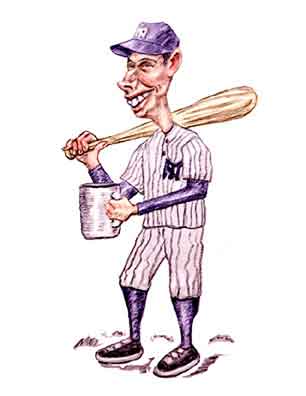
Joltin' Joe
He didn't mince words.
In the end there were too many people who rated Satchel among the best to say his reputation was inflated. When Ted Williams was inducted into the Baseball Hall of Fame he said "I hope that someday the names of Satchel Paige and Josh Gibson in some way could be added". Ted, we need not mention, was not a man who said something if he didn't mean it. Joe DiMaggio said that Satchel was the best and fastest pitcher he ever saw. Joe was also not a man to mince words.
But still, like many celebrities, once he retired Satchel began to fade from the American collective consciousness. As the Nifty Fifties merged into the Swinging Sixties, older people wondered what ever happened to Satchel Paige while a lot of younger people never knew he existed.
Then in 1965, Charlie Finley, the owner of the Kansas City Athletics, was struggling with falling attendance and a non-winning baseball team. Things seemed to hit the nadir on September 23, 1965 when a whopping 690 fans showed up in a ballpark with a seating capacity of over 35,000 to watch the Athletics battle the Washington Senators.
Charlie, it must be admitted had a reputation for being a bit cantankerous and one sportswriter referred to him as a self-made millionaire who worshipped his creator. But Charlie was an original thinker and he knew that in Kansas City, the home of the recently disbanded Kansas City Monarchs, Satchel still had his fans. So Charlie decided to host a Satchel Paige Night on September 25. Maybe that would beef up the attendance.
But rather than just have some pre-game ceremonies where Satchel would be given a plaque, Charlie decided he'd have Satchel actually pitch against the Red Sox. So he asked Satchel if he could handle, say, three innings. "That depends," Satchel replied. "How many times a day?"
So at age 59 (or thereabouts), Satchel signed a one game contract for $3500. That wasn't that bad pay considering the average yearly salary of an MLB player in 1965 was $14,341 for 162 games.
Cantankerous or not, Charlie's strategy worked. Instead of a few hundred spectators, 10,000 fans showed up, most of them to see Satchel pitch.
Satchel came up for the first three innings. The only Red Sox batter to make a notable hit was when Carl Yastrzemski, then in his prime, hit a double. But Carl was left stranded on second when the next batter flied out.
So how was Satchel's pitching in the game? Well, he avoided hurling his fastballs and the Red Sox catcher said his pitches were slow. But he kept getting outs and his three innings were scoreless. When Satchel left the mound at the start of the fourth inning, the crowd gave him a standing ovation.4
Footnote
The Athletics held the lead until the seventh inning when the Red Sox tied the game at 2-2. Then in the eighth the Sox got three more hits and won the game 5-2.
The game began a new era for Satchel. Even kids started learning about Satchel Paige and who he was. This was also the era of the talk show and Satchel made the rounds. Of course, he was was a guest on The Tonight Show and when he appeared on the The Dick Cavett Show Satchel shared the program with no less than the impressionist painter Salvador Dalí and silent screen actress Lillian Gish.
Of course, to the audiences Satchel was sure to give his advice for healthy living. These oft repeated rules - and Satchel swore by them all - are:
- Avoid fried meats which angry up the blood.
- If your stomach disputes you, lie down and pacify it with cool thoughts.
- Keep the juices flowing by jangling around gently as you move.
- Go very light on the vices, such as carrying on in society. The social ramble ain't restful.
- Avoid running at all times.
- And don’t look back. Something might be gaining on you.
References and Further Reading
Don't Look Back: Satchel Paige in the Shadows of Baseball, David Shirley, Chelsea House, 1992.
Satchel Paige: Baseball Great, David Shirley, Chelsea House, 1992.
"Satchel Paige", Baseball Reference.
"Satchel Paige's Legendary Talent Hard to Fathom", Matt Kelly, Major League Baseball, February 4, 2024.
"A Statistical Look into Satchel Paige's Dominance", Glenn DuPaul, Beyond the Box Score, June 13, 2012.
"Stat Changes for 8 Legends Who Got Their Start in Negro Leagues", Sarah Langs, Major League Baseball, May 29, 2024.
"10 Things You May Not Know About Satchel Paige", Evan Andrews, History, May 28, 2025.
"Other Sports News Here and There", Atlanta Daily World, October 13, 1948.
"Protest Paige 'Hesitation Pitch'",The New York Times, August 2, 1951, p. 24.
"Babe Ruth Enters St. Mary's Industrial School for Boys", How Stuff Works.
"Fun with Naming Decades in History", Livia Gershon, Politics & History, JSTOR, April 22, 2021.
"September 25, 1965: Satchel Paige Pitches Three Scoreless Innings at age 59", Mike Huber, Society for American Baseball Research.
"Charlie Finley" Mark Armour, Society for American Baseball Research.
"Rediscoveries #8, Louis Armstrong in London", Robert Baird, Stereophile, October 3, 2024.
"Satchel Paige", Find-a-Grave, Find-a-Grave Memorial ID 1425, April 25, 1998.