Actually in the movie Giulia's character is just referred to as Countess Giulietta. She was - as they say in Hollywood - a "composite" character who could have been a number of women that Ludwig may have shown particular interest in. These ladies include Countess Giulietta Guicciardi, Countess Josephine Brunsvik and her Countess sister Therese, Countess Anna Marie Erdődy, Baroness Therese Malfatti, or perhaps the pianist Dorothea von Ertmann.
The Magnificent Rebel was filmed in 1961 and broadcast in 1962 on one of the most popular television series of the time. Every Sunday evening most families in the United States would tune in and see everything from the adventures of General Francis Marion, known as "The Swamp Fox" and a hero of the American Revolution, to the temper tantrums thrown by an irascible duck that you couldn't understand and who wore a sailor's costume without any pants.1
Footnote
In searching for information about the film The Magnificent Rebel there can be confusion with the book Magnificent Rebel released in 2023. Magnificent Rebel (without the "The") is about the life of Nancy Cunard who established the Hours Press which published the work of early 20th Century writers in post-World War I Paris. She was particularly known for her political opposition to the rising fascist movement that appeared in Europe in the 1920's and 30's.
The Magnificent Rebel did (and does) receive largely favorable reviews even among the younger viewers. Of course, trying to cram the life of Ludwig Van Beethoven into 96 minutes2 requires considerable editing and - well, "adaptation". Reviews of the movie refer to it as being generally accurate that covers the basics of Beethoven's life to being "largely fictionalized".
Footnote
As a two-part broadcast of one hour per segment there was time enough to fill in 24 more minutes. Given 10 minutes for an introduction and closing credits, that left about 14 minutes for commercials. The film was not shown on European television but it was released to movie theaters sans ads.
The two descriptions - "generally accurate" and "largely fictionalized" - are by no means exclusive. Although the general timeline of Ludwig's life is adhered to - his arrival in Vienna in 1792, to his rise in popularity as a young composer and musician, through the attack on Vienna by Napoleon, and the years of his increasing deafness - the actual scenes and dialog were by necessity created by the scriptwriters with the action compressed and simplified. Other important episodes - such as Ludwig's dealing with his brothers and other relatives - were completely omitted.
There is the story that on a visit to Vienna in 1787, a sixteen or seventeen year old Ludwig (no one can decide his age) met Mozart who claimed "This boy will make a noise in the world!"3 Some scholars say the two did meet but others doubt it. But Ludwig definitely knew Antonio Salieri and they seemed to have gotten along quite well. If people know Salieri today it is as the villain in the play and movie Amadeus.
Footnote
The quote varies in the different versions of the story and the words here are a "reconstruction".
Throughout his life Ludwig was freelance. He never had an official post as did Handel, Haydn, and Salieri. The days of noble patronage were fading during Beethoven's lifetime which required composers and musicians not only to independently practice their art but to be astute businessmen.
So how did Ludwig make his living? Well, he was a much-in-demand composer and he accepted commissions from wealthy patrons such as the Archduke Rudolf, Gottfried van Swieten, the Count Razumovsky, Prince Ferdinand Johann Nepomuk Kinsky. He would then sell his compositions to music publishers although he sometimes joked when calculating the payments that he was a poor mathematician and businessman. Perhaps he was a poor mathematician but certainly not a poor businessman.
Ludwig was a virtuoso piano player and in his early years he made a goodly part of his income by performing "benefit concerts". Unlike today where a benefit concert is one performed to help fund a worthy cause or charity, in Beethoven's day the "beneficiary" was the performer. The posters would mention that on such-and-such day at such-and-such place, Herr Ludwig van Beethoven would perform in a concert for his benefit. Of course the benefit concerts could also be where Ludwig conducted a concert of his or other composers' works.
One such concert for Ludwig's benefit included a Mozart symphony, some excerpts from Hadyn's oratorio The Creation, one of Ludwig's own piano concertos, one of his septets, a "new grand symphony" by Ludwig, and Ludwig would also improvise on the piano.
The whole shebang was organized by Ludwig and the costs must have been considerable. He hired the theater, contracted other performers (including other conductors for the orchestral pieces), and even sold the tickets from his apartment. The admission price, we learn, was "as usual".
What has vanished from modern concerts is the "improvising" by a performer. It was, in fact, common for musicians to sit down at the piano in front of the audience and simply make up songs on the fly. Improvising in classical performances seems to have disappeared in the latter part of the 19th Century even though Franz Liszt was still improvising in his concerts as late as the 1870's.
One thing about the pianos of Ludwig's time was that the hammers that strike the strings were covered in leather, not by felt as is more common today. The leather produces a more jangling tone although music connoisseurs prefer to use terms like "bright" and "crisp". Some of the restored pianos have a tone not too far from the old barroom pianos of the Old West.
You do wonder how well the restored pianos reproduce their original tones. References written during Beethoven's time sometimes refer to a piano as sounding like a harp. On the other hand a sampling of the older instruments suggests that the comparison is at best approximate. Of course, a string that is struck will sound apart from one that is plucked.
Famous Conductors
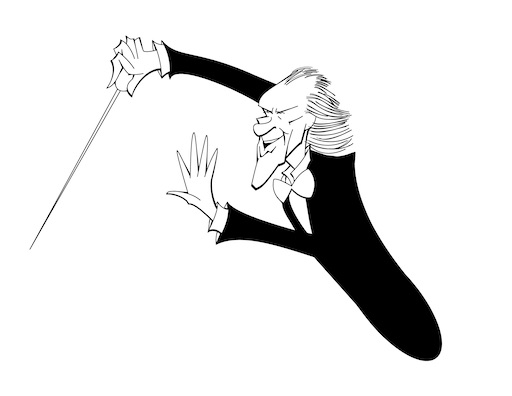
Frederick
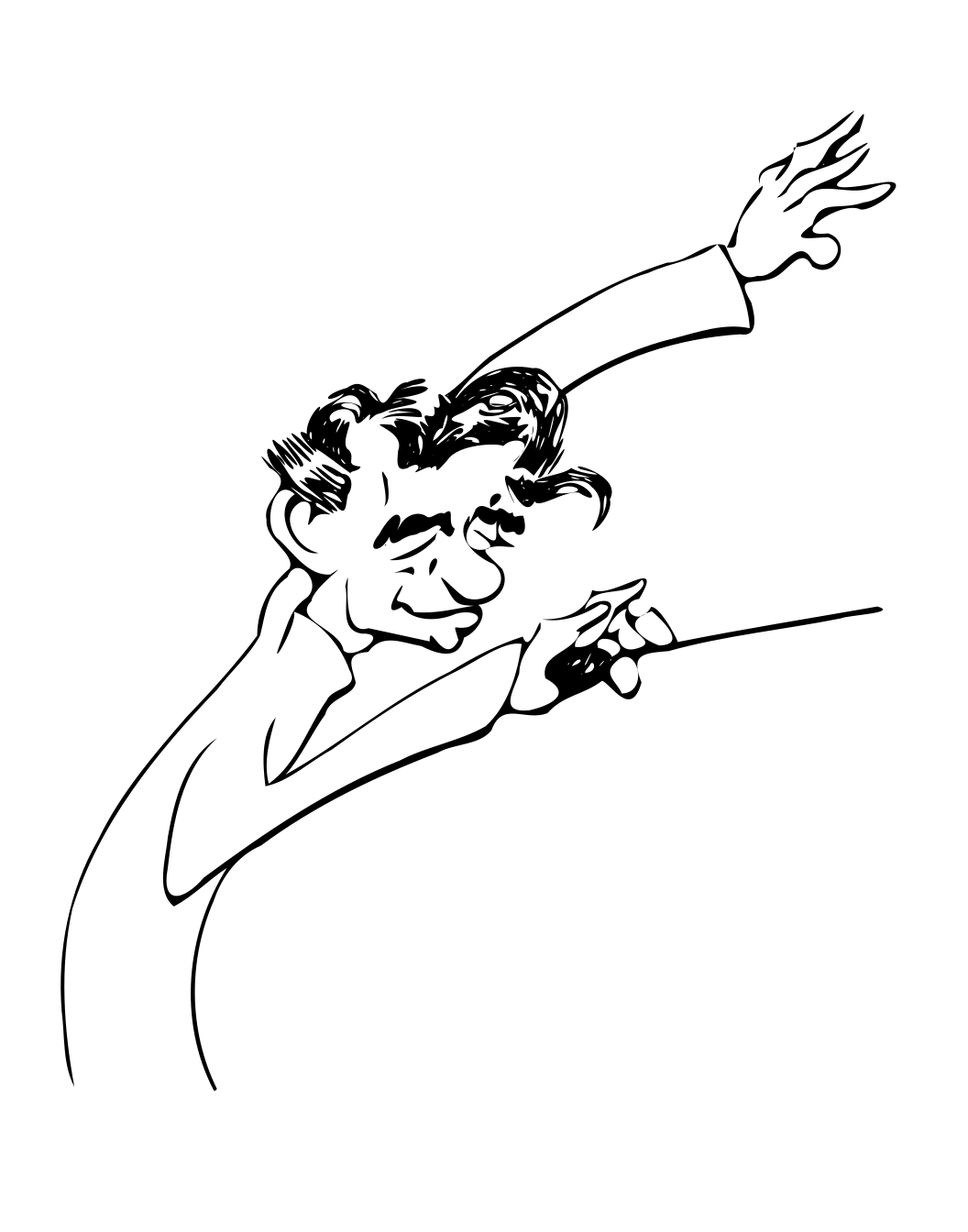
Lenny
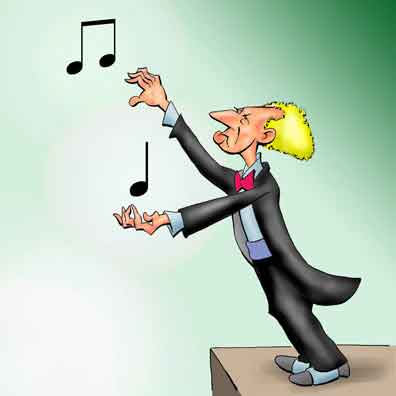
Leopold! Leopold!
Naturally Ludwig conducted a number of his own premieres and for those who have sat in on the batons of many famous conductors (such as Frederick Fennell, Leonard Bernstein, and Leopold Stokowski) it's interesting to read first hand accounts of Ludwig at the podium. As one of his assistants Ignaz von Seyfried (later a composer and conductor in his own right) wrote:
Our master could not be presented as a model in respect of conducting, and the orchestra always had to have a care in order not to be led astray by its mentor; for he had ears only for his composition and was ceaselessly occupied by manifold gesticulations to indicate the desired expression. He often made a downbeat for an accent in the wrong place. He used to suggest a diminuendo by crouching down more and more, and at a pianissimo he would almost creep under the desk. When the volume of sound grew he rose up also as if out of a stage-trap, and with the entrance of the power of the band he would stand upon the tips of his toes almost as big as a giant, and waving his arms, seemed about to soar upwards to the skies. Everything about him was active, not a bit of his organism idle, and the man was comparable to a perpetuum mobile.
He did not belong to those capricious composers whom no orchestra in the world can satisfy. At times, indeed, he was altogether too considerate and did not even repeat passages which went badly at the rehearsal: "It will go better next time," he would say. He was very particular about expression, the delicate nuances, the equable distribution of light and shade as well as an effective tempo rubato, and without betraying vexation, would discuss them with the individual players. When he then observed that the players would enter into his intentions and play together with increasing ardor, inspired by the magical power of his creations, his face would be transfigured with joy, all his features beamed pleasure and satisfaction, a pleased smile would play around his lips and a thundering "Bravi tutti!" reward the successful achievement. It was the first and loftiest triumphal moment for the genius, compared with which, as he confessed, the tempestuous applause of a receptive audience was as nothing. When playing at first sight, there were frequent pauses for the purpose of correcting the parts and then the thread would be broken; but he was patient even then; but when things went to pieces, particularly in the scherzos of his symphonies at a sudden and unexpected change of rhythm, he would shout with laughter and say he had expected nothing else, but was reckoning on it from the beginning; he was almost childishly glad that he had been successful in "unhorsing such excellent riders".
If there's one thing everyone knows about Beethoven is that he eventually became deaf. It was, though, not an all or nothing affliction. It began gradually when he was around twenty-eight. Although it was not always complete deafness it could present hazards. We read in a newspaper from 1819:
Beethoven, the great music composer, has lately met with a severe accident, having been nearly run over by a carriage, the noise of which in consequence of partial deafness he could not hear in time.
So even at age 48 he could hear some things. But in a few years we were reading:
The following particulars concerning this great musician are from the journal of a late traveller in Germany.
[Beethoven] is described as filthy, and his manners as bearish.
He is very deaf, and therefore has always a small paper book4 with him; and what conversation takes place, is carried on in writing. In this, too, he instantly puts down any musical idea which strikes him. These notes would be utterly unintelligible even to another musician, for they have thus no comparative value: he alone has in his mind the thread, by which he brings out of this labyrinth of dots and circles the richest and most astounding harmonies. The moment he is seated at his piano, he is evidently unconscious that there is any thing in existence, but himself and his instrument; and considering how very deaf he is, it seems impossible, that he should hear all he plays. Accordingly, when playing very piano, he often does not bring out a single note. He hears it himself in the "mind's ear" while the eye and the almost imperceptible motion of his fingers, show that he is following out the strain in his own soul, through all its dying gradations tho' the instrument is actually as dumb as the musician is deaf. I have heard him play, but to bring him so far required some management, so great is his horror of being anything like exhibited.
Had he been plainly asked to do the company that favor, he would have flatly refused. He had to be cheated into it; every person left the room, except Beethoven and the master of the house, one of his most intimate acquaintances. These two carried on a conversation in the paper-book about bank stock. The gentleman, as if by chance, struck the keys of the open piano beside which they were sitting; gradually began to run over one of Beethoven's own compositions, made a thousand errors, and speedily blundered one passage so thoroughly, that the composer condescended to stretch out his hand and put him right.
It was enough: the hand was on the piano his companion immediately left him, on some pretext, and joined the rest of the company, who, in the next room, from which they could see and hear everything, patiently waited the issue of this tiresome conjuration. Beethoven, left alone seated himself at the piano. At first, he only struck now and then a few hurried and interrupted notes, as if afraid of being detected in a crime; but gradually he forgot everything else, and ran on during half an hour, in a phantasy, in a style extremely varied and marked; above all, by the most abrupt transitions. The amateurs were enraptured: to the uninitiated, it was more interesting to observe how the music of the man's soul passed over his countenance. He seems to feel the bold, the commanding, and the impetuous, more than what is soothing or gentle. The muscles of the face swell, and its veins start out; the wild eye rails doubly wild; the mouth quivers; and Beethoven looks like a wizard overpowered by the demon, whom he himself has called up.
Footnote
The reference to a paper book is about the famous "Conservation Books" that Beethoven carried with him. When his deafness got so severe he could no longer hear people speaking he would hand them one of the books and they would write what they wanted to say.
After Beethoven died the Conversation Books were first kept in the Prussian Royal Library in Berlin. During World War II they were taken out of the city for safekeeping and afterwards returned to the library. However, the library was in the section occupied by the Russians and in 1951 the head of the museum's music department snuck the books out and took them to the Beethoven Haus Museum in Bonn. However, the books were later returned to Berlin.
Beethoven usually responded with his voice so reading many of the conversations are like listening to a phone conversation where you only hear one person. But Beethoven might write down his part of the conversation if he didn't want others to overhear or if he was conversing with another person with impaired hearing.
He also used the books to write down memoranda which covered topics as varied as new musical ideas to grocery lists. So reading the books is a challenge even for those well-versed in early 19th Century German. But they have often been used by scholars when writing books and articles about Beethoven and his life.
Sometimes, though, the performances were not quite so sublime. Louis Spohr, at one time a popular composer, once heard Beethoven rehearsing for a concert.5
Footnote
Although you can find modern recordings of Spohr's compositions and his works are sometimes featured in concerts, he is virtually unknown to the general public. But during his lifetime (1784 - 1859) he was one of the most successful of the European composers. Fans of Gilbert and Sullivan will remember he is mentioned along with Beethoven in the lyrics of "My Object All Sublime" from The Mikdado. Some of his works - like his opera Faust - remained popular even into the 20th Century.
Spohr was by no means the only famous composer who fell into oblivion. Beethoven himself stated the best composer of all was Louis Cherubini.
Scholars offer a variety of explanations why composers who were literally of rock star status quickly vanished from the public's collective consciousness. Some explanations - particularly when offered in terms of artistic criticism have little real meaning. You might read a scholar say that Spohr is not heard today because "his reach exceeded his grasp", "the pleasure of his music is marred by its chromatic melody", or "his highest assets have ended up as his most demanding limitations".
A more concrete explanation is that before the 20th Century there were just too many composers and compositions for later generations to keep track off. People also had to go out of their homes for entertainment. Without recordings or broadcasts you needed a lot of composers just to fill out the concerts with something more than Bach, Mozart, or Beethoven. Now selecting one or two composers from each musical epoch, there's plenty of songs to hear from the top few and you don't need to pad the programs with Spohr, Praetorius, Hummel, Paisiello, Gottschalk, Mehul, Onslow, Taliafferre, Szymamowski, Boismortier, Moszkowski, or Raff.
It was hardly a treat, for in the first place the piano was badly out of tune, which did not bother Beethoven much, since he could not hear it; and second, because of his deafness, hardly anything was left of the virtuosity of the artist who had formerly been so greatly admired. The poor deaf man - in forte passages he pounded so that the strings jingled, and in piano he played so softly that whole phrases were unheard.
Sometimes Beethoven would fake it. He would take the podium to conduct an orchestra but there would be a second conductor standing behind him who the musicians actually followed. But his insistence on conducting still caused problems as one of his friends stated when the opera Fidelio was being rehearsed in 1822.
We all advised against it, in fact we pleaded with him to resist his own desires and to remember the difficulties that had attended the concert in the University auditorium as long ago as 1819, and again at the Josephstadt Theater performance. After several days of indecision, he finally declared his readiness to conduct the work, a deplorable decision on many counts. At his request I accompanied him to the dress rehearsal. The E-major overture went perfectly, for despite several hesitations on the part of their leader, the bold army of the orchestra moved in their customary disciplined ranks. But in the very first number, the duet between Marzelline and Jacquino, it was apparent that Beethoven could hear nothing of what was happening on the stage. He seemed to be fighting to hold back. The orchestra stayed with him but the singers pressed on, and at the point where knocking is heard at the prison door, everything fell apart. Umlauf [another conductor] told the musicians to stop without telling the master the reason. After a few minutes discussion with the singers, the order was given: da capo. The duet began again and as before the disunity was noticeable, and again at the knocking there was general confusion. Again the musicians were stopped.
The impossibility of continuing under the direction of the creator of the work was obvious. But who was to tell him, and how? Neither the manager, Duport, nor Umlauf wanted to have to say, "It cannot be done. Go away, you unhappy man!" Beethoven, now growing apprehensive, turned from one side to another, searching the faces to see what was interrupting the rehearsal. All were silent. Then he called me to him. I stepped to his side in the orchestra and he handed me his notebook motioning for me to write down what was wrong. I wrote as fast as I could something like "Please don't go on. I'll explain at home." He jumped down onto the floor and said only, "Let's get out of here." Without stopping he hastened to his apartment in Pfarrgasse in the suburb of Laimgrube. Once there he threw himself on the sofa, covered his face with both hands, and remained so until we went to dinner.
As far as his personality and appearance there was general agreement.
Beethoven is the most celebrated of the living composers in Vienna, and in certain departments the foremost of his day. His powers of harmony are prodigious. Though not an old man, he is lost to society, in consequence of his extreme deafness, which has rendered him almost unsocial. The neglect of his person which he exhibits gives him a somewhat wild appearance. His features are strong and prominent; his eye is full of rude energy; his hair, which neither comb nor scissors seem to have visited for years, overshadows his broad brow in a quantity and confusion, to which only the snakes round a Gorgon's head offer a parallel. His general behaviour does not ill accord with the unpromising exterior. Except when he is among his chosen friends, kindliness or affability are not his characteristics. The total loss of hearing has deprived him of all the pleasure which society can give, and perhaps soured his temper. Even among his oldest friends he must be humoured like a spoiled child. He always has a small prayer book with him and what conversation takes place is carried on in writing.
Ludwig's life was in some ways simple but in other ways complex. He lived virtually all of his adult life in Vienna with occasional trips to nearby towns and resorts. However his dealings with his family, particularly with his brothers, their wives, and especially his young nephew Karl, were quite involved. Trying to write a biography of Beethoven in a chronological fashion can make a confusing narrative. So one author found he had to deal with Beethoven's music, his personal life (and possible girlfriends), and his family in separate chapters.

Beethoven probably remains the #1 of the Classical composers as far as name recognition goes. He even found his way into American comics. In the Peanuts newspaper cartoon of September 28, 1960, Schroeder was reading a book to Lucy.
"He would sometimes startle people in public places," Schroeder read. "He flew out in anger against all that was petty, dull, or greedy in men. Often, however, his scorn would turn to high hilarity and humorous jests."
Lucy then asked, "Are you reading about Beethoven or Mort Sahl?"6
Footnote
Mort Sahl is largely forgotten today although in the 1950's and early 1960's he was one of the best known stand-up comedians in the United States. Lucy's question referred to Mort's monologues which were heavy in social commentary with current events and politics being the major topics.
So we see that despite the trials and tribulations that Beethoven encountered, people have found freude! in Beethoven's life and times. And some of the other witticisms you can find are:
What was Beethoven's favorite fruit?
Ba-na-na-NAAAAAAAAA!
What was Beethoven's favorite drink?
Beethoven's Fifth.
Then there's the famous joke favored by the kids:
What do you call something that ...
Well, we'll skip that one for now.
References and Further Reading
Beethoven: Biography of a Genius, George Marek, Funk and Wagnalls, 1969.
"Big Eater, Fretful Uncle, Always on the Move: Beethoven's Conversation Books Bring the Great Composer to Vivid Life", Michael Church, Classical Music, September 21, 2024.
"German News", Alexandria Gazette & Daily Advertiser, April 29, 1819, p. 2.
"BEETHOVEN", The Intelligencer & Petersburg [Virginia] Commercial Advertiser, August 9, 1825, p. 2.
"BEETHOVEN", The Wilmingtonian and Delaware Register, February 10, 1825, p. 4.