Throughout English history there has only been one King John. Compare that to 10 monarchs named Edward, 8 Henrys, 6 Georges, 4 Williams, 3 Charleses and Richards, and 2 Edgars, Edmunds, Elizabeths, Harolds, James, and Marys. But with only one John at least everyone knows who he was.1
Footnote
The other English monarchs of singular nomenclature are AEthelred, AEthestan, Anne, Cnut, Eadred, Eadwig, Harthacnut, Matilda, Stephen, Sweyn, and - of course - Victoria.
However - quote - "King" - unquote - Sweyn was king pretty much by convention rather than actuality. He was really the King of Norway and held the title King of England for a little more than a month.
Often omitted in this list is King Alfred. The rationale is that Alfred was King of the Anglo-Saxons, not all of England. However, that's a bit too restrictive as the Anglo-Saxons occupied most of what is now modern England. So Alfred should be in the list.
And what they'll say is that John was the King of England who in 1215 signed the Magna Carta. This, they add, was the document that gave all citizens their freedom and civil rights, trial by jury, freedom of speech, and freedom of religion.
Of course, things are not always what you hear. Despite illustrations to the contrary, King John did not actually sign the document. He - or his clerks - only affixed his seal. But that's about as far as any king in John's time went to signing anything.2
Footnote
The earliest actual "autograph" signature of an English king - the "royal sign-manual" as the eggheads call it - is that of Richard II from 1386. There are earlier signatures, of course, chiefly from the scribes of Sumeria and Egypt. There is even one papyrus that may have Cleopatra's John Hancock.
As far as the rights granted to Englishmen everywhere, here are some of the laws, newly translated and edited, that are specified in what is properly called The Great Charter:
- No citizens of any town shall be compelled to build bridges across the riverbanks, except those who are obligated to do so by tradition or law.
- Fishing nets are to be removed entirely from the Thames, from the River Medway, and throughout all England except along the sea coast.
- There shall be a standard measure of wine throughout the whole kingdom and a standard measure of beer.
As far as the rights of Englishwomen in this England of Law, they are mentioned. One provision states:
- No widow shall be compelled to marry, so long as she prefers to remain without a husband.
Which seems fine, but then you also read things like:
- No one shall be arrested or imprisoned at the request of a woman for the death of anyone except her husband.
Hm. Seems like the "Great Charter" still needed some work.
In fact the Great Charter was deemed null and void as soon as it was issued. As students of history know, John agreed to the provisions only after he had been defeated by the English Barons at the Battle of Runnymede. But John had no intention of keeping his promises and after the battle he went bellyaching to the Pope, Innocent III. Innocent said John should do as he pleased. After all he was the King.
The episode of John reneging on the Magna Carta is a prime example of John being a Royal Jerk. True, there have been historians who have tried to "re-evaluate" his reign and question whether he was as big a jerk as everyone seems to think. But as much as they may try to "judge John by the standards of his own time" and "compare him to other sovereigns of the time and place", he still comes off as a jerk.
Part of the problem in evaluating the Jerkdom of King John is that the truly contemporary documents are mostly expense accounts and travel itineraries. The actual "chronicles" were written after his reign ended and as they say were written with an agenda.
One of the major sources of John's reign is a book written by a monk named Roger of Wendover. Actually Roger of Wendover lived at St. Albans Abbey in (where else?) St. Albans. What made Roger's work so popular is that he wrote with the idea of making history entertaining. And in his entertaining chronicle The Flowers of History, Roger pictured John as a most unsatisfactory character.
For instance we read:
A part of [King John's] army came to Dovington, a town belonging to John de Lacy, and finding it untenanted, it was immediately razed to the ground by order of the king. After this he separated his wicked army, and took his march towards the northern provinces, burning the buildings belonging to the barons, making booty of their cattle, plundering them of their goods and destroying everything they came to with the sword.
The whole surface of the earth was covered with these limbs of the devil like locusts, who assembled from remote regions to blot out every thing from the face of the earth, from man down to his cattle. For, running about with drawn swords and open knives, they ransacked towns, houses, cemeteries, and churches, robbing every one, and sparing neither women or children.
The king's enemies wherever they were found were imprisoned in chains and compelled to pay a heavy ransom. Even the priests whilst standing at the very altars, with the cross of the Lord in their hands, clad in their sacred robes, were seized, tortured, robbed, and ill-treated. And there was no pontiff, priest, or Levite to pour oil or wine on their wounds.
In his writings, Roger not only wanted to entertain but also to include moral messages. So some scholars think he may have been trying to spice up his tales in the style of today's looser "popular" histories.
Of course, there are other scholars who point out that there must have been something about John that made Roger's rather jaundiced stories so believable. Yes, Roger was writing after John died. But there were still people living who had remembered John's reign and who could have fed Roger first hand information. And when the river is making noise, as they say, the water must be flowing.
John came from a big family with a lot of nephews, nieces, cousins, and in-laws. Although John's dad was King Henry II of England, everyone was actually French. Henry was born at Le Mans in 1133 and Henry's dad was Geoffrey, the Count of Anjou. Anjou was a fairly small region lying about half-way between Paris and the tip of Brittany near Brest.
Geoffrey was a bit of a dandy and took to wearing a sprig of the common broom plant (Cytisus scoparius) in his hat. In Latin the name is genista and so he picked up the nickname Geoffrey Planta genista. The name stuck and the family became the Plantagenets.3
Footnote
The pronunciation of the word "Plantagenet" can cause some difficulties if you use it around a bunch of eggheads who always like to correct people. The tendency for English speakers is to say PLANT-uh-jen-ET. However, the - quote - "proper" - unquote - pronunciation is with the accent on the second syllable: plan-TĂJ -uh-net where the Ă in the second syllable is like in hat.
The French pronunciation, of course, would be something like plahn-tah-zhun-EY, where the last syllable rhymes with hay.
When Geoffrey died in 1151, Henry inherited his father's lands which through various circumstances and machinations had grown to include not just Anjou but Brittany, Normandy, Maine, and Touraine as well. Those were pretty impressive holdings and when Henry married Eleanor of Aquitaine in 1152 he also became the Duke of Aquitaine. The Aquitaine was quite a haul as it was the most sizable chunk of the French holdings on the Continent.
So by 1153 when Henry was twenty, he controlled virtually all of what is now Western France. But his mom, Matilda had always believed her son should also be King of England. After all, her dad, Henry I, had been king of England as had her granddad, none other than William the Conqueror himself.
Unfortunately, there were other descendants of William who felt their kids should be King. In fact since 1135 the English King had been Stephen of Blois whose mom, Adela, was the daughter of the Conquerer. So Stephen and Adela thought that the next King of England should be Stephen's own son, Eustace. Stephen's other son, Gervase, was the Abbott of Westminster and was out of the running.
With Eustace having the better claim to be the next King4 the only way for Matilda to press her case for her son was to go to war. She was clearly planning ahead since when the war began in 1138, Henry was only seven years old. The war didn't end until 1153 after Henry and Eleanor were married. The fifteen years in the interim put England into a state of virtual anarchy - a time commonsensically called "The Anarchy".
Footnote
The best claimant for being the King of England had originally been the son of King Henry I. As King Henry I was the son of William the Conqueror, his oldest son - named William after his granddad - was indisputably next in line.
William and his dad had been fighting the French. By November 25, 1120, they had wound up their business and were getting ready to return to England from the town of Barfleur on the coast of Normandy. Henry and his entourage left first and William and his buddies would follow later.
They were about to leave Brittany for England on the Blanche-Nef (the White Ship), but William liked to party. Wine flowed freely and William and about 300 others crammed into the ship. Among those with William were his sister, Matilda, and his cousin, Stephen.
Stephen, though, had already taken as much wine as was good for him and was feeling indisposed. In fact, he needed to find what the polite call a "lavatory". So he decided to take a later ship.
Since King Henry had already left, William in an act of (drunken) bravado and his (drunken) friends told the captain they wanted to beat Henry's ship to England. The captain obliged - William was going to be king, after all - and they set off with rowers pulling at full speed.
They had only gone about a mile when they smashed right into what is known as Quillebeuf Rock, a known hazard to navigation that is visible only at low tide during the day and virtually impossible to see at night regardless of the tide. The only survivor was a butcher who had come to collect some payments from some deadbeat passengers and had remained on board. He said that William had been about to save himself by getting into a lifeboat but turned back when he heard his sister calling for help.
The White Ship Disaster - as it's called - removed the unambiguous heir to the throne and set off the succession crises that plagued the English monarchy well into the 17th Century. Today who's next in line - called the primogeniture - is set by a law of Parliament. Until 2013 the next in line was the eldest son of the monarch with alternatives spelled out clearly. But that year the law was changed to be the oldest child, male of female.
Then suddenly in 1153 and for no apparent reason Eustace died age 23. Stephen realized he was getting old and now there was no one with a better claim to the throne than Henry. So Stephen bowed to the inevitable and named Henry as his heir. Stephen died the following year and young Henry Plantagenet - he was only 21 - became King Henry II of England and Eleanor was Queen.
But remember Henry was not just the King of England but also held the independent titles of the Duke of Normandy, the Duke of Aquitaine, Count of Anjou, Count of Maine, and Count of Touraine. He also ended up controlling a small region called the Vexin which was a buffer zone between his lands in Western France and France Proper. At that time "France" referred to the area immediately around Paris and was ruled by its own King. So Henry's sons stood in line to inherit the largest region in Europe.
Although the family was actually French, Henry took his job as King of England seriously. He and Eleanor spent a lot of time there and John and Richard - whose heroically but laughably posing statue stands outside the Houses of Parliament - were both born at Oxford. Still their native language was French, albeit the older and dialectal form called Norman French. If they knew English it was likely only a smattering.
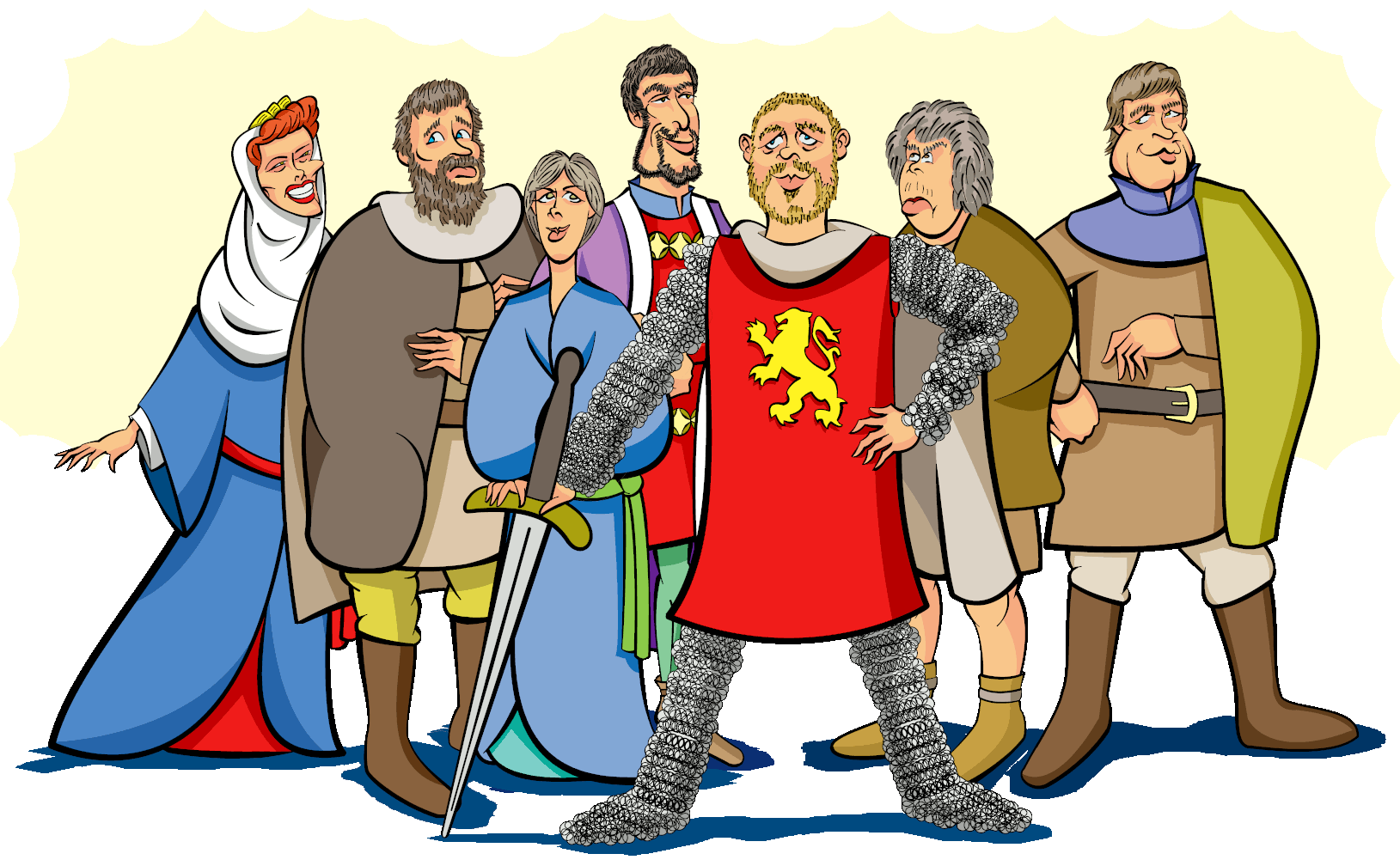
John's Family and Friends
Left to Right: Eleanor, Henry, Alice of France
Philip of France, Richard, John, and Geoffrey
(Actually, it's Katharine, Peter, Jane,
Timothy, Anthony, Nigel, and John)
From the first it was assumed John would never be King. There were, after all, three older brothers in his way. The oldest was named Henry after his dad, and then there was Richard later called the Lion-Hearted. Finally the third in line was Geoffrey. Actually Geoffrey was considered the most intelligent and savvy of the family but he was also sneaky and devious. Henry and Eleanor also had three daughters, Eleanor, Matilda, and Joan, but at that time the royal succession was limited to men.
Probably Henry and Eleanor intended John to join the Church and make his way up the clerical ladder to become a Cardinal or something. So Henry didn't even bother giving John any lands. Henry, though, and with Eleanor's acquiescence appointed Richard as Duke of Aquitaine and Geoffrey was made the Duke of Brittany. But with no lands of his own, John got stuck with the rather snarky nickname of Jean Sans-Terre or John Lackland.
However, it soon became evident John was not cut out for a higher calling. So Henry had to figure where to find some real estate that John could rule over and not step on the toes of his older brothers.
So Henry had an idea. After he became king his army had moved into Ireland and had forced the local leaders to acknowledge his sovereignty. Ireland, Henry thought, was well away from the lands of his other sons and would be a great place for John to rule.
But John made a hash out of it. When he finally got to Ireland, he and his hangers-on met the Irish leaders. But they thought the long shaggy Hibernian beards were funny and laughed most discourteously. Then - as a joke, of course, - John and his buddies pulled on the Irishmen's beards.
That did it. The normally divided Irishmen banded together. Far superior at waging war than John and his friends, they drove the English back across the sea. John's lack of martial skill landed him yet another nickname, Softsword, although there could have been some other (snicker) reason. Now Henry had to admit that if John had the makings of a king it was the makings of a rotten king.
So what about Henry's oldest son, also named Henry? Well, back in 1170, the senior Henry decided he would just make his son the Co-King of England. This was a fairly common tradition in many monarchal cultures and is one way to unambiguously establish the next king. Technically the older Henry and the Young King (as he was called) shared the same lands and so Young Henry actually had more lands than any of his brothers.
But the Young Henry didn't see it that way. He had no real power and he chafed at having no territory he could call his own. His so-called lands were really controlled by his dad. Worse, their revenues went to the Senior King, so Young Henry had to live only on an allowance.
Worse, the Young King was kept on such a tight rein - no pun intended - that he had to stay with his dad at all times. Sometimes they even slept in the same room. It was as if the Old King didn't trust his eldest son.
This was not a satisfactory situation and the Young King kept making demands that he wanted to be a real king with his own castles and territory. After all, Richard had the Aquitaine and Geoffrey ruled Brittany. They had their own income and didn't have to live on handouts from Daddy. But the elder Henry told his son he had to be patient. After all, he stood to inherit all of the lands Henry controlled and that included all of England.
Well, the Young King kept stewing and decided there was only one way out. So on the night of March 5, 1173 and while his dad was sleeping, Young Henry snuck out of the castle and rode away.
This was not to be some James Dean type Rebel-Without-a-Cause adolescent rebellion where the Young Henry wore leather jackets and brushed his hair back in a duck-tail pompadour and stayed out late at night. Instead he gathered an army and waged a bona fide war against his dad.
Although Roger of Wendover had trashed John for sending his soldiers into villages and pillaging and looting, this was pretty much par for the battlefield for all armies in the Middle Ages. Instead of armies clashing in massive pitched battles like in the movies, a real medieval war was mostly the knights riding into their opponents' lands, plundering the towns, stealing the livestock, killing the peasants, and making whoopee. There might be a skirmish now and then but these were usually brief and inconsequential.
So once Young Henry rode off, he began laying waste to his father's lands. To pay for his soldiers he would even attack the monasteries which generally held large amounts of gold, jewels, and cash.
Of course, there's only so much countryside you can plunder. Eventually the Young King turned to the King of France, Louis VII, for help. In fact, Young Henry had married Louis's daughter, Margaret, in 1172. So King Louis was family.
It was a smart move. Louis didn't like the Older Henry a-tall. You see, from 1137 to 1152, King Louis had been married to - get this - Eleanor of Aquitaine. Yes, Eleanor, now Queen of England, had once been Queen of France.
But from the first she and Louis had, well, compatibility problems. Eleanor was an active and assertive woman who liked having a good time. She enjoyed dinner parties with music and dancing with the young swains fawning over the damsels. But Louis was a pious man who focused on being the best king possible and who trusted to Divine Guidance for help. So being King of France took a lot of prayer, fasting, and going to Church. At one point Eleanor said she thought she had married a man but instead had married a monk.
So it's no real surprise that after 15 years of marriage Louis and Eleanor had only two daughters and no sons. Both Louis and Eleanor wanted to call it quits but that wasn't possible by the Church rules.
Unless...
Unless, that is, they were too closely related - a state of affairs called "consanguinity". And it turns out that Louis and Eleanor were fourth cousins. And by the Church Rules you had to be at least seventh cousins to get married.
Even today a lot of royal spouses are distant cousins - say, 9th or more removed - but a lot of the old-time kings and queens were more closely related than seven steps. So in that case they would go to the Pope and he could give them what was called a dispensation.
A dispensation is a relaxation of church rules if the circumstances dictate that the rules should be relaxed. They can be granted on a multitude of topics and are fairly common even now. Depending on the type of request, a dispensation can be granted from the levels of the parish priests up to the Pope. Of course, not all rules can be dispensed with and dispensations are supposed to be for a single instance for a specific case.
In Louis and Eleanor's case, the local priest wasn't sufficient and they had gone to Pope Innocent to get permission to marry. This, though, was an earlier Pope Innocent, Innocent II. But Innocent II had died in 1143 and so now they had to go to Pope Eugene III and tell him Innocent had made a mistake.
Eugene agreed the dispensation had been in error and granted the annulment. Louis was now free to marry a less carefree girl, and Eleanor could find someone more suited to her active lifestyle.
Such a man she found in Henry Plantagenet who was only eighteen (she was thirty). Henry wasn't the English King yet but with the agreement with King Stephen it looked like he would be in short order. So Eleanor decided to take the chance.
But officially she would have to get permission from Louis. You see, there was a glitch in feudal society that complicated royal matters. Remember that Eleanor was the Duchess of Aquitaine and Henry was Count of Anjou and Duke and Count of other regions on the Continent as well. As medieval society was primarily patriarchal, once Henry married Eleanor he then had the title of Duke of Aquitaine although ultimately the land still belonged to Eleanor.
Although Henry and Eleanor had the actual control of their regions, it turns out that the lands had been part of Greater France once ruled by Charlemagne. So by tradition King Louis remained the overlord of the Continental holdings. These included those owned by Henry and Eleanor.
However, Louis was not the overlord of England. That was Henry, who was the King of England independent of his Continental possessions. This complex situation meant that Henry was the ruler - but not the King - of what is now known as the Angevin Empire.
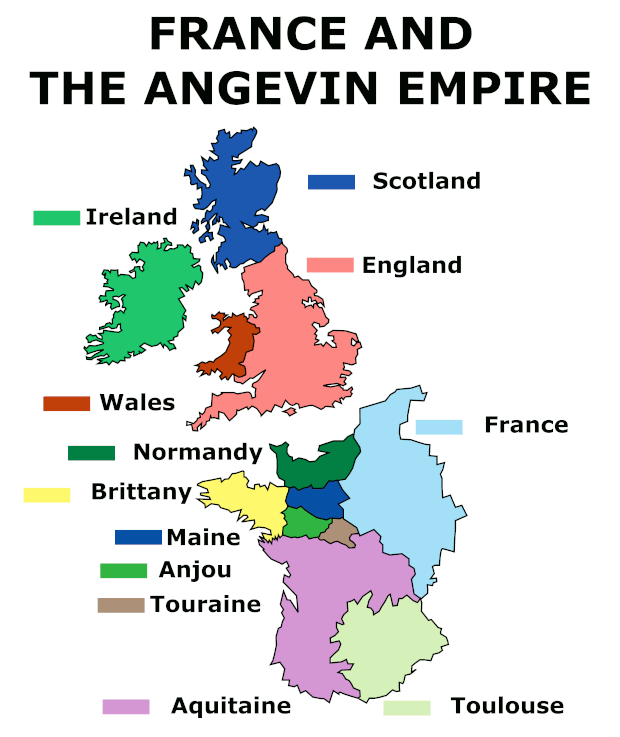
(Click to open larger
image in new window.)
The Angevin Empire gets the name from Henry's first title which was the Count of Anjou. At its height the Angevin Empire covered Anjou, Maine, Normandy, Brittany, Touraine, the Aquitaine, England, Wales, and arguably a little bit of Ireland. Although the Empire arose quickly we'll see it endured for only about 50 years.
But whoever directly owned the lands, they owed their overlord loyalty or fealty. This meant that the overlord could call on the Dukes, Counts, and Barons - the overlord's vassals - for assistance, both in money and matériel. For instance, if the overlord wanted to fight a war, he could summon his vassals and have them supply soldiers or if the vassal didn't want to send knights, he could make a payment called scutage (pronounced SKOOT-edge). The payment of scutage would give the overlord enough money to hire mercenaries.
The vassal's obligation to the overlord was affirmed by paying the king homage. There would be an actual ceremony where a vassal would kneel before their overlord, take his hands in theirs, and swear that they would obey his summons and render assistance when asked.
Louis might not have been Eleanor's husband any longer, but he remained overlord to both Eleanor and Henry. Strictly speaking they needed Louis's permission to marry.
But someone slated to be King of England would not meet Louis's approval to marry Eleanor. If Henry married Eleanor he would have direct control of the Aquitaine. With the Aquitaine in his pocket plus his other holdings, Henry would be more powerful than Louis - nominally Henry's overlord.
There was only one way to resolve the issue. So just two months after Eleanor's annulment with Louis, she and Henry just up and got hitched without asking. If Louis didn't like it, well, c'est pas de pot!.
Louis was not pleased but decided not to make any waves. Instead he promptly married Constance of Castile and they ended up with five daughters, Marie, Alix, Margaret, Alys (sometimes spelled Alice), and Agnes.
Oh, yes. And one son, Philip. And Philip turned out to be a real casse-bonbon to Henry and his sons.
Henry's reign was mostly spent presiding over a well-run Kingdom which was almost always on the verge of chaos. Things would go along fine for a while but then someone would toss des bâtons dans les roues. Usually this was some baron wanting to rebel for one reason or another. So it was all the more ironic that one of the earliest and worst of Henry's problems was not with his barons but with his good friend and the Archbishop of Canterbury, Thomas Becket.
Thomas Becket had been born in the emerging middle class. His dad was a prosperous London merchant and he sent Young Thomas off to school, first in England and then on the Continent. Eventually Thomas landed a job as secretary to Theobald of Bec who was the Archbishop of Canterbury. For the job Thomas had to take what were called "minor orders" in the Church and under Theobald he rose to be the Archdeacon of Canterbury.
During the course of his duties he met Henry and although Thomas was about fifteen years older, the two men became good friends. They socialized together and shared a common fondness for wine and song but not women. At least not Thomas. Earlier he had taken a vow of chastity which he seems to have kept.
Then after Henry had been King for about a year he appointed Thomas as his chancellor - essentially the prime minister. The two men worked well together and then in a few years, Henry had a great idea. Given the conflict he'd been having with the Church - such as priests claiming they were immune from the King's laws - he'd appoint Thomas as the Archbishop of Canterbury. Now Henry would have a Chancellor who also held the highest ecclesiastical office of the land and who would do his bidding.
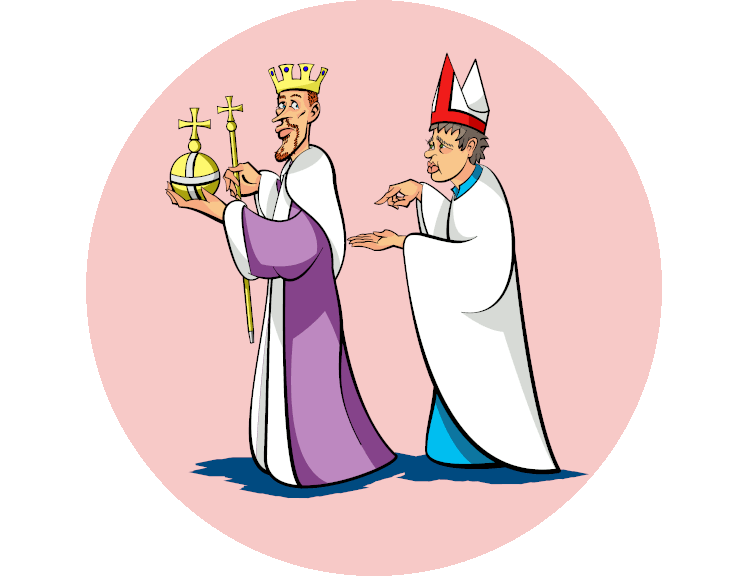
Henry and Thomas
(It's really Peter and Richard.)
(Click to zoom in and out)
But that's not the way things worked out, and Henry was flummoxed when Thomas sent back the seal of the Chancellor. Holding both offices, Thomas said, would be too much of a burden. If he had to serve King or God, Thomas had to serve God.
Almost immediately the two men ended up tooth and nail. The biggest problem was that Henry expected unswerving loyalty from all his subjects. So when he met with Thomas he would ask if the Archbishop would give his loyalty and fealty to the King of England. Of course, Thomas said. He was completely loyal to Henry and would obey all commands of the King in any matter whatsoever.
But then Thomas would always tack on the phrase "saving my order" or "save for the honor of God". This meant he would obey the King in all matters - except if the king's commands were counter to his obligations to the Church. Thomas's qualification would send Henry into spittle-flinging diatribes and any meeting would fall apart in acrimony. Things got so bad that Thomas ended up crossing the Channel and taking refuge with King Louis in France.
Eventually negotiations allowed Thomas to return to England but he kept claiming independence over Henry in religious matters. Most of all he would not consent to having members of the clergy - no matter how junior - being tried in secular courts. This meant there were some priests who were quite literally getting away with murder.
Finally Henry had all he could stand and he couldn't stand no more. On December 29, 1170, Henry was stewing over his problems with Thomas when he burst out so all could hear:
What miserable drones and traitors have I nurtured and promoted in my household who let their lord be treated with such shameful contempt by a low-born cleric!"
Immediately, four of the knights in attendance - Hugh de Morville, Richard le Breton, Reginald FitzUrse, and William de Tracy - left the building and rode off to Canterbury. They entered the cathedral and found Thomas and the monks about to celebrate Vespers.
The knights demanded Thomas come with them. He looked at them askance and said the service was just beginning. Then when Thomas turned away, the knights drew their swords and hacked him to death. One of the eyewitnesses, a monk named Edward Grim, wrote an account of the murder and it makes pretty gruesome reading.
The murder of Thomas Becket came near to destroying Henry's reign. Thomas immediately was declared Venerable and then Beatified. It was clear he would quickly be elevated to Sainthood (which happened on February 21, 1173).
Henry admitted he had spoken in anger but had never intended his words to incite violence or harm to Thomas. The people thought that was a stretch and it seems that the King of England had ordered the murder of the Archbishop of Canterbury.
To make amends for his rash words Henry agreed to do public penance. The penance involved him walking barefoot through the streets of Canterbury and then kneeling before the altar in the cathedral where Thomas was murdered. There he was flogged by the monks with each one delivering three to five stripes on Henry's bare back. Although it was a humiliating experience, the act did save Henry's throne.
His throne, yes, but not necessarily his international prestige. In particular the barons began to question if Henry had the stuff of being a real leader. The barons in the Aquitaine - a cantankerous lot in the best of times - began murmuring amongst themselves that it would be better if they owed their fealty directly to King Louis.
If the murder of Becket hadn't caused enough trouble, it was just a short time afterwards that Henry was having to deal with his wayward eldest son. Remember that the Young King had ridden off and was now in active rebellion against his father. The fighting continued from 1173 to 1183, and to make matters worse, Richard and Geoffrey soon joined their brother. Even Eleanor threw her lot in with the kids, for heaven's sake! Talk about a family argument!
What were the young Henry, Richard, Geoffrey, and Eleanor trying to achieve? Clearly they all didn't share the same beef, so why were they banding together?
One scholar has pointed out that going to war in Medieval Europe was kind of like going on strike in the modern era. The purpose was not to necessarily kill your opponent or even defeat them in a military sense. Instead warfare was a way to exert pressure to force everyone to come to the bargaining table.
We've seen that war was fought by the knights riding into the opponent's lands, devastating the villages, stealing the livestock and crops, and burning what you left behind. If you needed hard cash, you could plunder a monastery. Eventually everyone would usually sit down at a conference and come to an agreement, although they were often short-lived.
So at base, they all had an axe to grind. Young Henry wanted actual lands under his control, Richard wanted more control over the Aquitaine, and Geoffrey wanted to expand his jurisdiction beyond Brittany. So if they won the war, they could force Henry to grant their wishes.
Henry, though, was afraid his kids and Eleanor were really trying to topple him. Certainly if he was out of the way, Young Henry would be the Real King. He could then grant the others what they wanted as a reward for their help.
The Old King, though, was a far better soldier than his sons. Then as Eleanor was on her way to join Richard, she was waylaid by Henry's soldiers and taken prisoner. Henry kept her locked up for ten years, although she usually had the freedom of whatever castle she was held at and was not confined to a dungeon.
Another plus was that the Young King was really a pretty rotten soldier. He might be able to lay waste to a village or plunder a monastery but whenever his father's soldiers showed up, he and his knights skedaddled off. Eventually Young Henry had to hie off to Paris and took refuge with his father-in-law, King Louis.
As you may guess by now, Louis loved to see England in turmoil. It got to the point where he claimed that since the Old Henry had made his son a co-ruler, he had in effect forfeited his power and had abdicated.
So when some messengers arrived saying the King of England wanted his son to return, Louis archly replied he had no idea who the messengers were talking about. Here, Louis said pointing to his son-in-law, is the King of England. The man they were calling the King had surrendered his powers to his son and was no longer King.
So the war kept dragging on. After a while, Richard saw the way the wind was blowing and joined his dad's side. But the Young King kept attacking villages and plundering monasteries until June 1183. Then while his army was in Limoges, he contracted dysentery and died on June 7. That left three sons left for Henry to divvy up the Empire.
But then in 1186 Geoffrey died of an accident during a tournament. With John as the youngest by nine years, it looks like Richard would be the next King, non?
Well, non. You see John had NOT joined Henry, Richard, Geoffrey, and Eleanor in the rebellions. Since John seemed to be the only one he could trust, Henry wanted his youngest to succeed him.
Now it was Richard's turn to be annoyed. He was the eldest, and so he was properly next in line. After all, what's a few rebellions in the family? Henry, though, was the King and it was up to him to name his successor.
But yes, there was yet one more catch. The King of France was no longer Louis. He had died in 1180, and his able son, Philip, had stepped in to wear the royal godillots. This complicated things for Henry since Philip and Richard had always been good friends and some modern theorists felt they were good friends indeed. Philip sided with Richard and again fighting against Henry broke out.
As in most medieval wars, after a while the principals found they weren't getting anywhere. So Henry, Richard, and Philip met for a conference. There Richard asked his dad flat out if he was to be the next King.
When Henry stood silent, Richard exclaimed that he now saw clearly what he had only suspected. Turning away he knelt before Philip and acknowledged Philip as the overlord of the Aquitaine. In effect Richard was stating that Henry had no authority over the province, and he, Richard, as Duke, owed his loyalty only to Philip.
The fighting resumed. By the summer of 1189, Henry had taken refuge at his birthplace Le Mans, when Philip and Richard attacked. Henry and his knights retreated, but now Henry was old and sick with a fistula. He didn't think he could make it to the relative safety of Normandy.
So on July 4, he, Richard, and Philip met at Ballan to see if they could work out an agreement. There Henry recognized Richard as the sole heir. But Philip insisted that Henry give Richard the kiss of peace. But as the two men embraced Henry whispered, "May God grant that I may not die until I have had my revenge on you!"
It was not to be. As Henry lay on his bed too ill to get up, a messenger came in with the names of those who had joined with Richard. Somewhere along the line John had a change of heart and he was first on the list. That was too much. Henry turned his face to the wall and died on July 6, 1189.
Richard immediately rode off to set his mother free only to find she had already been released. Then once he was crowned King he and Philip said they would head off to the Middle East on what has become known as the Third Crusade.
Naturally, when Richard was crowned King the question was who would be next in line. John was the logical choice but there was a bit of a snag. Although neither Henry the Young King nor Richard had any kids Geoffrey's wife Constance had given birth to a son who they named Arthur. Because Geoffrey was older than John, some thought that Arthur should be Richard's heir. Richard finally agreed to make Arthur his heir and John, at least for now, went along.
But Arthur was only three years old and so Richard appointed John as the "regent". This is, he was sort of a proxy King. So when Richard and Philip headed off on Crusade John was in charge.
John found he liked the job. But after three years of Richard fighting Saladin, murdering prisoners, and accomplishing nothing, he decided to return. Then on the way back home, he was kidnapped by Leopold of Austria and held for ransom. So it looked like John would be running the country indefinitely, and if luck was with him, permanently.
Naturally John decided to help his luck along. Although Philip had also gone on Crusade he had returned early and immediately began trying to take over Richard's lands. John had joined Philip in the war even though the territories of Kings on Crusade were supposed to be off limits.
John hoped that the amount of the ransom - 150,000 silver marks or about £67,000 which was two to three times England's annual revenues - would be impossible to raise. But Eleanor took charge of the financing and eventually the money was obtained after literally milking the citizens dry. When Richard was released on February 5, 1194, he may have been the King but a bankrupt King.
Now that he was back Richard could revert to his favorite pastime of fighting against anyone who he wanted to. The barons in the Aquitaine were a particularly cantankerous lot and were always rebelling for one reason or another. As with every other medieval ruler, Richard fought back by laying waste to villages and monasteries, besieging castles, and having the occasional ineffectual skirmish. In all his life, Richard never fought an actual battle in Europe.
But on his return Richard found he had other problems. It seems that Philip and John were still laying siege to his castles and plundering his lands. So Richard made his way to Verneuil where he beat Philip's army back. Then he rode to Lisieux where he found John holed up sniveling in fear.
John begged his brother's pardon, and Richard - no doubt with a smirk - replied "Don't be afraid, John, you are a child. You have got into bad company, and it is those who led you astray who will be punished". So John - who was actually 27 - was again relegated to being second banana.
The fighting with Philip continued and the barons weren't becoming any easier to deal with. Then in early 1199 Richard was laying siege to the castle at Châlus-Chabrol near Limoges. The story is that he had heard there was a hoard of gold on the premises and he could certainly use the money. However, the best records indicate the fight was because the local barons had rebelled as was their wont.
In general sieges were not particularly hazardous to the besiegers. But as Richard was walking around the perimeter someone fired a crossbow from the walls, and the bolt hit him in the shoulder. The surgeon was not very skilled and the wound became infected. Richard managed to linger eleven days before he died on April 6, 1199. So against all expectations it looked like John was going to be king after all.
Here though was yet another volte-face. Originally Richard had designated Arthur as his heir. But now as he lay dying at Châlus-Chabrol he said that John should be the next king. Although Constance was not pleased, on May 27, 1199, John was crowned King of England.
The trouble is that King Philip hadn't bought into the plan. And Philip was definitely in the pro-Arthur camp. It was Arthur, Philip maintained, not John, who was the rightful king. So he was going to fight on Arthur's behalf.
The truth is that Philip's stance was less altruistic than an excuse. What Philip really wanted was all the lands on the Continent that were now held by the Plantagenets. This included Normandy, Brittany, Anjou, the Vexin, and the Aquitaine - and anything else he could grab.
But Arthur was still in John's custody, and in 1203 Arthur simply disappeared. Philip immediately declared that John had murdered the rightful king of England.
The only moral thing for Philip to do was to wage to war on John and by 1204, Philip had taken over Normandy. Eleanor, though, and Philip's step-mother by the way, kept control of the Aquitaine. But she was now quite elderly and retired to Fontevraud Abbey (pronounced sort of like FONT-ev-ROH) about 30 miles west-southwest of Tours and where she died later that year.
John, though, wasn't going to give up his lands without a fight (even if someone else did the fighting). So he continued to battle Philip.
But John had a leg up on Philip in any upcoming conflict. In addition to his knights in Continental Europe, John could also summon the English barons for the fight. But wars cost money and also took the barons away from their own lands which also needed protecting. Worse, once it started the war kept dragging on for years and eventually the barons got tired of John's never ending and ever increasing demands on their time and money.
At first the barons tried to reason with John and get him to voluntarily limit his demands. Of course, John refused any restrictions on the King's power. So by 1215, the barons had a bellyful and on May 5, they got together at Brackley about 5 miles northwest of London. There they renounced their loyalty to John.
Of course, there were still some barons on John's side and so began the First Barons' War (although it was anything but). The war lasted three years but it was in the beginning - 1215 - that the armies met at the Battle of Runnymede (yes, an actual battle). The rebel barons won and forced John to - quote - "sign" - unquote - the Magna Carta.
The Magna Carta was not actually a document declaring freedom for all English citizens. Instead it was an agreement that limited the King's power over his barons. And although John put his seal on the document, he had no intention of sticking to the agreements.
It's not just that agreements under duress are not binding, but the Pope - now Innocent III - was shocked! shocked! that a king would agree to demands ceding even part of his authority to his underlings. Innocent declared the document invalid and for what it's worth, Pope Innocent only lived a year, a month, and a day past John agreeing to the charter.
With John reneging on the Magna Carta, the barons said enough was enough. They wanted another King. But where do you go for a new King of England?
Why to France, of course!
This isn't quite so strange as it seems. In a few centuries later, the English went to Germany for their king. This was George I who throughout his 12 years on the throne couldn't speak a word of English. But he did start the line of Kings that eventually led to the Royal Family of today. So the barons went to Philip and asked that Philip's grown son, Louis, come to England and be King.
This was better than anything Philip had imagined. Now England was going to be under French control. So Louis and his army crossed the Channel and came to England.
Louis was crowned King of England on June 2, 1216. This prompted yet another war, this time between John and his English barons and Louis and his English barons.
By October, John and his army were in East Anglia and he was traveling near modern day King's Lynn (then called Bishop's Lynn). They were marching along the coast where the ground was soggy - technically it was an estuary - and the wagons carrying supplies got bogged down.
It's bad enough to have your supplies and transport stuck in the mud, but with effort you can probably get them freed and continue the journey. The trouble was John and the others had completely mistimed the tide. So the tide came in and washed everything away.
According to one story John lost not just their food, tents, and extra clothes, but religious relics as well. In yet another telling he even lost the crown jewels (no wisecracks, please!). Whether he actually had the jewels in his possession isn't really known, but it is true that at about this time that the crown jewels went missing.
John was not feeling particularly cheerful - in fact he had a bad case of the sq---, well, let's say John was having abdominal distress. So he stopped at Newark Castle in Nottinghamshire about 50 miles to the northwest of King's Lynn. It was there that he died sometime during the night of October 18, 1216. Various stories circulated about what "really happened" including ones that the monks poisoned him or that he died from eating too many peaches.
Today John is remembered as the worst king of England. As to why John is considered so bad, even though a lot of the good kings and queens were also pretty rotten, there's a lot of reasons. For one thing John is the "bad guy" in the Robin Hood stories. And like today when people see movies and think they're seeing actual history, in the Middle Ages people heard legends and ballads and thought they were real. So the tradition of "Bad King John" started early.
But moving into historical events, even by the standards of medieval monarchs John was remembered as unusually cruel and sadistic. Once his forces captured 22 opposing knights and rather than keep them in relatively comfortable confinement until they could be ransomed - which was the custom - he put them in prison and starved them to death. Then when John imprisoned the wife and young son of William de Briouze, he also put them in a dungeon and let them starve.
One of the most notorious examples of John's cruelty was in 1212 when he had demanded the Welsh Nobleman Llywelyn ab Iorwerth to turn over 28 hostages age 12 to 14 as a guarantee for Llywelyn's obedience. But then after he heard the rumor that the Welsh had again broken out in revolt, he ordered all the hostages to be killed. Even in that era, these were still seen as kids and their deaths were considered an atrocity of the worst order.
John was also seen as cowardly which is one thing knights and kings were not supposed to be. He was always happy to let other people fight for him as he kept away from the action. Once John was in Normandy when Philip invaded the region in 1203. But rather than lead the army against the invaders as a Good King should, John took a ship and hied off for England. And then when the French forces landed on the beaches of Blighty, he turned and rode away leaving his troops behind.
John was not only considered cruel and cowardly, but he was also someone you couldn't trust. Remember that when Richard left on Crusade he had put John in charge. But John did everything to make sure Richard didn't return including helping Philip take Richard's lands. John also levied high taxes and made ever-increasing demands on the people. Modern re-evaluations notwithstanding, it's indisputable that people who lived during his reign considered him Bad King John.
After John's death there was, though, still (yet another) war on - with John's son, Henry fighting against "King Louis". The fighting kept going on until Louis was defeated at the Battle of Lincoln on May 20, 1217.
Louis agreed to return to France and say he had never been King of England. His barons also agreed to say they had never asked him. So Louis is the King of England who never was and who even many Englishmen have never heard of.
THIS Henry, though, was only ten years old and had been living under the tutelage of William Marshall. William was a knight in the long-time employ of the Plantagenet family and who was somehow able to stay on good terms with all of them. William managed this by the odd expedience of being completely honest and trustworthy even if you were fighting against him.
Henry ultimately became King Henry III of England and one of his goals was to reclaim the old family lands on the Continent. He invaded France in 1230 and achieved absolutely nothing. In the end Henry ruled for 56 years although he was not a particularly popular or enlightened monarch.
The Aquitaine, though, remained in English hands until 1337 when King Philip IV of France claimed it as French territory. The English King, Edward III, argued with this and even claimed that all of France - even Paris - was English. This kicked off the slightly understated Hundred Years War which ended in 1475 with the Treaty of Picquigny when the Aquitaine was formally ceded to France.
Whatever else John may or may not have done, he will always be linked to the Magna Carta. Although the original charter was declared invalid later versions were accepted by the English Kings. As you can expect, there is a memorial set up at the Runnymede Battlefield which lies just west of metropolitan London. Visitors can go there and look out on the field although exactly where is still a guess.
There's an interesting side trip, and a short walk to the northwest will take you to a memorial to John Kennedy. The JFK memorial was dedicated on May 14, 1965, with Jackie in attendance. During her remarks Queen Elizabeth bequeathed the area where the memorial stands to the United States. So there is actually an acre of United States in the midst of England near where the Magna Carta was sealed if not signed.
John had specified he was to be buried in Worcester Cathedral (pronounced WOOS-ter). This is about 100 miles northwest of London and a short distance from Birmingham. The tomb was redesigned in the reign of Henry VIII who seemed to like John. The tomb was later shifted a few feet from its original position.
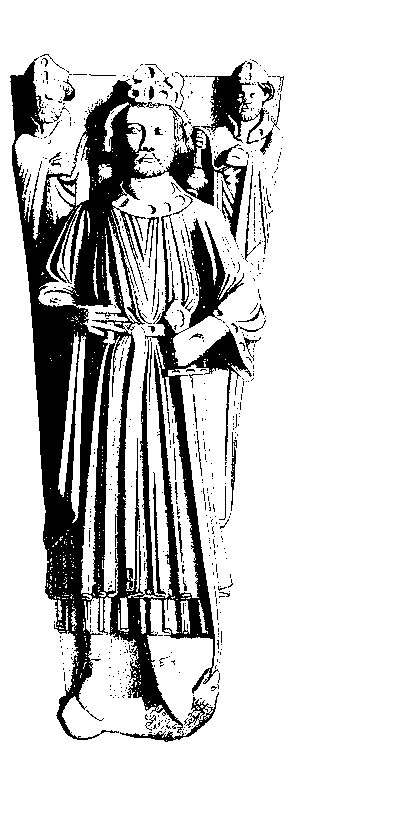
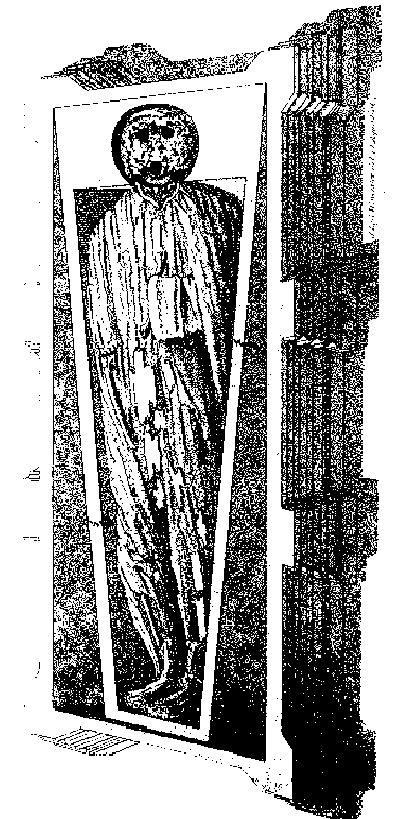
John at Worcester
Before - After
Unlike some of the other family - particularly John's dad, mom, and brother Richard - John is still where he was buried. This was verified in 1797 during the reign of King George III. People had begun to doubt there was anyone in the tomb and there were thoughts of doing some construction that might disturb the tomb. So approval was granted for its opening on July 17, 1797 and a fairly detailed account was written up.
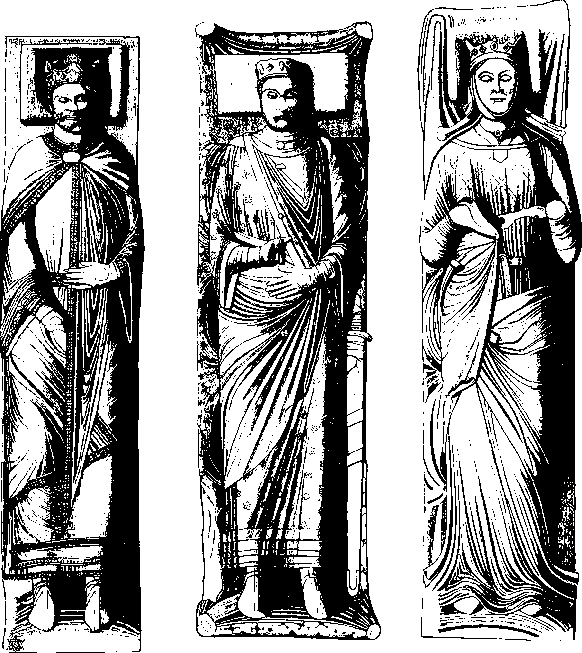
Richard, Henry, and Eleanor
At Fontrvrault
(Not There)
John was the exact median height for men of the Middle Ages - 5'7". Also as was typical for medieval men pushing fifty, he had lost most of his teeth and at least some of his hair had turned gray. He had been dressed in a fairly simple robe and he held a sword in a leather scabbard. Overall the clothing was not well preserved and it wasn't possible to tell if John was wearing footwear.
Naturally people were curious when word got out that King John's tomb would be opened. A long line of people had queued up and they were allowed to file by. However, they got a bit unruly and so the investigation was cut short. The tomb was closed and has not been opened since.
If we go by the statue of King John on his tomb and his portraits, the King John played by Leonard Rossiter was about as close an actor can get. Leonard is probably best known to British viewers for his comedic performances on BBC television but he was also a prolific stage actor. His performance as King John in the Royal Shakespeare Company production was well-praised by the critics.
The play, The Life and Death of King John is not, we are told, Will's best play. But like most of Will's historical plays he pretty much stuck with the facts as they were known at the time. Of course, then as now historians always didn't agree and so Will could pick and choose what made a better story.
Will did not picture John as the worst of English kings but as decisive and forthright, if a bit smarmy. In the first scene some of Philip's envoys come in and tell John who's the real king.
Philip of France, in right and true behalfe
Of thy deceased brother, Geffreyes sonne,
Arthur Plantaginet, laies most lawfull claime
To this faire Iland, and the Territories:
To Ireland, Poyctiers, Aniowe, Torayne, Maine,
Desiring thee to lay aside the sword
Which swaies vsurpingly these seuerall titles,
And put the same into yong Arthurs hand,
Thy Nephew, and right royall Soueraigne
John (Leoanrd) with a smirk, asks:
What followes if we disallow of this?
The envoy replies:
The proud controle of fierce and bloudy warre,
To inforce these rights, so forcibly with-held.
To which John gives a rather haughty answer:
Heere haue we war for war, & bloud for bloud,
Controlement for controlement: so answer France.
Still, in this play John isn't quite the "villaine" of popular legend, and the story has the young Arthur being killed in an accident.
The truth is that unlike the early and later consensus, John was viewed reasonably favorably by the Tudors, not just by Henry VIII but also by Henry's daughter Elizabeth I who was a Shakespeare fan. John also had his trouble with the Popes which was something that the Tudors - especially King Henry VIII - could sympathize with. John's difficulty was he and the Pope disagreed with who should be Archbishop of Canterbury. John made the monks elect his candidate John de Grey. But Pope Innocent III wanted Stephen Langton to take the seat.
Then when John made the monks elect De Grey, the Pope excommunicated him. That meant that John couldn't go to church. Then when John still wouldn't budge, Innocent placed the whole of England under interdict, for crying out loud! That meant that NO ONE could go to church, get married, baptized, or even get buried. Worse, the barons were no longer required to give allegiance to John and King Philip had carte blanche to invade England. This sorry state of affairs continued until John gave in and accepted Stephen as Archbishop.
Perhaps the strangest part of the Saga of King John is that he became enshrined in the lyrics of popular music during the Swinging Sixties. He was specifically mentioned in one of the biggest and unexpected hits of the decade:
Dominique, -nique, -nique s'en allait tout simplement
Routier pauvre et chantant
En tous chemins, en tous lieux, il ne parle que du bon Dieu
Il ne parle que du bon Dieu
A l'e poque ou Jean-sans-Terre de' Angleterre etait Roi
Dominique, notre Pere, combattit les Albigeois
Which sort of means:
Dominique, -nique, -nique, was walking over all the lands.
A poor wanderer6 singing songs.
Along all the roads at every place, he just talks of the Good Lord
He just talks of the Good Lord
At the time when John Lackland of England was the King
Dominic, our Father, fought the Albigensians.
Footnote
You have to be wary of modern automated translations. On a popular translation website, the words which mean "a poor wanderer" who was singing the songs come out as "a poor truck driver".
The song was recorded by Sister Jeanne Deckers and some of her fellow sisters - kind of a contradiction in terms - and released in 1963. As you might expect from the lyrics, Sister Jeanne was of the Dominican Order. The order was founded by Dominic de Guzmán in France. Sister Jeanne, entered Our Lady of Fichermont Convent, and contrary to considerable opinion she was not French but Belgian.
As far as the song, St. Dominic's life did indeed fall in the epoch of John Lackland. In fact the two men were almost exact contemporaries. St. Dominic was born August 8, 1170, and died August 6, 1221. King John's span was December 24, 1166 - yes, Christmas Eve - and he died October 19, 1216.
"Dominique" was released as a single and then on an album titled The Singing Nun. The album hit #1 on December 7, 1963, making Sister Jeanne the first woman to have a #1 hit on Billboard's Top 200. The album was also four weeks at #1 on Billboard's Top 100. The recording remained at the Top in 1964 until an album hit the shops titled Meet the Beatles whoever they were.
Of course, as serious as the history of England is, there is always room for some levity. So for some jokes that are fit for a king, we have:
| What type of steak does the king like? | Sir Loin. |
| Why did the king like to play poker in the bathroom? | He was sure to have a royal flush. |
| What type of car did Richard III hate? | A Twodoor. |
| What do the king and queen have at 4:00 p. m.? | Royal tea. |
And of course there's the bon mot:
| What's the difference between the Crown Prince and a bald headed man? | With one you see the heir apparent. On the other you see no hair apparent. |
References and Further Reading
King John, W. L. Warren, English Monarchs Series, Volume 11, University of California Press, 1978.
Henry II, W. L. Warren, University of California Press, 1973.
Eleanor of Aquitaine, Alison Weir, Jonathan Cape (publisher), 1999.
Richard the Lionheart, John Ginningham, Times Books, 1978.
Roger of Wendover's Flowers of History, Roger of Wendover, J. A. Giles (translator), H. G. Bohn (publisher), 1849.
"Divers Find The Tragic White Ship", Diver Net, June 13, 2021.
"The Life and Death of King John", Mr. William Shakespeare's Comedies, Histories, & Tragedies, William Shakespeare, Edward Blount and William and Isaac Jaggard Publishers, 1623 [First Folio].
An Account of the Discovery of the Body of King John, in the Cathedral Church of Worcester, July 17th, 1797, Valentine Green, V. and R. Green (publisher).
Student's History of England From the Earliest Times to the Death of King Edward VII, Volume 1, Samuel Gardiner, Publisher: Longmans, Green, and Company, 1915.
Asimov's Guide to Shakespeare, Isaac Asimov, Doubleday, 1970
Source Problems in English History, Albert Beebe White and Wallace Notestein, Harper Brothers, 1915.
"JFK Memorial at Runnymede", Runnymede and Ankerwycke, National Trust.
"10 Facts About King John's Tomb in Worcester Cathedral", Love English History, Jo Romero, February 15, 2023
"Men From Early Middle Ages Were Nearly As Tall As Modern People", Ohio State News August 31, 2004.
"Henry II of England", World Encyclopedia.
Kings and Queens of England, Alan Ereira (presenter and writer), Rachael Griffiths (director), Rachael Griffiths (producer), UKTV History, 2004.
"The Life and Death of King John", Leonard Rossiter (actor), William Shakespeare (writer), David Giles (director), Shaun Sutton (producer), BBC, 1984.
"England's King and Queen Are Actually Related!", Ancestry, June 12, 2023.