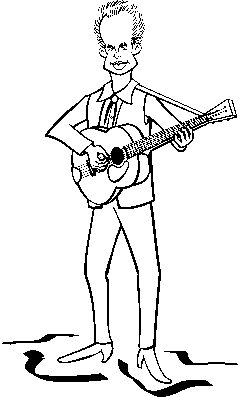
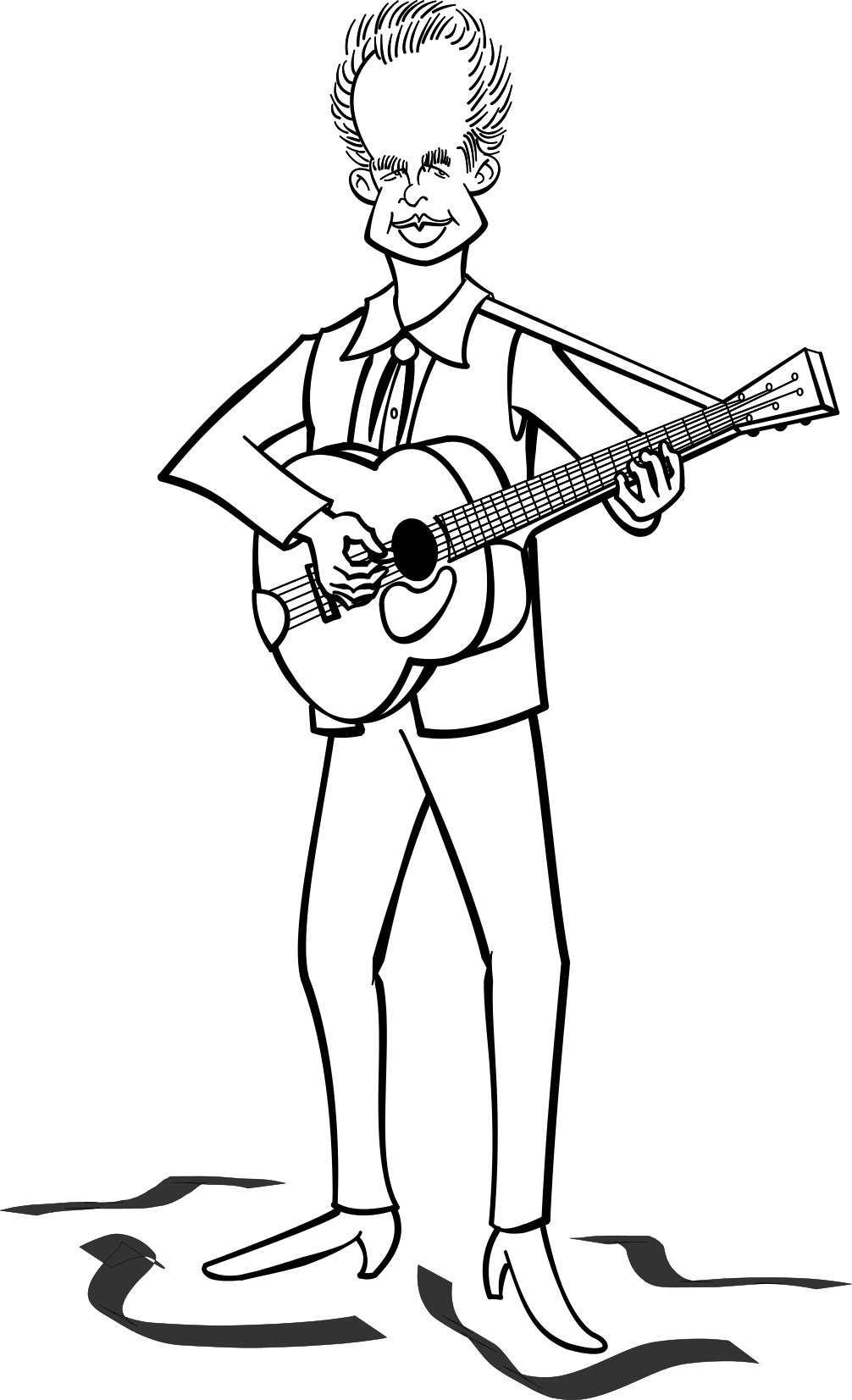
(Click Image to Zoom In and Out.)
Yes. Those who remember Merle Haggard as the Grand Old Man of Country and Western Music when he toured with a future Nobel Prize Winner forget that there was a time when Merle was a young and smooth visaged singer just beginning his career. Merle was only in his mid-twenties when he began appearing at Bob's Lucky Spot in Bakersville, California, the Gay Spot Bar in Pumpkin Center, and at the Santa Fe High School auditorium.
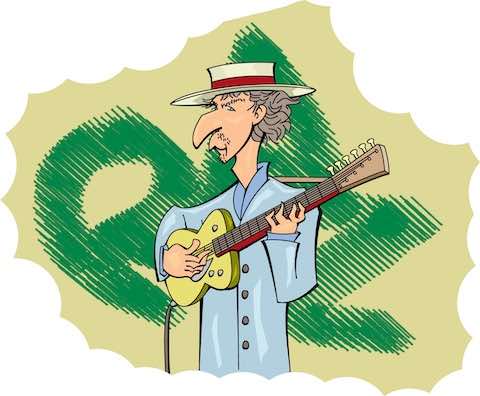
Prize Winner
But by the time he was thirty, Merle was performing at the Hollywood Bowl which had seen the likes of (to name a few) Leonard Bernstein and the New York Philharmonic, Leopold Stokowski and the Los Angeles Philharmonic, Jascha Heifetz, Duke Ellington, Frank Sinatra, Tony Bennett, Pete Seeger, Peter Paul and Mary, The Beatles, and the future Nobel Prize winner we mentioned (whose name was Robert). From there Merle moved on to playing at the University of Florida, the Warfield Theater and Regency Ballroom in San Francisco, the Congress Theater in Chicago, the State Theater in Minneapolis, the famous Surf Ballroom in Cedar Rapids, Iowa1, Hurrah's at Atlantic City, and at Van's Old Skool in London.
The Likes of Merle
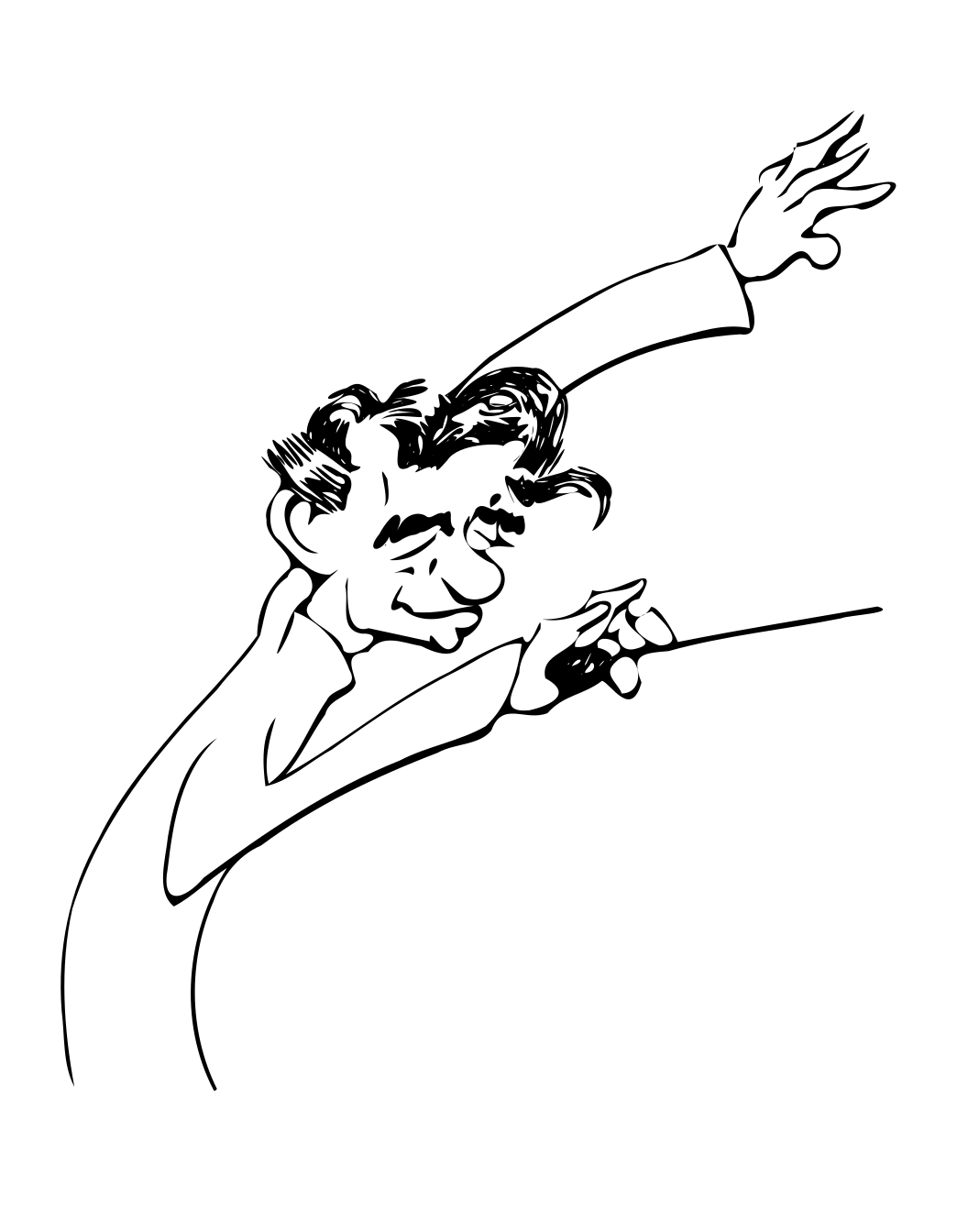
Lenny
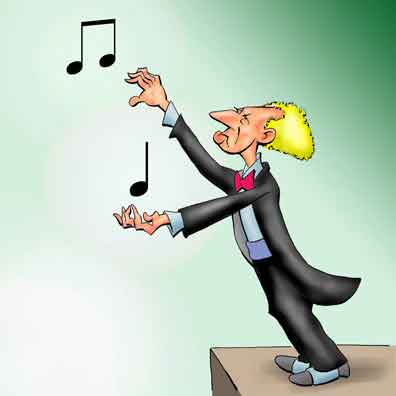
Leopold! Leopold!
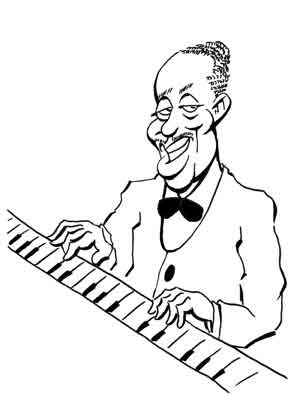
Duke
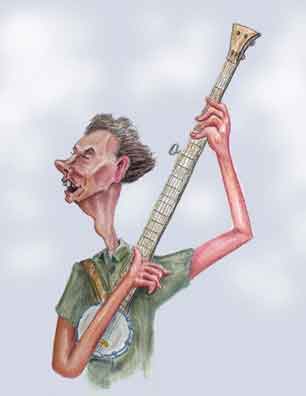
Pete
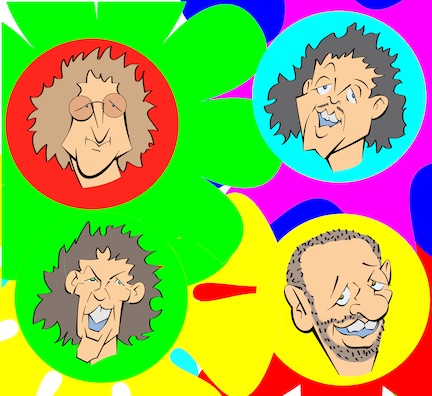
The Fab Four
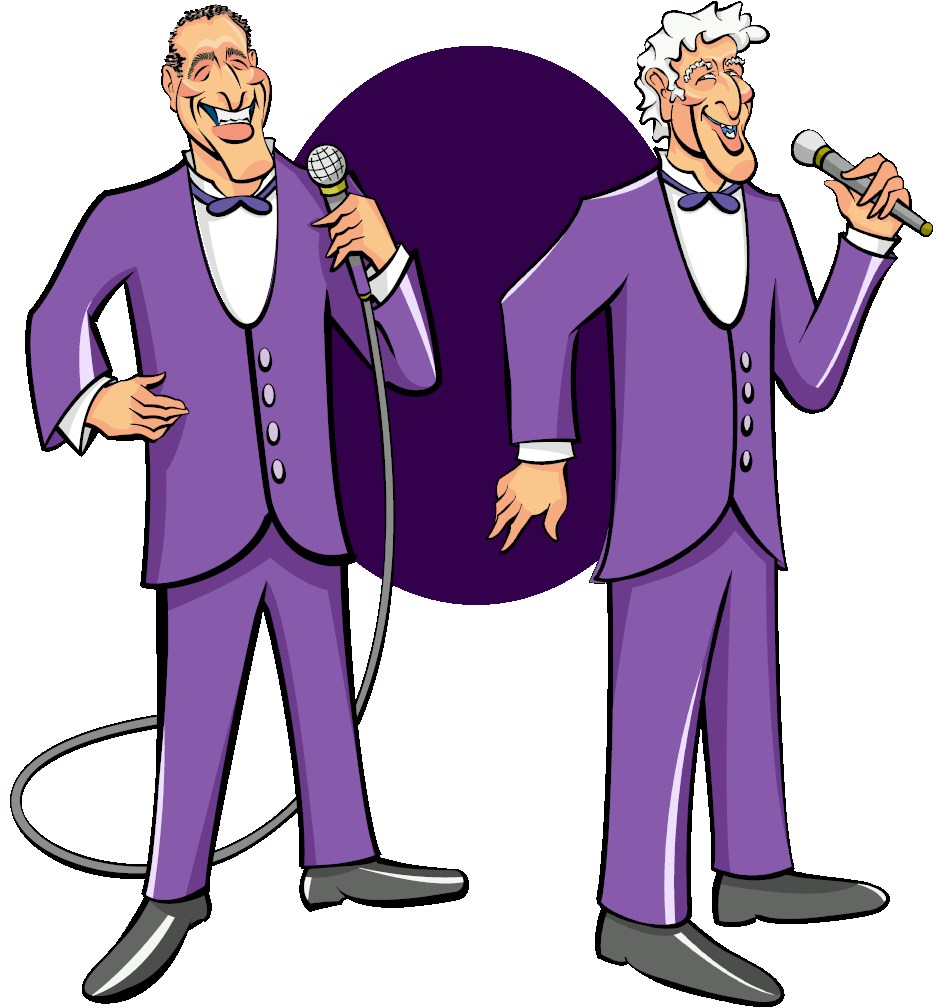
Tony Bennett(s)
Of course by then Merle and his band The Strangers had a number of hit recordings. From 1966 through 1969 they had eight #1 Country Singles and four #1 Country Albums. Then in 1969 Merle was a guest star on the mainstream but Country oriented hit TV show Hee-Haw hosted by Buck Owens and Roy Clark.
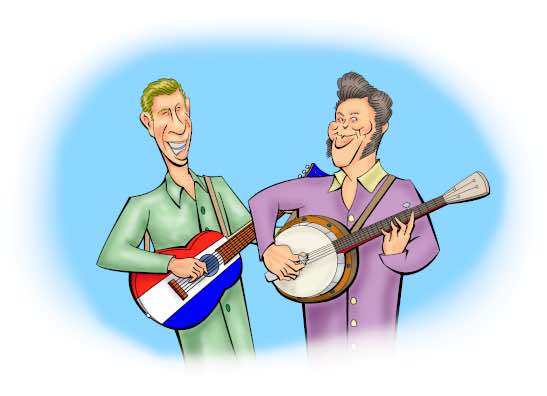
Buck and Roy
Mainstream
The Surf Ballroom - which is still a major entertainment venue - is most famous as hosting the last concert of Buddy Holly, Ritchie Valens, and J. P. Richardson ("The Big Bopper") on February 2, 1959.
The picture of Merle displayed above was NOT created by any expert computer system, often called artificial intelligence or AI. The basic drawing was in pencil and then the final image was rendered by hand albeit formatted for digital display using scaleable vector graphics or SVG for short.
But just what is scaleable vector graphics? We've always wanted to know that.
No doubt you have, as Captain Mephisto said to Sidney Brand. It's very simple really.
Most electronic images - JPEG's, TIFF's, PNG's, and GIF's - are bitmaps. A bitmap displays the image as a collection of dots of the required colors within an area on the computer display. In our bitmap of Merle, the dots - that is, the pixels2 - are mostly black and white with a few scatterings of gray. The pixel is the smallest unit of display on a computer screen and the traditional screen resolution is 72 pixels per inch - called dpi or "dots per inch".
Pixels are actually tiny squares. But whether a dot can be a square is a philosophical question that has yet to be resolved.
.
Two Merles: Bitmap (Left) and Vector (Right)
In many cases the 72 dpi resolution is fine. At a first glance the two Merles above look essentially the same. The left image is a bitmap - in fact a GIF3 file - and the picture on the right is the SVG file.
The pronunciation of GIF is a bit of a touchy topic. The Merriam-Webster Dictionary says both "JIF" and a hard-G "GIF" are used.
GIF \'gif, 'jif\ n [graphic interchange format : a computer file format for digital images; also : the image itself
Curmudgeons will sneeringly point out, well, the "hard G" is listed first so that must be correct. But those who have taken freshman English at a major Midwestern University know that Merriam-Webster normally posts the earliest pronunciation first. But that may or may not be the current preference.
But the American Heritage Dictionary lists the most current pronunciation first. And what we read there is:
GIF (jĭf, gĭf) Computers, A service mark used for a raster-based format for storing files of color graphics.
And as any linguistics professor will tell you, usage dictates correctness. So by this criterial JIF is correct.
But more to the point, the gentleman who invented the GIF format has weighed in on the controversy. During one presentation, he put up a slide reading:
IT'S PRONOUNCED "JIF"
NOT "GIF".
So by the creator's prerogative, the word should sound like "JIF"
.
But if you zoom in on the bitmap to make the image bigger you also expand the size of the dots. So the image gets larger but not sharper. In fact, if you expand a bitmap too much, the edges get blurry and blocky.
On the other hand with scalable vector graphics images the computer draws the image by plotting equations where the primary variable is the screen pixel. Then when you zoom in, the computer simply redraws the equation. But because the variable of the equations is a single pixel, when you zoom in the edges of the lines stay sharp and crisp.
Expanded Merles
Although Merle was never a big cross-over artist, in his heyday he was very nearly a household word, and he did have a number of songs make the Billboard Top 100. These included "If We Make It Through December", "From Graceland To The Promised Land", "Carolyn", "Everybody's Had The Blues", "Soldier's Last Letter", and "The Fightin' Side Of Me".
But the one song that garnered Merle the most nationwide fame - although it didn't break into the Billboard Top 40 - was the title song of his first live album. Released in 1969, the song and its history - and a few details about Merle's life and times - merit an essay in themselves.
References and Further Reading
"Merle Haggard", Concert Archives.
"Merle Haggard Discography", Discogs.
"Hollywood Bowl History", Concert Archives.
"Merle Haggard", Billboard.
"The Truth Behind Merle Haggard's Time In Prison", Eric Meisfjord, Grunge, March 18, 2020 (Update).
"Is 'GIF' Pronounced 'Jiff' or 'Giff'?, Merriam Webster.
Return to CooperToons Caricatures
Return to CooperToons Homepage