Dick Plasman
(Click on the image to zoom in.)
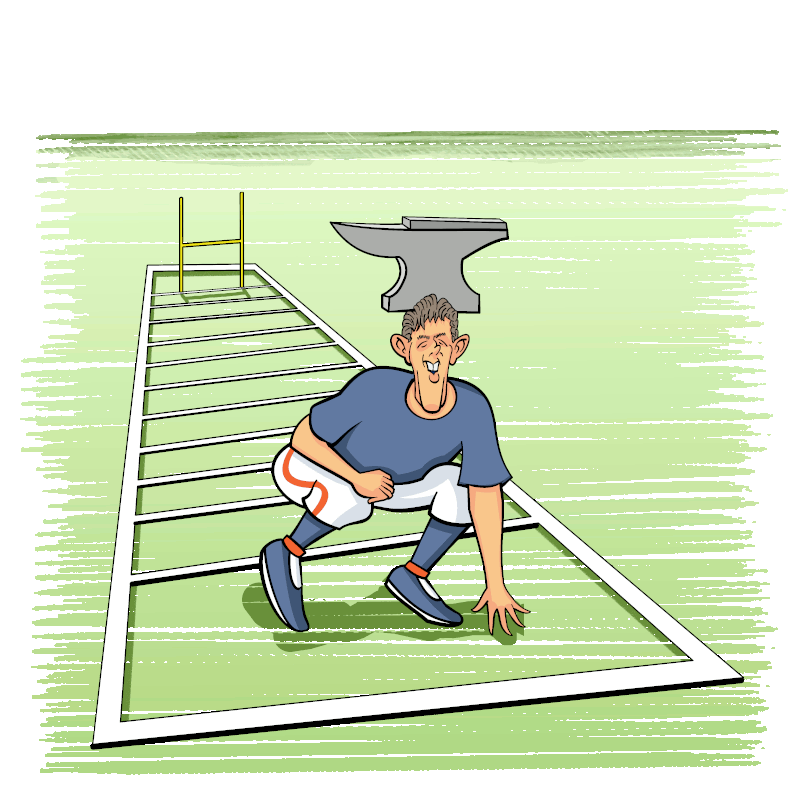
Admittedly Herbert Gustave Plasman is not a name often brought up in discussions of America's professional sports. However, Dick - as he was known to his friends and fans - has a unique place in the history of the National Football League.
First of all, Dick was a very tough man, and one of the most respected scholars of America's favorite pastime1 stated that Dick should be in the Hall of Fame. Unfortunately, Dick played professional football in the 1930's and 1940's which is one of the sport's least studied eras. Pay was low and the seasons short. All players had off-season jobs which could range from selling insurance to working construction to coaching high school kids. Although college football was one of the most popular sports, professional football was literally a non-entity. With a few exceptions, the players and coaches remained virtually unknown.2
Footnote
In 1965 baseball still claimed to be ahead of football in popularity. But that was also the year that football and baseball polled as parity in popularity. Starting in 1966, football pulled ahead.
Today 38% of Americans canvassed say that football is their favorite sport. Baseball, once hailed as America's National Pastime, merits - get this - a paltry 9%. But the highest ranking of football was in 2006 when a whopping 43% of the populace said it was their favorite sport.
Footnote
Even well into the 1950's the best pro football players were not known to most of the American public. In 1956 Frank Gifford was the star halfback for the New York Giants and had been voted the Most Valuable Player in the NFL Championship. But after the game, when he appeared as a contestant on the celebrity panel quiz show What's My Line?, only Bennet Cerf knew who he was.
It wasn't just the players who languished in anonymity. The next year the head coach of the Giants, Jim Lee Howell, was one of the spurious guests brought in to confuse the panelists. No one recognized him either. The real contestant was Robert Crowder, the Chief of the Texas Rangers.
Then in 1958 the NFL Championship was held in New York and pitted the Giants against the Baltimore Colts. This game was soon dubbed - and sometimes still is - the greatest football game ever played. The game made the front page news and the evening news on television. That evening the Giants' Ray Berry - who had caught 12 passes in the game - was a guest on What's My Line. No one recognized him and what will SHOCK! SHOCK! today's fans is that when Bennett mentioned Baltimore's quarterback Johnny Unitas he pronounced his name yoo-nee-TASS rather than the correct and now universally known you-NYE-tus.
Even more amazing is that as late as 1962 - yes, 1962 Green Bay linebacker Ray Nitschke also appeared on What's My Line. That day Green Bay had played against the New York Giants and Ray was voted the Most Valuable Player. The game was televised from New York AND Ray was appearing on a TV show where the celebrity panelists - Bennett Cerf, Dorothy Kilgallen, Arlene Francis, and Martin Gabel - were all New Yorkers. And yet no one recognized him!
It was also the era of minimal protection. As can be seen from players from the era of Jim Thorpe (or his cinematic counterparts), the players sported small shoulder pads and the pants had minimalistic padding around the knees, thighs, and waist. The head protection was the old snug-fitting and often unpadded helmets. Although rubber and plastic helmets were beginning to show up, a lot of players kept with the old leather helmets which are perhaps more accurately referred to as caps.
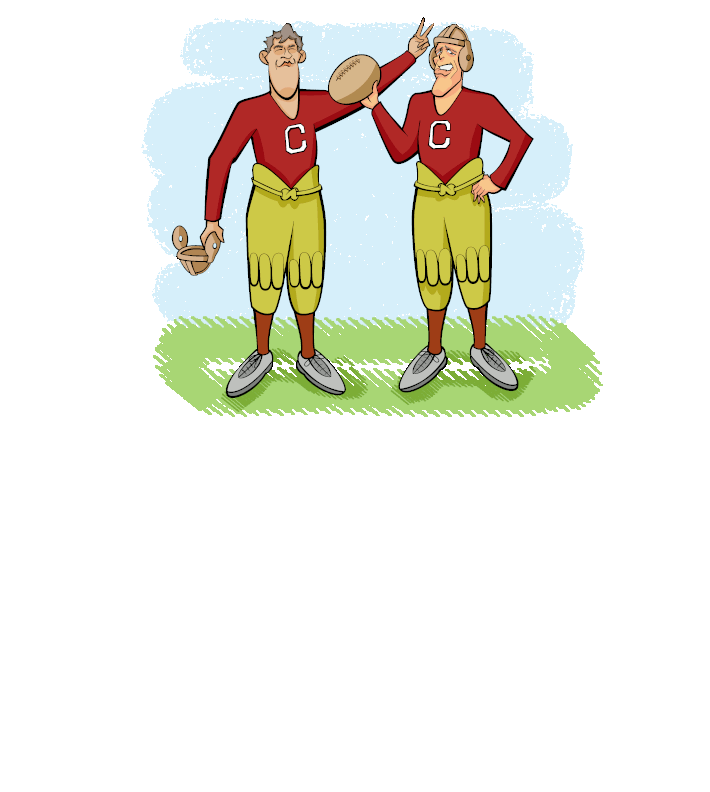
A quick perusal of the old football games - and we're talking about not long after Pudge Heffelfinger played for Yale - reveals many players forswore headgear altogether. A film clip from a 1903 game of Princeton vs. Yale shows helmets were definitely optional. The feeling seems to have been why wear protective gear that provided no protection. Of course, today there are strict requirements for helmets and their design. But it wasn't until 1943 that their wearing was mandated by the NFL.3
Footnote
The finalization of the rules for face masks is a bit harder to trace down. Some references cite 1962 as the year the NFL made face masks mandatory but other scholars mention that flanker Tommy McDonald went maskless as late as 1968 when playing for Cleveland. Bobby Layne was the last quarterback to go without a mask when he played for Pittsburgh and he retired after the 1962 season.
However there are pictures of kickers and punters, and holders playing without masks as late as the early 1970's. Use of more than single and double bar masks were required by 1975.
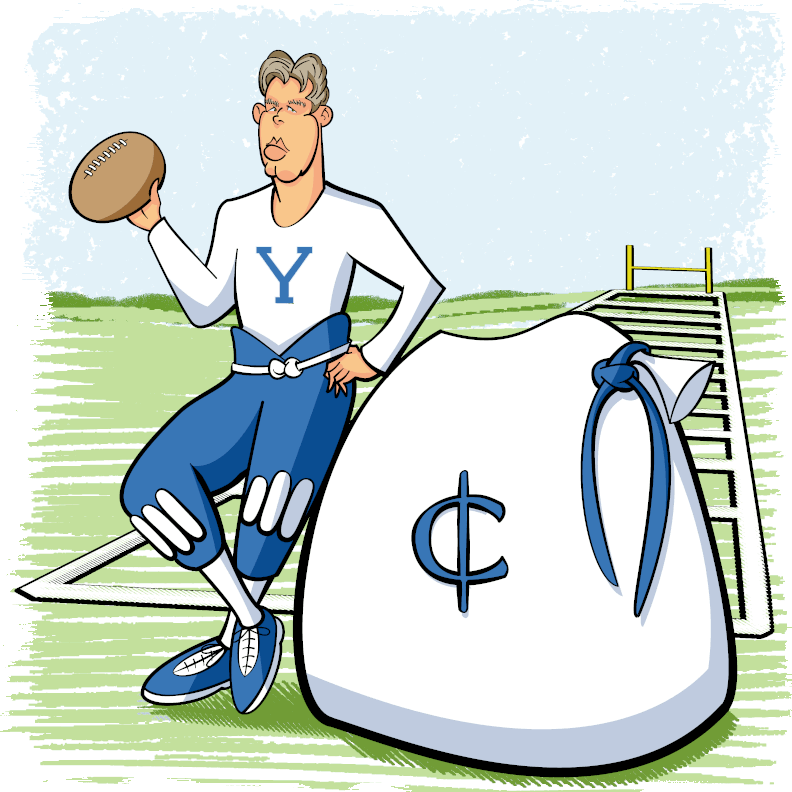
Pudge
Yale and the Bulldogs
(Click to zoom in and out.)
It was, though, Dick who began playing for the Chicago Bears in 1937 who was the last NFL player to take the field in a regular season game without headgear. Yes, Dick played the game without the regulation helmet, casque, toque, or lid. Even off the field he seems to have preferred the bareheaded look.4
Footnote
On the other hand one scholar has found that as late as 1965, the Detroit running back Joe Don Looney played in practice without a helmet. Joe Don misplaced his helmet and simply didn't want a new one.
Joe Don's last name was truly prophetic and he was definitely from the far end of the bell curve. Joe Don had played for three colleges (including Cameron Junior College in Lawton, Oklahoma) and never played for a professional team for more than two seasons before getting cut or traded.
Although when Joe Don would arrive at the training camps the coaches had high expectations, it didn't take long to see the best football lteam was one without Joe Don Looney. He would cut practices and if he didn't want to do as a coach instructed, he didn't. Once when a coach told him to take a play into the huddle Joe Don replied "If you want a messenger boy, call Western Union."
So it's no surprise that during his career Joe Don played for five teams over six years. Once he was walking along the street with a friend named Bob Tate and looked up. "You know, Tate", Joe Don said, "I sure am glad I'm not a building." "Yeah, Joe", Bob said, "It would be awful hard on you moving from town to town."
Naturally this modus footballerandi had its hazards. On November 6, 1938, at Green Bay, quarterback Ray Buivid hefted a pass to Dick. Dick ran down the field and while keeping his eye on the ball ran right into the wall in the end zone. The collision ripped open his scalp and broke his wrist and three ribs. Although Dick's mother thought he would never play again he was back playing the next year with the side benefit that he married the nurse who attended to him while he was in the hospital. (Pst! Green Bay won the game.)
Dick's last helmetless game was December 28, 1941, two weeks after Pearl Harbor. It was for the NFL Championship. The helmetless Dick made two receptions and Chicago won handily 37-9.
Dick soon went into what was then called the Army Air Force and returned to the Bears in 1944. By then, though, the Powers That Be The NFL told Dick to wear a helmet. He did, but he didn't like it.
After the War, Dick moved on to play for the Chicago Cardinals, a team that eventually relocated to St. Louis and then to Arizona where they remain. In 1947 Dick became an assistant coach for the Cardinals and later was assistant for the Green Bay Packers and the Pittsburgh Steelers. He retired in 1961.
Of course, all scholarship and no levity makes for a dull gridiron. So it seems proper to wind up this discussion about football with some jokes of uniform quality.5
Where do football players go when they need a new uniform?
New Jersey.
Why couldn't the football player understand a joke about his helmet?
It went over his head.
Why does it take so long to tell jokes about football uniforms?
Because there's so much padding.
And of course there's ...
Why did the football player hang his helmet on the field's palisade?
He heard you needed helmets for de-fence.
References and Further Reading
"Dick Plasman", Football Reference.
"Last Man to Play Without a Helmet Has Hole in His Head", The Southeast Missourian, October 31, 1974, p. 17.
"The NFL's Last Helmetless Player Didn’t Even Like Hats", Christopher Klein, History, November 11, 2021 (Updated: May 28, 2025).
"Leatherhead to Radio-Head: The Evolution of the Football Helmet", Jimmy Stamp, Smithsonian, October 1, 2012.
"A History of Helmet and Face Mask Requirements", Football Archaeology, November 24, 2024.
"Molded Rubber Helmet", Chris Hornung, Antique Football.
"Football Still Americans' Favorite Sport to Watch", Jim Norman, Gallup News, January 4, 2018.
"The Evolution Of NFL Helmets, From Leather To Polycarbonate", Sandra Mardenfeld, Grunge, March 13, 2023.
"Offensive and Defensive Linemen of the Decades", John Turney, Pro Football Journal, June 17, 2019.
"17 Photos From The Early Days of American Football (1900s)", Matt Staff, The Scroller, March 6, 2025.
"First American Football Game Ever Filmed: 1903 Princeton Tigers vs. Yale Bulldogs", History Color.
"The Last Helmetless Player - in 1965?", Dan Daly, Profootball Daly.
The Thinking Man's Guide to Pro Football, Paul Zimmerman, Dutton, 1970, (Revised: The New Thing Man's Guide to Pro Football, HarperCollins, 1987).
"The Bronk and the Gazelle", Paul Zimmerman, Sports Illustrated, September 11, 1989.
"Plasman, Chibear End, Sent to Hospital", [Washington, D. C.] Evening Star, November 7, 1938, p. A-15., Chronicling America, Library of Congress.