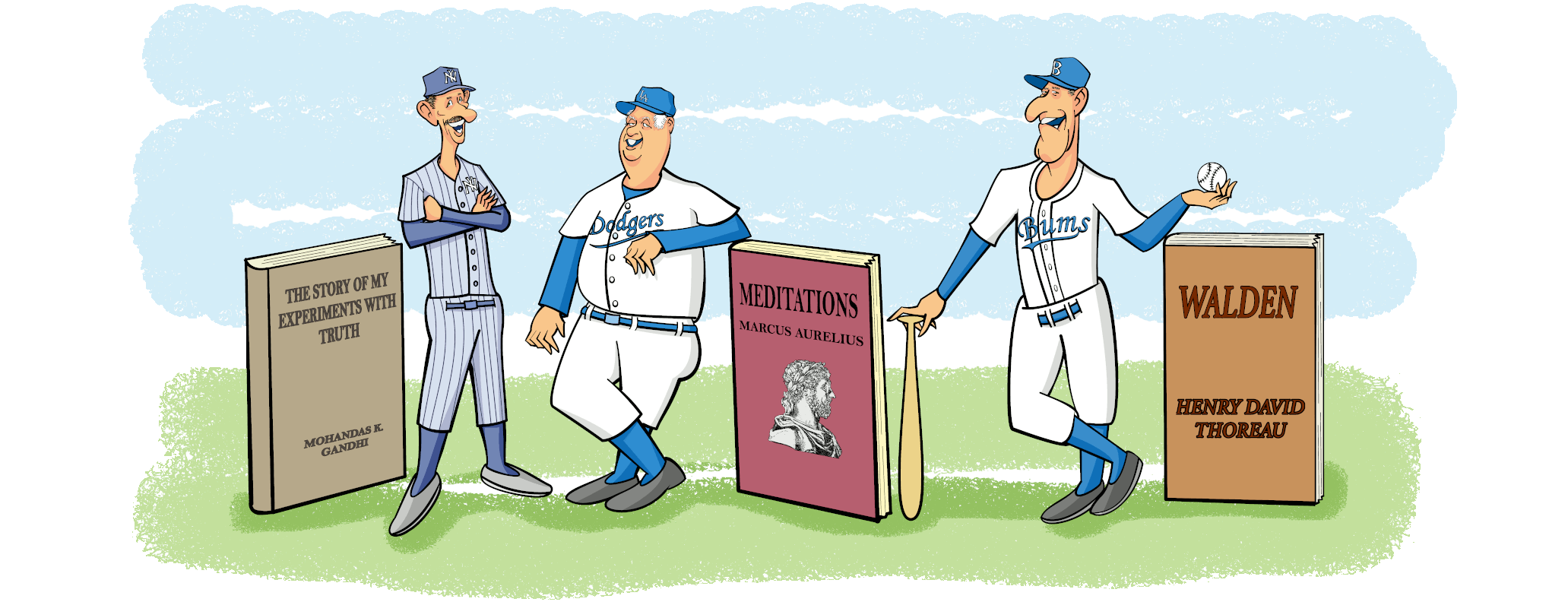
Billy Martin, Tommy Lasorda,
and Leo Durocher
(Click on the image to zoom in.)
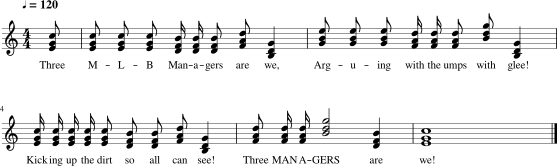
Three MLB Managers are we,
Arguing with the umps with glee.
Kicking up the dirt so all can see!
Three MAN-A-GERS ---- are we!
Billy Martin, Tommy Lasorda, and Leo Durocher were among the most famous of the managers of 
 National Pastime during what some scholars call the Classic Era. Tommy and Leo are best known for their time with the Brooklyn/Los Angeles Dodges. Billy won his fame first as a player and then manager of the New York Yankees.1
Footnote
Some scholars will argue against including Tommy and Billy with Leo as managers of the Classic Era which is usually regarded as ending in 1980. Leo began managing in the late 1930's and retired in 1973. Billy debuted as a manager for Minnesota in 1969 and finally retired in 1988. Tommy began managing the Dodgers in 1976 and retired in 1996. However, both Bill and Tommy began managing teams in the Classic Era and so it seems only just and proper to include them.
Leo Durocher was the senior of trio. Leo was born in 1905 and although a native born American citizen, was of French Canadian heritage and didn't even speak English until he started school. So perhaps we should be referring to LAY-oh duh-roh-SHAY.
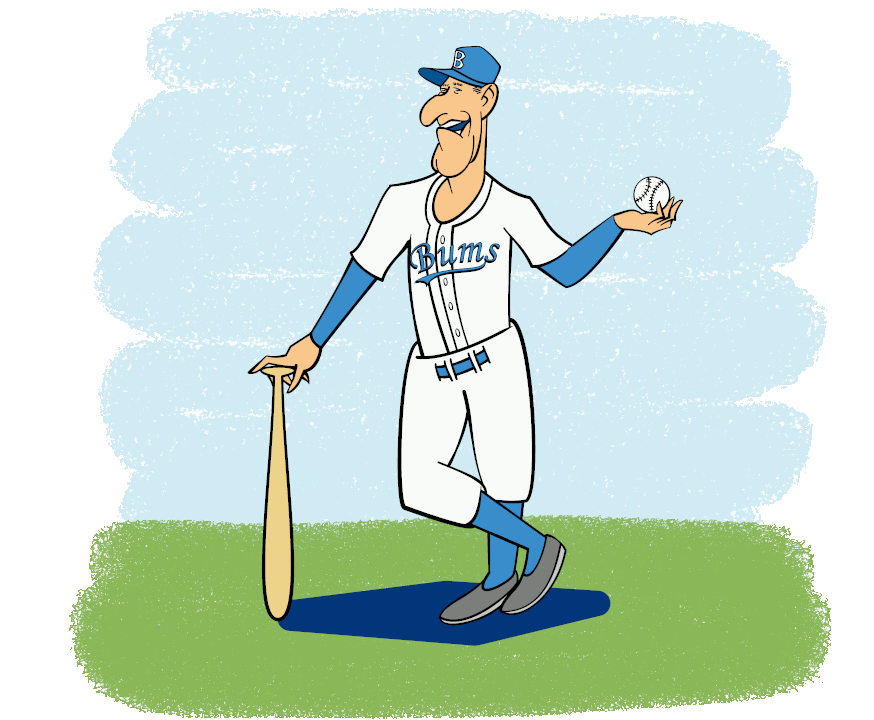
Léo le Lèvre
Rien ne se résout jamais par la dispute.
(Cliquez sur l'image pour effectuer un zoom avant ou arrière.)
Leo is considered one of the winningest managers of Major League Baseball. He led teams in a total of 3739 games and won 2008, lost 1709, and tied 22.2 Critics, though, will point out this is a WIN-LOSS PERCENTAGE (WLP) of a mediocre 54%. Scarce anything to get excited about.
Footnote
Yes, although rare, you can have tie games in baseball. Historically most ties were due to the game having to be stopped due to weather or dark. If there were less than five innings completed, the game would be continued at a later date. But if the game was "official" - five innings - and had to be stopped with equal scores, the game was done and ended in a tie.
Tie games, though, are increasingly rare even though "extra-inning" games are ballooning in number. Of course, this is because nowadays games can extend well into the night. The last holdout for no-games-but-in-the-day was famously the Chicago Cubs. But finally in 1988 Wrigley Field had electric lights installed that let them play as long as the men (and the pitching rotation) could hold on. Interestingly the last tie game was a 1-1 score on September 29, 2016, between the Pirates and the Cubs in, yes, Wrigley Field. The game was called in the 6th inning because of rain.
The 2002 All-Star Game also ended in a tie, but that was because the managers ran out of pitchers. There was also an extra-innings game back in 1920 between the Brooklyn Dodgers and the Boston Braves that ended in a 1-1 tie. After 26 innings - the current record for a baseball game - the game was called because of darkness.
Today ties are not permitted in playoff games. If the game has to be stopped before someone wins, the game must be resumed at a later date.
Not so fast, there, pardner. A middlin' value WLP is pretty much what you get for a high winning manager who had a long professional career. After all in their later years it's understandable if they lose a bit of steam compared to their salad days.
Leo's Wins
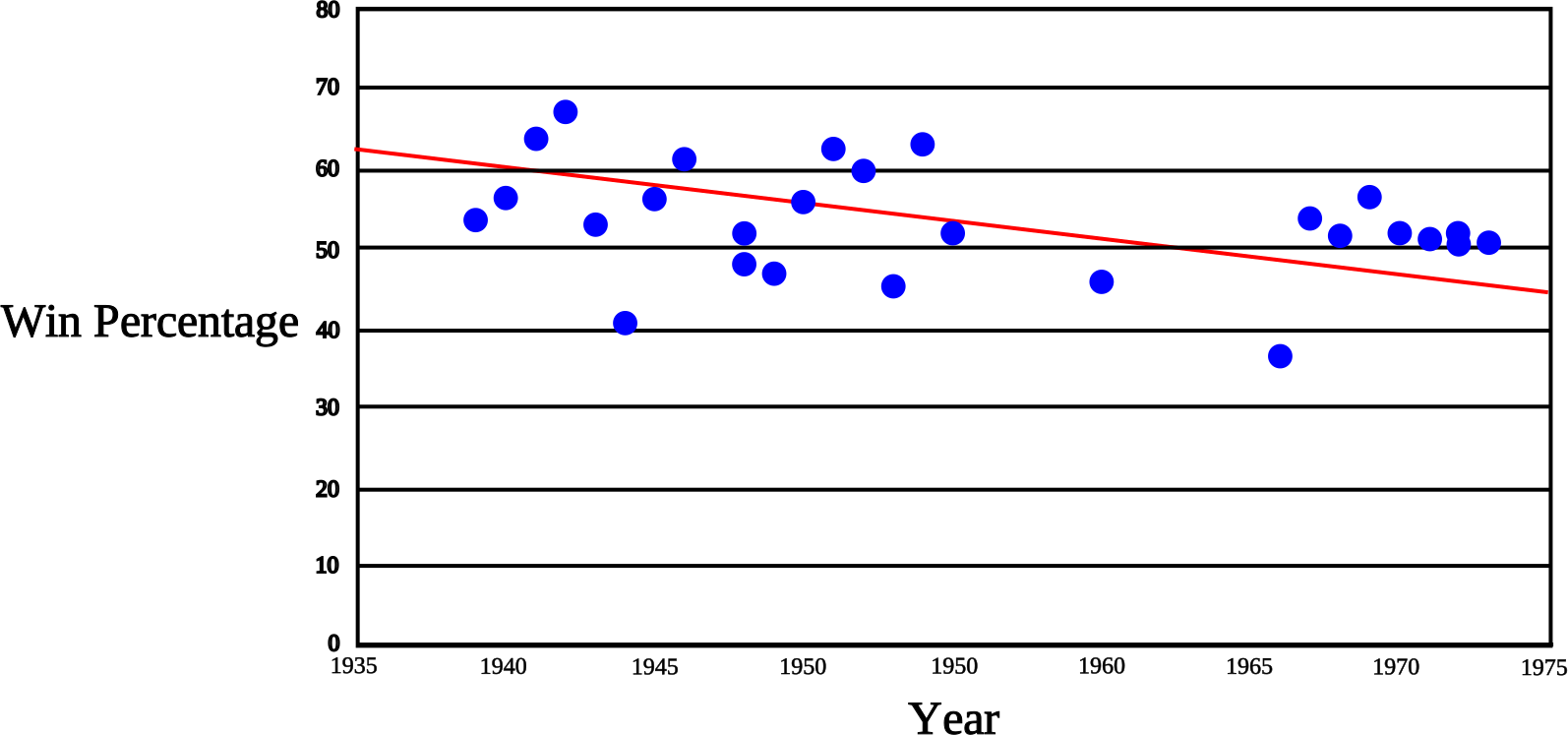
On the average Leo's WLP dropped about only 0.5% per year and at the time when the teams played between 154 and 162 games. Statistical curmudgeons will also point out that the apparent drop is not - quote - "statistically significant" - unquote.3 In any case, the percentage of wins means little by itself. After all, the managers Mel Harder, Clyde Sukeforth, Dick Tracewski, Vern Benson, Bill Burwell, Andy Cohen, Bibb Falk, and Jo-Jo White had winning percentages of 100%. Of course, they also only managed one game.
Footnote
Statistical significance is a concept that everyone has heard about but few people understand. Briefly statistical significance is the probability that when you think a change has occurred it hasn't. Instead you're just seeing a chance fluctuations in the individual data points.
More exactly believing there is a change and there isn't is called a Type I Error and the significance of the analysis is the probability that you will make a Type I Error using the data you have. If the probability you make a Type I Error is low, the probability is high that the observed change is real.
What confuses people is that to calculate the statistical significance, you work backwards. That is to prove there is a change you assume there isn't. Then you calculate how often you will see a change in the data that is equal to or greater than what was observed in your actual experimental sample. There are formulas for calculating significance but with the advent of the computer age numerical alternatives have been developed.
For instance to determine if Leo's slowly decreasing WLP was "real" you assume it isn't decreasing but is actually holding constant. That means that the changes in the WLP in a given year were simply change fluctuations. Then you calculate how often chance alone would produce an apparent and false drop in Leo's WLP.
If the significance is below 0.05, then that means the probability you are seeing a Type I Error is 5 % or less and and so the confidence there is a real change after all is 95 % or greater.
In the case with Leo, the significance in the WLP change over time is 0.09 or 9%. This is not significant at the 95% confidence but is at 90% confidence.
The conclusion is that we can't prove that Leo's wins were dropping off throughout the years with the confidence everyone craves. But it's probably true nevertheless.
Billy, Tommy, and Leo were what we call "characters". Leo was brash but approachable and he appeared in a number of movies and television shows. He was a guest star on Mr. Ed, The Munsters, and The Beverly Hillbillies where he played - yes - Leo Durocher. In one movie he gave an inspirational speech to some young athletes telling the young men that they should be kind to each other and avoid arguments - because, Leo said, nothing ever gets solved by arguing.
It should be noted that Leo delivered his inspirational speech in a comedy. At first the viewers couldn't see who was speaking. But then after the kids accepted the advice, the camera panned up to reveal it was Leo Durocher who was talking.
Today the humor about Leo saying that nothing ever gets solved by arguing may be so obscure as to require considerable elaboration. But at one time it would have been so familiar as to require no explanation. If there was anyone who ever tried to solve matters by arguing it was Leo "The Lip" Durocher.
As a player, Leo was part of the 1920's Yankees where Babe Ruth gave him the nickname "The All American Out". He later went to St. Louis as part of the Gas House Gang. Never a power hitter in his 17 years as a player Leo managed 24 home runs but a fairly respectable career batting average of 0.247.4
Footnote
So much is made about hitting home runs, it's often missed that a number of successful players have hit few out of the park smackers. Of course, pitchers aren't expected to hit many homers and with the lamentable arrival of the designated pinch hitter many don't even get a chance. On the other hand, shortstop Frank Taveras managed only two homers in his 11 years in the major leagues. His fielding skills made up for his lack of power hits. Also Duane Kuiper, later a successful sports announcer, spent over 10 years in the majors and hit one - count 'em - one home run.
As a manager, though, Leo's record is not to be denied. He not only won a total of 2008 games but in the interim he picked up three pennants and the 1954 World Series. And yes, Leo ended up in the Baseball Hall of Fame where his official biography mentions his famous nickname and his arguments with the umpires.
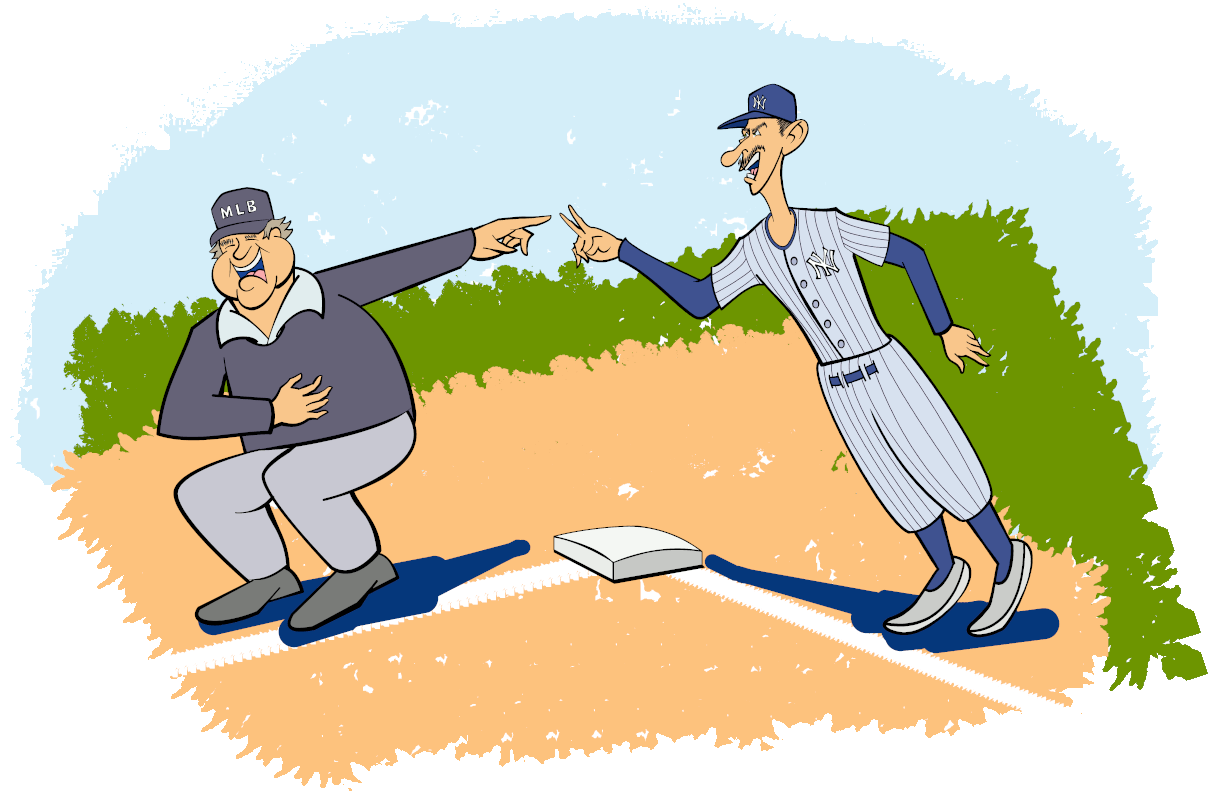
Disputations on the Diamond
(Click to zoom in and out.)
Of course, Leo had no monopoly on Disputations on the Diamond. In the mind of many, one of the Champion Umpire Arguers - and who some may think even eclipsed Leo the Lip in linguistic lambastics - was Alfred Manuel Martin, Jr. We mean Billy, of course. Although he's most famous as a Yankee, he also played for the Kansas City Athletics, the Detroit Tigers, Cleveland Indians, Cincinnati Red, Milwaukee Braves, and the Minnesota Twins. Following his playing years he managed successively for the Minnesota Twins, Detroit Tigers, Texas Rangers, New York Yankees, Oakland Athletics, and then coming a full circle he came back to the Yankees. But as the many video clips of Billy attest, he was also famous for arguing most voraciously with the umpires.
But in fairness to Billy, if the actual numbers are consulted, Billy doesn't really come off as that cantankerous.
| Ranking | Manager | Ejections |
| 1 | Bobby Cox | 162 |
| 2 | John McGraw | 121 |
| 3 | Leo Durocher | 100 |
| 4 | Earl Weaver | 96 |
| 5 | Tony La Russa | 93 |
| 6 | Bruce Bochy | 89 |
| 7 | Frankie Frisch | 88 |
| 8 | Ron Gardenhire | 84 |
| 9 | Paul Richards | 82 |
| 10 | Jim Leyland | 73 |
| 11 | Clark Griffith | 73 |
| 12 | Joe Torre | 70 |
| 13 | Bob Melvin | 68 |
| 14 | Lou Piniella | 64 |
| 15 | Clint Hurdle | 64 |
| 16 | Bill Rigney | 64 |
| 17 | Joe Maddon | 59 |
| 18 | Dick Williams | 57 |
| 19 | Sparky Anderson | 56 |
| 20 | Gene Mauch | 54 |
| 21 | Terry Francona | 54 |
| 22 | John Gibbons | 53 |
| 23 | Charlie Manuel | 52 |
| 24 | Jimmy Dykes | 51 |
| 25 | Mike Hargrove | 50 |
| 26 | Tommy Lasorda | 48 |
| 27 | Billy Martin | 48 |
| 28 | Mike Scioscia | 47 |
| 29 | Ned Yost | 47 |
| 30 | Jim Fregosi | 46 |
| 31 | Aaron Boone | 46 |
| 32 | Ralph Houk | 45 |
| 33 | Fred Hutchinson | 45 |
| 34 | Bobby Valentine | 44 |
| 35 | Phil Garner | 44 |
| 36 | Joe Girardi | 43 |
| 37 | Whitey Herzog | 42 |
| 38 | Buddy Bell | 42 |
| 39 | Casey Stengel | 40 |
| 40 | Terry Collins | 40 |
| 41 | Chuck Tanner | 38 |
| 42 | Bud Black | 38 |
| 43 | Don Mattingly | 38 |
| 44 | Pat Corrales | 38 |
| 45 | Walter Alston | 37 |
| 46 | Dave Bristol | 37 |
| 47 | Buck Showalter | 36 |
| 48 | Davey Johnson | 36 |
| 49 | Bill Dahlen | 36 |
| 50 | Fred Clarke | 35 |
So if you go by the total number of times a manager got the old heave-ho Billy doesn't even make the top twenty. WAY below Leo.
Admittedly the rankings are a bit of a surprise. Joe Torre never came off as grumpier than Billy, nor did Charlie Manuel. Of course what we're seeing here is the total number of ejections which is not necessarily a complete measure of contention. A better marker might be the ejection rate, that is the number of ejections as the percentage of games played. And what we see then is veeerrrrryyyyy interesting.
| Ranking | Manager | Ejections | Games | Percentage |
| 1 | Bill Dahlen | 36 | 615 | 5.85 |
| 2 | Paul Richards | 82 | 1837 | 4.46 |
| 3 | Frankie Frisch | 88 | 2246 | 3.92 |
| 4 | Aaron Boone | 46 | 1194 | 3.85 |
| 5 | Earl Weaver | 96 | 2541 | 3.78 |
| 6 | Bobby Cox | 162 | 4508 | 3.59 |
| 7 | Ron Gardenhire | 84 | 2480 | 3.39 |
| 8 | Buddy Bell | 42 | 1243 | 3.38 |
| 9 | John Gibbons | 53 | 1582 | 3.35 |
| 10 | Pat Corrales | 38 | 1211 | 3.14 |
| 11 | Charlie Manuel | 52 | 1826 | 2.85 |
| 12 | Fred Hutchinson | 45 | 1666 | 2.7 |
| 13 | Leo Durocher | 100 | 3739 | 2.67 |
| 14 | Dave Bristol | 37 | 1424 | 2.6 |
| 15 | John McGraw | 121 | 4769 | 2.54 |
| 16 | Clark Griffith | 73 | 2917 | 2.5 |
| 17 | Bill Rigney | 64 | 2561 | 2.5 |
| 18 | Clint Hurdle | 64 | 2615 | 2.45 |
| 19 | Joe Maddon | 59 | 2599 | 2.27 |
| 20 | Jim Fregosi | 46 | 2122 | 2.17 |
| 21 | Phil Garner | 44 | 2040 | 2.16 |
| 22 | Billy Martin | 48 | 2267 | 2.12 |
| 23 | Mike Hargrove | 50 | 2363 | 2.12 |
| 24 | Joe Girardi | 43 | 2055 | 2.09 |
| 25 | Jim Leyland | 73 | 3499 | 2.09 |
| 26 | Bob Melvin | 68 | 3266 | 2.08 |
| 27 | Don Mattingly | 38 | 1839 | 2.07 |
| 28 | Terry Collins | 40 | 2012 | 1.99 |
| 29 | Bruce Bochy | 89 | 4518 | 1.97 |
| 30 | Dick Williams | 57 | 3023 | 1.89 |
| 31 | Bobby Valentine | 44 | 2351 | 1.87 |
| 32 | Ned Yost | 47 | 2544 | 1.85 |
| 33 | Lou Piniella | 64 | 3548 | 1.80 |
| 34 | Whitey Herzog | 42 | 2409 | 1.74 |
| 35 | Tony La Russa | 93 | 5387 | 1.73 |
| 36 | Jimmy Dykes | 51 | 2962 | 1.72 |
| 37 | Joe Torre | 70 | 4329 | 1.62 |
| 38 | Tommy Lasorda | 48 | 3040 | 1.58 |
| 39 | Mike Scioscia | 47 | 3078 | 1.53 |
| 40 | Davey Johnson | 36 | 2445 | 1.47 |
| 41 | Bud Black | 38 | 2596 | 1.46 |
| 42 | Terry Francona | 54 | 3784 | 1.43 |
| 43 | Ralph Houk | 45 | 3157 | 1.43 |
| 44 | Sparky Anderson | 56 | 4030 | 1.39 |
| 45 | Chuck Tanner | 38 | 2738 | 1.39 |
| 46 | Gene Mauch | 54 | 3942 | 1.37 |
| 47 | Fred Clarke | 35 | 2826 | 1.24 |
| 48 | Casey Stengel | 40 | 3766 | 1.06 |
| 49 | Buck Showalter | 36 | 3393 | 1.06 |
| 50 | Walter Alston | 37 | 3658 | 1.01 |
In that case Leo, who comes in at a 2.6% ejection rate, drops below the Top 10. That's lower than even Charlie Manuel (2.8%). Joe Torre is actually quite cheerful at 1.6%. Even Billy is still below the Top 20 with a 2.2% ranking. So Billy was scarcely the most fractious of managers and Casey Stengel barely makes the list at all.5
Footnote
Some just criticism may also be directed at the percentage as a proper ranking as it deals only with the matter of the ejection but not the manner. For instance, Lou Piniella who sequentially managed the New York Yankees, Cincinnati Reds, Seattle Mariners, Tampa Bay Devil Rays, and the Chicago Cubs has a mere 1.8% ranking and so comes off as quite mild.
But what Lou has lacked in quantity he compensated in quality. He is famous for showing his displeasure by kicking dirt on the umpires and even covering up home plate. In one game after an objectionable call he ran out of the dugout and began shouting and threw his hat on the ground. The umpire then signaled that Lou was out of the game.
Rather than Leo going back to the club house - ejected players are supposed to leave the playing area - he yanked out the first base bag and tossed it into right field. He then walked over, picked up the base again and threw it again even further.
Tommy Lasorda was one of Billy's contemporaries and he signed up as a southpaw pitcher with the Philadelphia Phillies in 1945. Of course he first played in the Phillies farm system where in one game in 1949 he tossed a flabbergasting 25 strikeouts. He then went to the Dodgers playing in their minor league teams. After two years he was traded to the Kansas City Athletics and retired in 1960 after one season.
Now we have to admit Tommy did not have a stellar playing career. As a pitcher his win-loss percentage in the majors was 0% and it was accumulated over four - count 'em - four games. Yes, Tommy's MLP career as a pitcher was 0-4.
But if Tommy may have lacked as a player he certainly made up as a manager. His entire managerial career was with the Dodgers where he won 1599 games for a WLP of 52.6 % - only slightly less than Leo's.6 He also won two World Series and ended up in the Baseball Hall of Fame.
Footnote
And yes, Tommy's WLP also shows a decrease with time - about 0.3 % or half a game per year. And no, Tommys drop in WLP - like Leo's - is not statistically significant.
Even though quantitatively Tommy doesn't rank as a particularly disputational manager, he was involved in one of the most famous confrontations in baseball. That was on August 28, 1988, and no, it wasn't with an umpire. Instead it was with the Phillies Phanatic, the mascot of the Philadelphia Phillies.
The Phillies Phanatic is - to quote popular informational website - a "large furry green creature". One story is the Phanatic is a bird supposedly from the Galapagos Islands although in place of a beak he has a torus shaped snout and a party horn tongue. He moves around the field in a multi-terrain vehicle (MLV) and has a number of routines intended to delight the Philadelphia fans while irritating the opposition.
One of the Phantics routines is to poke fun at particular individuals. In Tommy's case the Phanatic had a stuffed dummy of a Dodgers uniform with Tommy's name on the back. The Phanatic began cavorting the sidelines with the dummy.
Finally fed up what he considered disrespectful behavior, Tommy came onto the field. First he rolled the Phantics' MLV off the field. The Phanatic then stuck out his own ample paunch, obviously in a reference to Tommy's own heftiness. At that point Tommy stormed up to the Phanatic and took him by the neck and tossed him to the ground. He then took the stuffed dummy and used it to smack the Phanatic on the head before returning to the dugout. And yes, the Dodgers won, 5-0.
At first some thought the altercation was just Tommy going along with the gag. But Tommy really was ticked off. Later he said the Phanatic was a friend of his but he just had gone too far. They soon resumed their friendly rivalry.
In general the tables show that Tommy was about par with Billy in cantankerousness when considering the absolute number of toss-outs but he was quite mild when considering percentage of outta-heres. That both Tommy and Billy are rather calm compared to Leo is keeping with the trend that as the years have rolled on ejections have become less frequent. This, though, may not be because we have entered the Measure of the Mild Managers, but because instead we have entered into the Beginnings of the Burgeoning Baseball Bureaucracy. Today ejections require the umpire to file a written report. Not only is the paperwork a bother, but if the reasons for the ejection are deemed insufficient, the umpires themselves can be subject to sanctions.
But the consensus seems to be that the decline in tossing is actually because video reviews of the calls are allowed. Managers can ask for one review of a play in the first six innings and two more after that. On the other hand, if after a review a call is reversed and the manager still objects, that is an automatic ejection. When you get down to it, the umpires still have the final say.
The Final Say
(Click to zoom in and out.)
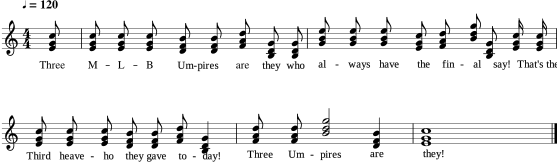
Three MLB Umpires are they,
Who always have the final say.
That's the
Third heave-ho they gave today!
Three UM-PIRES ---- are they!
References and Further Reading
Billy Martin: Baseball's Flawed Genius, Bill Pennington, Houghton-Mifflin Harcourt, 2015.Leo Durocher: Baseball's Prodigal Son, Paul Dickson, Bloomsbury, 2017.
Major League Baseball Umpire Manual, Office of the Commissioner of Baseball, 2019.
"Ejection", Baseball Reference.
"Debate at the Plate: Baseball's Unwritten Rules for Arguing Balls and Strikes", Lee Judge, Kansas City Star, July 13, 2018.
"My Pitcher Is Terrible, My Bullpen Can't Get Anybody Out": What Managers Really Yell About While Arguing With Umpires", Barry Petchesky, Deadspin, December 17, 2012.
"You’re Outa Here!", Indiana High School Coaches Association, March 11, 2025.
"Career Leaders & Records for Manager Ejections", Baseball Reference.
"20 Greatest Manager Meltdowns in Baseball History", Rick Weiner, Major League Baseball, June 4, 2018.
"Can You Tie in Baseball?", Mark Bailey, Baseball Bible, September 15, 2022, Updated: November 8th, 2023.
"Cubs-Pirates Stopped by Rain, FIrst Majors Tie in More Than a Decade", WK8W Buffalo. September 29, 2016.
"El Paso Wins Two Games From Clifton - Both Teams Play Well", El Paso [Texas] Herald, August 8, 1910, p. 8.
"Seventh-Inning Stretch", Michael Aubrecht, Baseball Almanac.
"Nothing But the Facts", Cincinnati Magazine, April, 1982, p. 111.
"Rays Fall To White Sox 6-1, Drop to 1-8 On Season", Erik Hahmann, DraysBay, April 10, 2011.
"A Brief History of Overturned Calls", Jack Moore, The Score,, October 24, 2013.
"Piniella: From Storyteller to Maniac", Marc Topkin, Tampa Bay Times,
"The 30 Biggest Temper Tantrums in MLB History", Doug Mead, Bleacher Report, June 6, 2018.
"Bench Jockey", Baseball Dictionary.
"Bench Jockey", Dickson Baseball Dictionary, Norton, 2011, Third Edition (First Edition, 1982).
"MLB to Expand Instant Replay in 2014", ESPN, August 15, 2013.
"6 Years Ago, the Phillie Phanatic Was Beaten Pp by the Dodgers' Tommy Lasorda", Dan Gelston, Associated Press, August 28, 2024.
"Interview with Mickey Mantle, Duke Snider, and Willie Mayes", Warner Wolf (interviewer), The Warner Wolf Show, WCBS, October 6, 1981.
The Errand Boy, Jerry Lewis (actor, writer, director), Ernest Gluscksman (producer), Stanley Adams (actor), Felicia Atkins (actor), Herb Vigran (actor), Barry Livingston (actor), Milton Frome (actor), Leo Durocher (cameo), Lorne Greene (cameo), Dan Blocker (cameo), Pernell Roberts (cameo), Michael Landon (cameo), Joe Besser (cameo), Walter Scharf (music), Paramount, 1961.