Phineas T. Barnum, Jumbo the Elephant, and Charles "General Tom Thumb" Stratton
(Click on the image to zoom in.)
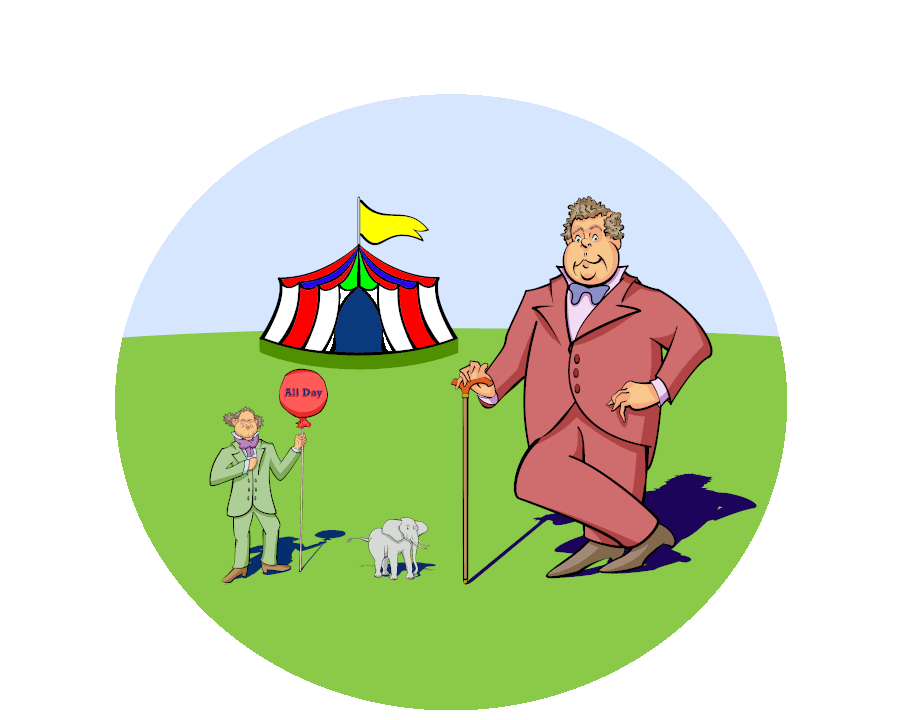
Jumbo: a clumsy or unwieldy fellow.
- Sportsman's Slang: A New Dictionary of Terms Used in the Affairs of the Turf, The Right, The Chase, and The Cock-pit; With Those of the Bon-Ton, and the Varieties of Life, Forming and Original and Authentic Lexicon Balatronicum et Macaronicum Paritcularly Adapted to the Use of The Sporting World, For Eludicating Words and Phrases that are necessarily, or purposely, rendered cramp, mutative and unitelligible, outside of the respective Spheres Interspersed With Anecdotes and Whimsies with Tart Quotations and Rum-Ones; With Examples, Proofs and Monitory Precepts, Useful and Proper, for Novices, Flats, and Yokels.
Jumbo appears to have been by right the head of all the Kroos
- West African Sketches, 1824.
ju.mbo, n. Big clumsy person, animal, or thing, esp. (J-) famous elephant in London Zool Gardens; notably successful person [?]
- The Concise Oxford Dictionary of Current English, Oxford, The Clarendon Press, 1911.
WILLIAM MAMMEl, a German by descent who was at one time member of No 148, from which he transferred to No. 3131, has emblazoned on his banner the motto, "There is a sucker born every minute."
- Railroad Brakemen's Journal, 1898.
We see, then, that the word Jumbo was used well before Phineas T. Barnum began taking the Titanic Tusker on tour. The origin of the word is a bit obscure although it may be derived by non-native speakers from the Swahili greeting "Jambo!"
However, the meaning of the word implying a huge object originates from Jumbo himself. Phineas certainly popularized the Prodigious Pachyderm but Jumbo was Jumbo before Phineas brought him to America.
Jumbo had in fact been born in 1860 in the Sudan. He was captured as an infant and eventually was sold to the Jardin des Plantes Zoo in Paris. Then in 1865 he was sold to the London Zoo.
But in a few years the managers of the zoo began saying that they were considering selling Jumbo as he was getting too hard to handle. This created a hue and cry throughout the land and thousands of kids wrote Queen Victoria to keep Jumbo in the zoo. But Phineas saw his chance and made an offer that the zoo accepted.
Jumbo remained one of the star attractions of the Barnum and Bailey Circus. Then as everyone knows on September 15, 1885, in St. Thomas, Ontario, Jumbo was crossing the track when he was hit by a train. He died almost immediately.
Well, Phineas figured if he couldn't exhibit a live Jumbo then a dead one would do. He had the skeleton mounted and also sent out bits of Jumbo to other exhibitions. After he got all he could, Phineas had Jumbo stuffed and sold it to Tufts University. There Jumbo remained until 1975 when a fire destroyed Jumbo once and for all.
If there is one person who personifies the swashbuckling Guilded Age Impresario of American Culture it was Phineas Taylor Barnum. "There's a sucker born every minute," he was supposed to have said. Even if he didn't he certainly approved of the sentiment.
Phineas was born one day after Independence Day in 1810 in Bethel, Connecticut, which is about 50 miles north of New York City. As usual for most heroes of success stories, he was born in humble circumstances. In fact, his dad, Philo, was a farmer and Phineas helped him out. Philo, though, like many agriculturists had other occupations and worked as a tailor and ran a tavern and grocery store. Ultimately Philo married twice and had 10 kids of which Phineas as the sixth.
Phineas, though, did attend school where he showed a bent for mathematics. But drudgery of everyday jobs didn't appeal and following the example of his grandfather, he became something of a practical joker. His grandfather particularly liked spoofing people with tall tales.
At age 12 Phineas helped drive a herd of cattle to Brooklyn which gave him the first look of the Big City. He didn't move from the farm right away but he saw there were opportunities in the urban centers that weren't available in the country.
When his father died in 1825, Phineas sold off the family farm and joined a local businessman in running a grocery store in Grassy Plains. In 1829, he met Charity Hallet and they got married. But being a grocer began to pale and when Phineas hit 21 he began editing a newspaper The Herald of Freedom a publication which, although not opposed to religion (as his competitors claimed), worked to promote church-state separation and to combat ignorance and superstition. Publishing a weekly paper, though, was a part time activity and as he himself admitted, he soon showed an aptitude for both earning and losing money. The latter characteristic was often due to his fondness for what one scholar called "speculative investments".
Phineas's first branch into show business was when a customer came in and asked if Phineas would want to help promote an "entertainment" which featured an African-American woman named Joice Heth who said she was over 160 years old and had been the nursemaid to George Washington. Barnum gleefully took up the offer and began spreading ads and posters around New York City inviting everyone to come and see (and pay a fee) for the lady Phineas marketed as "the greatest curiosity in the world".
This first foray into the entertainment industry taught Phineas the need for flexibility. He took Joice on tour throughout New England and when he found interest was waining, he claimed she was actually a robot - then called and "automaton". Although he probability didn't say there was a sucker born every minute, he did say Americans liked to be humbugged.
In 1841, Phineas learned that a museum in New York City was for sale. This was Scudder's American Museum which boasted a large collection of "curiosities". Digging up the $50,000 needed, he opened Barnum's American Museum.
Barnum's American Museum has been described as a "notorious" dime museum. Dime museums - named after a typical admittance fee - usually housed weird and often macabre collections - "curiosities" is the way the owners put it. Ostensively open to educate the public, the museums not only exhibited oddball items but also featured live people with deformities. These "freak shows" were still popular in the state fair sideshows up throughout the 1960's.
Also "on display" were people who claimed extraordinary powers: mind readers, fortune tellers, spiritualists, and conjurers. Sometimes you might even get a fairly normal singing or dance troupe. On the other hand, dime museums were not always the most respectable of venues and were pretty much the low rung of the entertainment venues. But many celebrities of the later 19th and early 20th Century got their start in the dime museums including a young immigrant from Hungary who with his family had settled in Appleton, Wisconsin, and who took the stage name (and later legally changed it to) Harry Houdini.

Harry and Bess
They got their start
In three years, Barnum's American Museum had grossed twice the amount needed to pay back the banks and with an ever changing series of attractions, the people kept coming in. Some articles have spoken in a rather censorious tone about P. T. Barnum's tendency to milk everyone for everything he could get. As far as dealing with his employees the word "exploitation" is bandied about when describing putting people with physical abnormalities on display.
Regardless of the rights or the wrongs in the criticism, one bright spot in Phineas's long career is his association with Charles Stratton, usually called "General" Tom Thumb. Although at a first reading Phineas's relationship with Charles may seem to corroborate the rather negative tone of the critics, the whole story shows that in the end Phineas could be a nice guy - and so could "General Tom Thumb".
Charles Stratton was born January 4, 1838, in Bridgeport, Connecticut. His parents were Sherwood Stratton, a carpenter, and Cynthia Thompson. Charles's normal growth stopped six months after his birth and it was evident he would never reach normal size. But in other ways his progress was typical and perhaps even advanced.
In 1842 the New England winter was particularly harsh and Phineas found himself stuck in Bridgeport. There he got wind of the precocious 4-year-old and 2-foot-1-inch son of Mr. and Mrs. Stratton. When he met the family, he saw the kid had potential as a performer and struck a deal with Charles's parents. He would hire the young kid at $3 a week for a one month trial. Of course, his mom could come along with expenses paid.
Ha? People ask, quoting Shakespeare. A lousy $3 per WEEK? Well, THAT sure sounds like exploitation, doesn't it?
Weeeeeehhhhhhheeeeeeelllllllll, hold on there. Let's look at the FACTS.
Admittedly $3 a week wasn't great pay but it was comparable to what many adult workers earned. Farm workers made between $7-$10 a month - yes, that's a MONTH. So we're talking less than the $3 a week paid to Tom. Also Phineas paid for the food, lodging, and transportation and there was no, that's NO income tax. Rural agricultural workers (farm and ranch hands) also usually had room and board - called "found" - paid for. Wages rose as the years rolled on and when the cattle drives began after the Civil War a cowboy - "drover" was the preferred term - would usually get $100 for a three month drive and this included "found".
Of course skilled workers made more. In the 1840's a carpenter - like Tom's dad - could expect to earn about $10 a week. On the other hand millworkers - representing "non-farm labor - might pull in only $1.75 per week. And yes, women made much less. A shoemaker (male) might earn $7 a week, a lady might make only $2.
Of course, a name like Charles Stratton wouldn't do for a four year old performer and Phineas picked the stage name of "General" Tom Thumb. For good measure, Phineas tacked an extra 7 years to Charles's age.
And everyone fell for it. That no one questioned that a four year old was eleven is pretty good evidence of the young "General Tom Thumb's" precocious personality.
But now all Phineas had to do was figure out an act. But that turned out to be pretty easy. Charles and Phineas would come on stage together. They would swap one-liners and if reports of their act are accurate, Phineas and Tom come off as an early day Abbott and Costello or Martin and Lewis.
Abbott and Costello
Martin and Lewis
After a month Phineas considered the trial a success and he upped Tom's salary first to $7 a week and then to $25. It needs to be noted that in the 1840's a $25 a week was a VERY good wage. Skilled engravers in the US Mint earned about $29 a week. Phineas also took a responsible position regarding Charles's upbringing, hiring his dad, Sherwood, to do odd-jobs around the museum and Cynthia, Charles's mother, was also on-site. To keep Tom up with his schooling Phineas hired a tutor.
It turned out that Charles was a natural. There would be a basic script but much of the act came from was Charles's own creativity. Soon he was appearing on stage alone, and one of his most popular (and his own favorite) act was an impression of a diminutive Napoleon Bonaparte.
But some parts of Charles's precociousness were not always for the best. Before he was ten years old he was drinking wine at dinner and smoking cigars. But he also quickly gained an appreciation of the value of money. Soon he began putting his earnings away for the proverbial rainy day.
Given the phenomenal success of the new act, the next and obvious step was to take the act to Europe. Specifically it was de rigueur that any first class performer would appear before Queen Victoria. So in January 1844, Phineas, Charles, and Charles's parents all sailed for Liverpool.
However, the timing could hardly have been worse. Prince Albert's father, Ernest I, the Duke of Saxe-Coburg and Gotha, had just died and the whole royal family was in mourning. Such obstacles never phased Phineas and he contacted the American ambassador, Edward Everett, who agreed to arrange a "command performance" for the Queen.2
Footnote
Edward Everett had a distinction that has been forgotten almost as much as he is. On November 19, 1863, he was the featured speaker at the dedication of the Gettysburg National Cemetery after the Battle of Gettysburg. Edward spoke for over two hours. After he completed his speech, another gentleman got up to close the ceremony with "a few appropriate remarks" which he delivered in less than two minutes.
While waiting to hear from the Queen, Charles appeared at the Egyptian Hall in Piccadilly, which was a rather high class version of the American Museum. All in all the English liked the little entertainer and the critics were generally favorable. Then Charles and Phineas finally got their "command" from the Queen and on March 23, 1844, they went to Buckingham Palace.
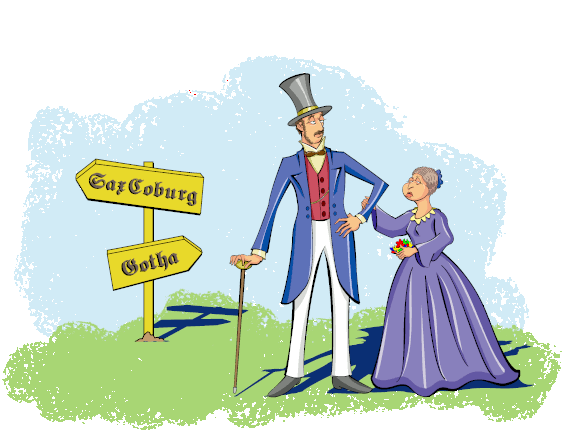
Albert and Victoria
(Click on the image to zoom and out.)
The accounts of the meeting are both legendary and apparantly accurate. Charles and Phineas first met in the Queen's private art gallery with Victoria, Prince Albert, and a crowd of about thirty court hangers-on. Victoria was quite friendly and personally showed Tom around the gallery.
The visit went well and then it became time for Tom and Phineas to leave. To leave the royal presence, though, there was strict protocol. The visitors were to face the Queen and Prince Albert and after bowing, were to back out of the room so the monarch and consort would not see their backs.
But as they made their backward exit, Tom's legs were so short they couldn't keep up with Phineas. So at intervals he had to turn around and run to catch up with Phineas. Then he'd turn back to face the Queen and resume backing out only to find himself again lagging in front of Phineas. So again he'd turn around, run to Phineas, and continue with his exit.
Far from being offended, everyone began to chuckle. Then the Queen's poodle - yes, Queen Victoria had a dog - began barking at Tom and leapt from the Queen's side and ran toward the small backward moving figure. Tom immediately pulled out his small sword and began acting as if he was trying to ward off the attacking beast. This brought the house down. Tom and Phineas were invited to appear before the Queen Mother and then later returned to Buckingham Palace two more times.
When he signed the contract with Charles's parents, Phineas also agreed that they would be full partners in their son's act. But then Phineas began to complain that the Strattons began "putting on airs". It was bad enough that they were getting snooty, but when they complained that expenses were too high and began making their own demands, Phineas put his foot down. HE was running the show, by golly, and if they tried to interfere further, he'd just pull out of the whole deal. Charles and Cynthia knew better than to push Phineas any further.
Charles, his parents, and Phineas returned to America in 1847. They continued to work together and Charles kept socking his money away. By the time he reached adulthood he was an inch short of three feet and a very rich man. He and Phineas agreed that Charles could carry on the act independently and he did.
Of course Phineas kept up his other businesses. He not only continued to make money in show business, but also invested it - as earlier - in "speculative" enterprises particularly in real estate. Unfortunately some of the business ventures didn't pan out and by the mid-1850's the great Phineas T. Barnum found himself completely ruined. There was, we must admit, a lot of schadenfreude expressed by men who didn't like Phineas very much such as Thomas Carlyle and Ralph Waldo Emerson (whoever they were). The press also had a field day and rejoiced that Phineas's "ill-gotten" gains had finally come back to haunt him.
However, Phineas also had a lot of friends and in surprisingly high places. One was about as high as you could get - at least in the business world. That was Cornelius Vanderbilt. Cornelius and others offered to help him out. And yet one more of these benefactors was none other than Charles Stratton who wrote:
My Dear Mr. Barnum, I understand your friends, and that means "all creation", intend to get up some benefits for your family. Now, my dear sir, just be good enough to remember that I belong to that mighty crowd, and I must have a finger (or at least a "thumb") in that pie. I am ready to go to New York and remain at Mr. Barnum’s service as long as I, in my small way, can be useful.
In many cases Phineas declined any assistance, but he agreed that he and Charles would arrange a new tour together in Europe that also featured the famous singer Jenny Lynd. Although the tour wasn't an immediate solution to his woes, it at least generated some money. In four years Phineas was able to arrange repayment of his major debts.
In 1863 now age 25 Charles married Lavinia Warren who was 23 years old and three inches shorter. Charles and Lavinia attended a reception at the White House where they met Abraham and Mary Lincoln. In fact, Mary had arranged the reception especially for the Strattons and of course it hit the news.
Charles and Lavinia were also photographed with an infant in arms although the child, Minnie, was not really their natural child. To what degree the family image was simply part of Barnum's plan for more publicity remains obscure. But whatever the cause and degree of informality, Tom and Lavinia assumed the role of parents. Sadly the child died in 1866 when they were in England.
Phineas, though, was still going strong. In 1875 along with Dan Castello and William Cameron Coup, he established what he called the P.T. Barnum's Great Traveling Museum, Menagerie, Caravan, and Hippodrome. Then in 1881 the show merged with a circus managed by James Bailey and James Cooper and was renamed the Barnum & Bailey Circus. If not necessarily the Greatest Show on Earth, many people thought it was Great Enough.
Then in 1884 five brothers from Wisconsin, Albert Carl "Al" Ringling, Otto Ringling, Alfred Theodore "Alf" Ringling, Charles Edward Ringling, Augustus "Gus" Ringling, and John Nicholas Ringling established a circus in Wisconsin. It made some sense to call it the Ringling Brothers Circus. But in 1907, they bought out James Baily's interest in his show and finally merged the two circuses in 1919. Two other brothers, Henry William George Ringling and Augustus "Gus" Ringling, were involved in running the circus as well. Knowing that the name Barnum was a big draw, but also being circus impresarios who liked seeing their names on posters, they dubbed the new company the Ringling Brothers and Barnum and Bailey Circus.
For most of the 20th Century and past the Millennium, the word "circus" was synonymous with Ringling Brothers (later usage tended to drop Phineas's name). In the 1930's John Ringling North, the son of the sole Ringling Sister, Ida, took over management of the circus. It was in the 1930's and 1940's that Frank Buck, famous as the man who "brought 'em back alive" and Emmett Kelly, whose clown persona was Weary Willie, became star attractions.
The Ringling Brothers kept going until 2017 but then finally closed down. The show was revived in 2023 but without any animal acts or clowns - or ringmaster. As of this writing the show is still going as yes, the Ringling Brothers Barnum and Bailey Circus. Barnum's name still brings 'em in.
Although the Strattons lived a comfortable and even opulent lifestyle, the late 1870's were personally hard on the family. Lavinia's sister who was also a little person died in childbirth, an event which left both Charles and Lavinia devastated. Now Phineas stepped in and knowing the best thing would be for them to begin something new, urged them to join him on another tour. They did so, but then in 1883 the wife of their manager - no, not Phineas - died in a hotel fire and Tom and Lavinia returned home. Some said Tom remained despondent and then on July 15, 1883, he suffered stroke and died. He was 45 and his long-time smoking habit may have contributed to his relatively young demise. Lavinia, though, survived her husband by more than three decades and lived until 1919 age 78.
Phineas died in 1891 at the venerable age of 80. During his lifetime he had not restricted his activities to business and entertainment. He contributed to many charities and he was elected to five terms in the Connecticut Legislature. But a run for Congress in 1867 was not successful. He was though mayor of Bridgeport for one term.
In the non-political arena Phineas was on the Board of Trustees of Tufts University (where Jumbo eventually ended up). He even set up the museum where Jumbo was displayed which is still there as Barnum Hall.
So perhaps the most lasting contribution of Phineas Taylor Barnum is to American Higher Education. In fact, at Tufts University the school's mascot is, yes, Jumbo the Elephant.
And the Tufts football team?
Yes, it's the JUMBOS!
References and Further Reading
Barnum: An Illustrated Biography, Alice Fleming, Knopf, 1995.
The Life of P. T. Barnum: Written by Himself, Phineas Taylor Barnum, The Courier Company, 1894.
P.T. Barnum: The World's Greatest Showman, Alice Fleming, Walker and Company, 1993.
"P. T. Barnum, King of the Circus", Lynn Groh, Garrard Publishing Company, 1966.
"The Real Tom Thumb and the Birth of Celebrity", Kathleen Hawkins, BBC, November 25, 2014.
Tom Thumb: The Remarkable True Story of a Man in Miniature, George Sullivan, Clarion Books, 2011.
"P. T. Barnum: An Entertaining Life", Gregg Mangan, Connecticut History, July 5, 2015.
"Personal Speech To The Future by P. T. Barnum (1890)", P. T. Barnum, Edison, 1890.
West-African Sketches: Compiled from the Reports of Sir. G. R. Collier, Sir Charles MacCarthy, and Other Official Sources, L. B. Seeley and Son (Publisher), 1824.
Sportsman's Slang: A New Dictionary of Terms Used in the Affairs of the Turf, The Right, The Chase, and The Cock-pit; With Those of the Bon-Ton, and the Varieties of Life, Forming and Original and Authentic Lexicon Balatronicum et Macaronicum Paritcularly Adapted to the Use of The Sporting World, For Eludicating Words and Phrases that are necessarily, or purposely, rendered cramp, mutative and unintelligible, outside of the respective Spheres Interspersed With Anecdotes and Whimsies with Tart Quotations and Rum-Ones; With Examples, Proofs and Monitory Precepts, Useful and Proper, for Novices, Flats, and Yokels, John Bee, Esq., (W. Lewis, Printer), 1825.
"William Mammel", Railroad Brakemen's Journal, Volume 15, No. 2, Brotherhood of Railroad Trainmen, February, 1898.
"East Room: Reception for General Tom Thumb", Mr. Lincoln's White House.
"Barnum and Bailey Circus", Circuses and Sideshows.
Trends in the American Economy in the Nineteenth Century, The Conference on Research in Income and Wealth, Princeton University Press, 1960.
"Prices and Wages by Decade: 1840-1849", University of Missouri Libraries.
Measuring Worth.