You may read on a popular academic university website that Roger Miller began recording songs in 1945. There we read he played trombone with the Johnny Long Orchestra on the 10" 78 rpm single1 "Between the Desert and Me/I Want to Go to Texas When I Die".
Footnote
For those of less venerable years than others, the description of a recording as a "single" refers to the physical "single" disk although there were usually two songs per disk. What was intended to be the principal song was labeled as the "A" side and you would turn the record over to play the "B" side - or as usually said - the "flip side".
Before the 1950's, the disks were 10" in diameter and were rotated on the record player at 78 revolutions per minute. However, in the 1950's the most popular recording format quickly became the smaller 7" disk spun at 45 rpm. Hence the term "45 single".
At one point some companies began releasing 45's with two songs on a side for a total of four songs per single. But these "enhanced" play recordings never proved particularly popular. By the 1960's, though, the long playing (LP) albums which were spun at 331/3 rpm were becoming popular and affordable. You could get 5 to 7 songs per side for a cumulative half an hour of listening pleasure. The kids began to opt for the albums and eventually the age of the 45's faded.
Needless to say all of Roger's fans might take this as a perfect example of what happens when a computer compiles information without a human being double checking the findings. But whatever the cause of the faux pas the truth is that in 1945, Roger was a 9-year-old farm boy living in Erick, Oklahoma, a small town that was on Route 66 heading to Amarillo. He certainly was not playing trombone in a swing band.
Instead Roger's first release was in 1957 with the single "My Pillow / Poor Little John". Neither song charted nor did his next three records.
It wasn't until 1960 that Roger Miller entered the American Collective Consciousness. That's when his "In the Summertime" reached into the Top 20 on the Country Charts. It was kind of a whacky tune where at one point Roger breaks into what may be honestly termed Country Scat. The next year "When Worlds Collide" reached #6.
An Erick upbringing notwithstanding, Roger was born on January 2, 1936, in Fort Worth, Texas. His father died when Roger was still an infant and his mother sent her kids to live with various aunts and uncles. Roger settled with Uncle Elmer and Aunt Armelia in Erick.
One person of some fame and notoriety remembered that Roger made rather disparaging remarks about the town, remarks which irritated the Town Fathers. The person of some fame and notoriety never gave exact details (or the source of his information), but we do know that when someone asked Roger where he was from, he replied it was Erick, Oklahoma.
When asked where Erick was close to, Roger joked, "It's close to extinction. The population is 1500, and that includes rakes and tractors." He also said, "It was so dull you could watch the colors run. We were so poor, words were our only toys." Whether such remarks really did irritate the leading citizens isn't clear - obviously Roger was joking - but for years there was a Roger Miller Museum on Erick's Main Street.2
In the 1930's Erick not only suffered through the Great Depression but was also on the fringes of the Dust Bowl - a time and place of tribulations made famous in songs, books, and cinema. Although the town did rebound during the 1940's it was still a time and place where if you wanted good music it had to be live music. And if you wanted live music you pretty much had to make it yourself.
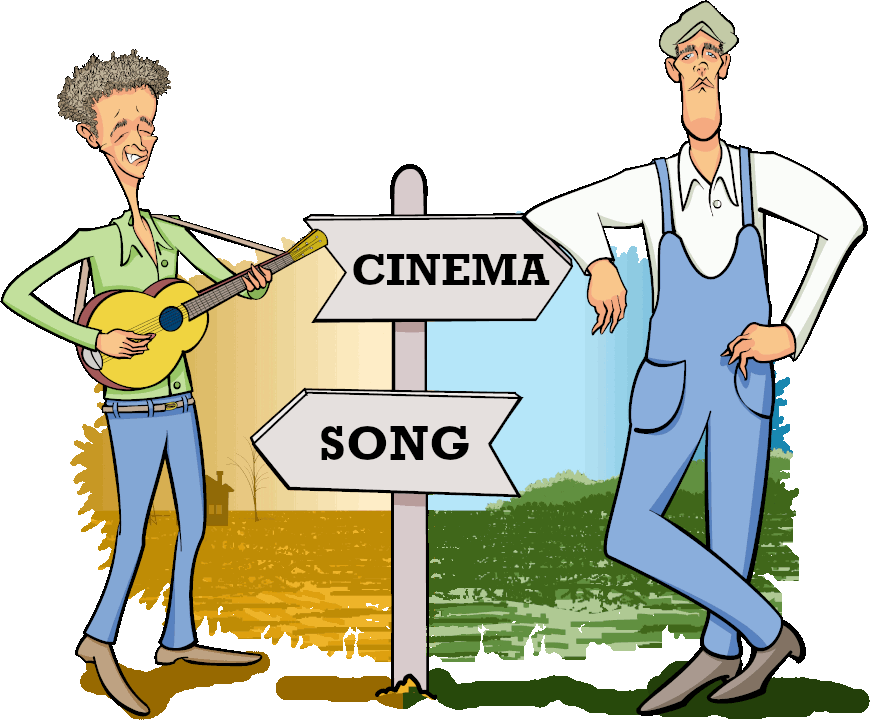
The Dust Bowl
Fortunately in 1940, Elmer and Armelia's grown daughter, Melva, married a young man named Sheb Wooley. Melva was 18 and Sheb was 19 but he had already established a career as a professional musician playing and recording Country and Western music. Sheb taught Roger the rudiments of guitar and fiddle playing and Roger learned fast. He was soon composing his own songs.
The trouble is Roger couldn't afford a decent guitar and he remedied the situation by the old five fingered discount. But his conscience got the better of him and he turned himself in. In lieu of serving time, he was offered the opportunity of serving time - in the Army, that is. After his discharge, he headed to Nashville.
Roger's first real music job was not - we repeat - was NOT playing trombone for Johnny Long. It was playing fiddle for Minnie Pearl. Although Roger wanted to make it as a solo artist, his early success came from selling songs to big name stars. Some of these compositions were "Invitation to the Blues" (Ray Price), "Half a Mind" (Ernest Tubb), and two songs recorded by Jim Reeves, "Home" and "Billy Bayou". All were pretty straightforward (and serious) Country and Western tunes.
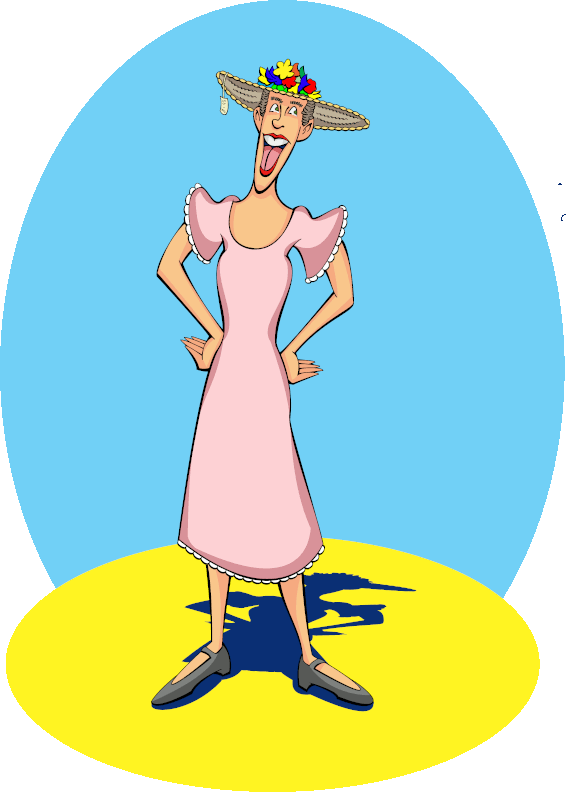
Minnie Pearl
Roger played fiddle.
With his songwriting credentials established, Roger managed to land a contract with Smash Records and the 1950's ended with several albums under his belt. Unfortunately none of them sold very well and he began souring a bit on the music business. So Roger figured he might give television and the movies a try.
But before he left for California he played a new song for the Smash producer Jerry Kennedy at Jerry's home. It was full of catchy riffs and made-up words and Jerry's kids thought it was the greatest song they ever heard. So in 1964, "Dang Me" was released as a single with "Chug-a-lug" on the flip side.
The two songs ensured that 1964 was Roger's annus mirabilis. "Chug-a-lug" reached #3 and "Dang Me" climbed to the Top Country, #1, and crossed over to the Pop Charts maxing at #7. In the end "Dang Me" won four Grammys: Best Country Song, Best Country and Western Recording, Best Country and Western Performance, and Best Country and Western Album. In addition, Roger garnered the Grammy for Best New Country and Western Artist. Roger was a star.
Roger immediately released other crossover tunes that sold well: "Doo-wacka-do" (1964), "England Swings" (1965)", and Roger's BIG hit "King of the Road" (also released in 1965). "King of the Road" reached #1 Country and #4 on Pop. In England - which as Roger assured us was swinging - it rose to #1 on the UK Pop Charts. The song grabbed Roger six more Grammys.
Although he was really a Country and Western singer, a lot of younger people thought of Roger as a pop star. What got the city kids liking Roger's music was his crazy persona and his love of wordplay and sound effects. After he sang "Dang Me" on American Bandstand, he showed Dick Clark how he could mimic ordinary sounds. Still, during the interview Roger seemed a bit ill-at-ease and as was typical for the guests on Bandstand, he lip-synched the words.
Roger appeared with ...
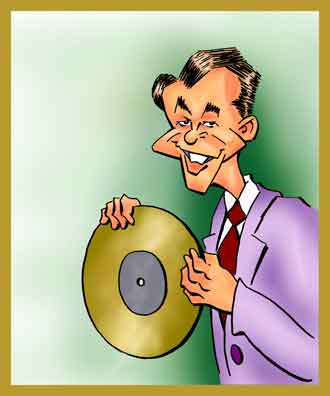
Dick Clark ...
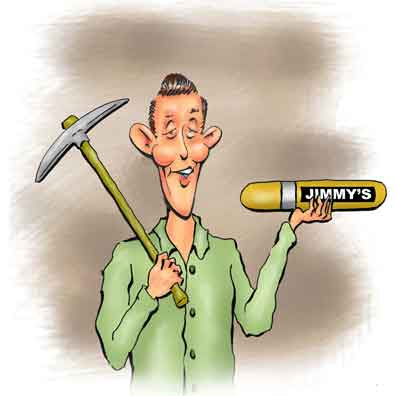
Jimmy Dean ...

... Johnny Carson ...
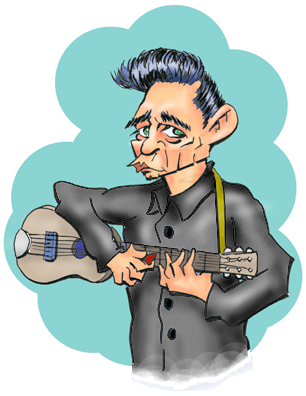
... Johnny Cash ...
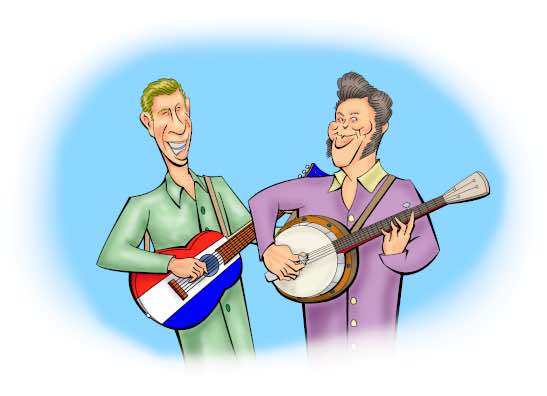
... and Buck Owens and Roy Clark.
But even before Roger had his big hits, he had been appearing on television in prestigious venues like The Merv Griffith Show, The Jimmy Dean Show, and The Tonight Show with Johnny Carson. Later he appeared on The Glen Campbell Goodtime Hour, The Johnny Cash Show, Rowan and Martin's Laugh-In, and Laugh-In's Country Incarnation, Hee-Haw starring Buck Owens and Roy Clark. After Roger became a household word he moved into straight acting where he showed up on primetime staples like Murder, She Wrote, Quincy, M.E, and Daniel Boone.
Roger also began working in motion pictures. In 1967 he provided a musical narration to the picaresque movie Waterhole #3 starring James Coburn, Maggie Blye, and Carroll O'Connor. Then in 1973, he voiced (and sang) the part of Allan-a-Dale, the rooster court minstrel in Walt Disney's animated feature Robin Hood.
As the Swinging Sixties stretched toward the Synthetic Seventies, Roger kept recording. Although a number of his songs reached into the Top 20 Country Hits only two "You Can't Rollerskate in a Buffalo Herd" (1966) and "Little Green Apples" (1968) just squeaked into the Pop Top 40. In the 1970's Roger continued to release songs, but only three broached the Top 20 on the Country Charts and none crossed over to Pop.
Then in 1984 Roger wrote the words and music for Big River, a musical based on Mark Twain's "Huckleberry Finn". It was, to put it mildly, a success. It won the 1985 Tony Award for Best Musical, Best Book and Best Score and the Broadway performance alone ran for over 1000 performances. Roger was no longer just a Country singer and songwriter. He was a distinguished composer and librettist.
But perhaps Roger's biggest claim to artistic immortality was from his earlier guest appearances on two of the most iconic television programs ever produced. In 1975 he was on Sesame Street where he sang "In the Summertime", "Do-Wacka-Do", "Dang Me", and "You Can't Rollerskate in a Buffalo Herd". But then Roger rose to the height above which no one can ascend.
Yes. On May 12, 1979, Roger was the host of The Muppet Show.
Today if you drive through Erick, you'll still find tributes to Roger. The main East-West road - which is the old Historic Route 66 - is now named Roger Miller Boulevard and as you drive towards the main street intersection you'll see an impressive muralic testimonial to Roger.
For a small town, Erick has certainly produced its share of celebrities. Remember Roger learned guitar from Sheb Wooley the son-in-law of Roger's Uncle Elmer and Aunt Armelia and Sheb had also become a Country and Western singer.
Unlike Roger, Sheb had actually been born in Erick but like Roger, he later moved to California. In addition to his music, Sheb also appeared in a number of television programs such as Rawhide, Death Valley Days, and even the Mod Squad. You can also see him in motion pictures such as The War Wagon with John Wayne and Kirk Douglas, Giant featuring Rock Hudson, James Dean, and Elizabeth Taylor, The Outlaw Josey Wales starring Clint Eastwood, and - get this - High Noon with Gary Cooper and Grace Kelly.
And no, Sheb has not been forgotten by the citizens of Erick. The North-South thoroughfare which connects the town to modern Interstate 40 - and together with Roger Miller Boulevard forms the town's main intersection - is even named Sheb Wooley Avenue. Although the Roger Miller Museum is now closed you still might be able to enjoy some good times honoring Sheb and his biggest hit. In fact, Sheb's song climbed higher than any of Roger's and even reached #1 on the US Pop Charts.
So if you're driving through Erick, Oklahoma, be sure to ask when you can take in the Purple People Eater Festival.
References and Further Reading
Roger Miller: Dang Him!, Don Cusic, Brackish Publications, 2012.
"The Amazing Adventures of Roger Miller", Listening Sessions, Robert Gilbert, September 20, 2022.
"Roger Miller", The Rock & Country Encyclopedia & Discography.
"60 Years Ago: Roger Miller Revolutionizes Country with 1:42 Song", Saving Country Music, January 11, 2024.
"'I just don't want to be forgotten.' Erick Still Remembers Hometown Hero, 'King of the Road' Roger Miller", Jordan Green, The Oklahoman, December 22, 2021.
"Searching for the Ghost of Roger Miller in Erick, Okla.", Malcolm Jones, The Daily Beast, September 23, 2012.
"Erick - The First Western Town on Route 66", Austin Whittall, The Route 66, Updated: September 9, 2023.
"Elmer D. Miller", Find-a-Grave, Memorial ID: 8554823, March 24, 2004.
"Armelia Gray Miller", Find-a-Grave, Memorial ID: 8554827, March 24, 2004.
"Melva Miller Pate", Find-a-Grave, Memorial ID: 51107313, April 14, 2010.