William James Butler
"Wild Bill" Hickok
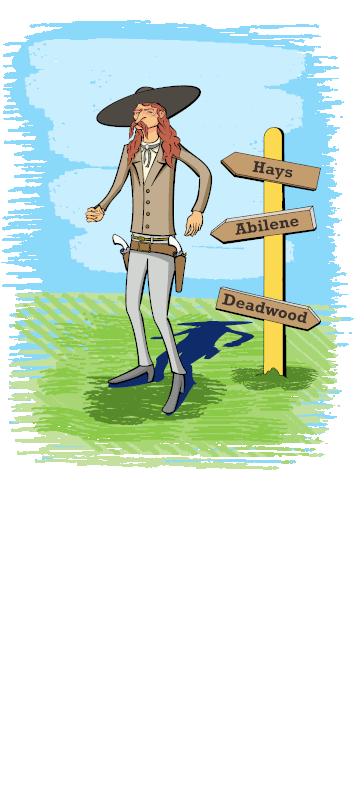
(Click on the image to zoom in.)
William Hickok, better known as "Wild Bill," was killed at Deadwood City, Aug. 2nd, by Bill Sutherland.
- The Cheyenne [Wyoming] Daily Leader, August 12, 1876, p. 2
James B. Hickok, alias Wild Bill, known in Kansas and in the Territories as a scout of some prominence in early days, was killed in a saloon at Deadwood on the second instant by one Bell.
- The Memphis [Tennessee] Daily Appeal, August 13, 1876, p. 1.
We see, then, that papers are not always correct. Not only was "William" Hickok's real name James, but there was no one named Sutherland or Bell at his last poker game. Wild Bill Hickok was killed by John "Broken Nose Jack" McCall.
However, within a year the accounts were agreeing (to quote Sir Isaac Newton) pretty nearly. As one report went:
[Wild Bill Hickok] does not appear to have set out on the prospecting tour to which he alludes in his letter [to his wife, Agnes], for August 1st he was still at Deadwood, where fate brought him to the same card-table with one Jack McCall, a gambling sharper1 and ugly character. Of him Bill got the better at poker. On the last hand McCall bet $10 and lost, and when he came to settle found that he had only $7.50. Bill, remarking, "you oughtn't to over bet your pile; that's no way to play cards," handed him back a $5 bill to pay for his lodging and breakfast, and the men parted. He thought no more of the matter, neither did anyone else who knew of it. Next morning Bill was sitting with a number of card players in the Senate saloon when McCall came behind him noiselessly, placed the muzzle of his revolver to the back of his head and crying "Take that d--n you," fired. Wild Bill died, and never knew how, why or by whom he was killed.
Footnote
Although today you hear about a "card shark", the original term was "card sharp" or "card sharper". Card shark began appearing in the early 20th Century although card sharp was actually used more frequently until about 1970 when card shark finally took over.
Broken Nose Jack then kept his revolver pulled and after warning everyone against trying to stop him, backed out of the door. He made his escape, but was captured before he could leave town. A group of men quickly convened a trial and after hearing Jack's claim that Bill had killed his brother they voted acquittal.
Jack left the territory and went to Wyoming. Repeatedly shooting off his mouth - no pun intended - that he was the man who killed Wild Bill Hickok (in a fair fight, of course), the Federal Marshal of Wyoming arrested him. Since the so-called trial in Deadwood had no legal standing, Jack was extradited back to Dakota Territory and tried by a real federal court in Yankton (now in South Dakota). On December 6, a verdict of guilty was returned and Jack was hanged three months later, not surviving Wild Bill by even a year.
Notice that there is nothing in the story about Bill (as we will continue to call him) holding the "dead man's hand". That is, two pairs of eights and aces. The story is almost certainly apocryphal as over the years "the dead man's hand" has varied (an early story was it was a full house of jacks and aces). In the tellings where it was eights and aces, the fifth card varies. More doubt is cast on the story since the "dead man's hand" wasn't associated with Bill's last game until fifty years afterwards.
But just how was it possible that a teamster and freight driver with long perfumed hair and a high-pitched voice and who had been derisively referred to as "Duck Bill" because of his long nose and prominent malocclusion became one of the most famous and feared gunmen in western history? We've always wanted to know that.
No doubt you have, as Captain Mephisto said to Sidney Brand. It's very simple really.
Well, as someone else named Will said, some men are born great, some men achieve greatness, and others have greatness thrust upon them. And it was on Thursday, July 27, 1865, that Bill had "greatness" thrust upon him. Or at least he came to national attention that day when the Springfield [Missouri] Weekly Patriot, reported:
 [sic] David Tuff, of Yellville, Ark., was shot on the public square, at 6 o'clock, P. M. on Friday last, by James B. Hickok, better known in Southwest Missouri as "Wild Bill". The difficulty occurred from a game of cards. Hickok is a native of Homer, Lasalle county, Ills. and is about twenty-six years of age [he was twenty-eight]. He has been engaged since his sixteenth year, with the exception of about two years with [freighting and staging firm] Russell, Majors & Waddill [sic, Waddell], in Government service as a scout, guide, or with exploring parties, and has rendered most efficient and signal service to the Union cause, as numerous acknowledgements from the different commanding officers with whom he has served with testify.
As is not unusual in a first report, there wasn't a lot of detail. But later articles and reports of the gunfight are surprisingly consistent. By sifting through the accounts and from consulting documents uncovered as late as the 1990's, scholars have deduced an unusually accurate description of what happened. There were also a number of reliable witnesses, one of whom was the commander of the Second Ohio Volunteer Cavalry, Major Albert Barnitz. Major Barnitz wrote down an account of the fight within a few hours of the event and was the officer to order Wild Bill's arrest.2
Footnote
Yes, arrest. Contrary to popular opinion, a survivor of a gunfight in the Old West did not simply ride off into the sunset. They were almost always arrested and there would always be at least a preliminary hearing. Although often perfunctory and brief, the hearings would usually satisfy the letter of whatever law then existed.
Even law officers would be arrested if during the course of their official duties they killed an assailant. Wyatt Earp and Doc Holliday, both deputized by Tombstone's town marshal and Wyatt's brother, Virgil, were arrested after the Gunfight at the OK Corral on October 26, 1881. They were absolved of wrongdoing only after a month long hearing. Then when El Paso constable John Selman shot and killed the notorious desperado John Wesley Hardin in 1895, he was immediately arrested by his own deputy - who also happened to be his son, John, Jr. However, John, Sr., never came to trial as he was himself killed in a gunfight with another lawman George Scarborough shortly afterwards. In 1900, George was killed in a gunfight although with whom and under what circumstances remain unclear.
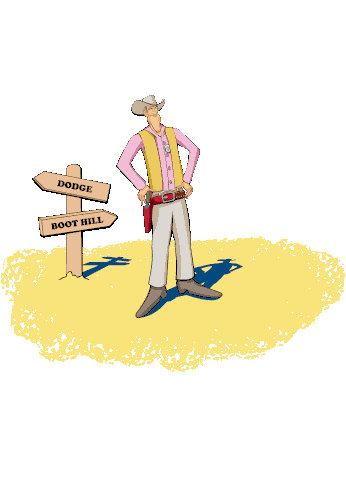
What has become known as the Tutt-Hickok Gunfight is famous since it's the first recorded Old West gunfight and is the closest any gunfight came to a television and movie style meet-on-main-street-fast-draw shootout. Even more unusual was that as happens in the TV and movie gunfights - particularly in the many "showdowns" with Marshall Matt Dillon - the "bad-guy" drew first and lost.
Both Bill and Dave were also known for carrying two revolvers strapped to their sides.3 Although Dave - known as "Little Dave" around town - had fought for the Confederacy and Bill was a Union man, they seem to have gotten along well enough. In fact, it seems that Dave had on several occasions loaned Bill money and the two men never had any problems.
Footnote
The carrying of two guns was not for show where the gunfighter would draw both pistols and fire both simultaneously. Instead, given the tendency of the early revolvers to misfire - particularly in the days of the cap-and-ball pistols - one gun was kept in reserve and used if the other one malfunctioned.
As stated in the newspaper article, the difficulty - a word often used for events leading to a gunfight - originated from a card game or rather card games. Bill and Dave had been playing poker and when it came time to settle up, Dave said Wild Bill owed him $35 - about $700 today. Bill said, no, it was only $25 as he had paid Dave $10 earlier. Bill then placed his gold (and expensive) watch on the table. Dave then picked it up and said Bill could have it back if he paid the $35. Then at some point Dave upped the cost - maybe as interest - and said Bill had to pay $45. That was more than a lot of people made in a month.
Both Dave and Bill began stewing about the matter and at one point one of Dave's brothers intervened and told Bill that they would work things out. Bill didn't seem mollified as he didn't like Dave walking town flashing the watch of Wild Bill Hickok to everyone.
At about 6 p. m. on July 21, 1865, Dave was in front of the courthouse in what is now the east border of Park Central Square. Bill was standing on the south side of the square. Witnesses said they heard the men exchange words but didn't catch what was said. Possibly Bill was warning Dave against displaying the watch. Bill and Dave were standing between 75 and 100 feet apart.
Suddenly Dave drew his gun and Bill immediately did the same. Witnesses said they heard "only one report" but they saw smoke from both guns. Dave missed his target but Bill didn't.
Bill was arrested for murder but the charge was reduced to manslaughter. The judge told the jury that if Bill could have avoided the fight he should be considered guilty as charged. But if he acted in self-defense he was innocent. With testimony that Dave fired first the jury was convinced and Bill set free.
From that day Bill was famous as a dead shot and a formidable gunfighter. It was on the strength of his new reputation that in 1869 he was hired both as city marshal of Hays, Kansas and elected sheriff of Ellis County. Later he was hired as city marshal of Abilene.
Another misconception derived from television and the movies is that in the Old West anyone could expect to have four or five gunfights a day. That is, to say the least, an exaggeration. Even though Marshall Dillon shot 400 men in 20 years, Wild Bill's total was eight gunfights over a span of fifteen years. Even this was an unusually high number for a real Old West gunfighter. Bat Masterson was in a total of three gunfights as was Jack Slade. Johnny Ringo (immortalized in Lorne, Greene's song) was in two. And from 1872 to 1875 Bill was in no gunfights whatsoever. Bill's last gunfight - if the word can be accurately used - was on August 2, 1876.
But Wild Bill's first recorded instance of gunplay was in 1861 when he was 22. In popular accounts Wild Bill stood off a gang of outlaws and managed to best them all. So some scholars may want to state this was the first Old-West style gunfight predating the fight with Dave Tutt. However, the facts don't really support such a charitable designation.
Instead, this - quote - "gunfight" - unquote - is sometimes called McCanles Massacre. Unlike the fight with Dave Tutt, information is sparse and accounts vary considerably. In fact, one of the first references to the gunfight/massacre is easily missed and didn't appear until nearly a year later. On August 16, 1862, the Nebraska papers published a brief notice:
PUBLIC NOTICE
Territory of Nebraska
County of Gage
Whereas, David Wolf and Frederick Hagenstein, died on the 28th day of July. A. D., 1862, file a petition asking of the Probate Court a decree that J. L. McCanles4 as Administrator of the estate of D. C. McCanles , late of Jones county, deceased, shall make a good and sufficient deed of Warrantee to the said petitioners of the following tract of land, being the west half of the north east quarter, and the south east forty of the north west quarter of section twenty-six. of township two, range three, east of the sixth principal meridian, in Jones County, Nebraska Territory.
Now. be it known that I have appointed Monday, the 15th day of September, A. D. 1862, at 10 o'clock A. M. for the hearing of said petition, and all persons interested therein may appear and show cause why the prayer of the petitioners shall not de granted.
ALBERT TOWLE,
Probate Jude, Gage, Co., Neb.
Beatrice, July 28, 1862.; n4 6w-8,00.
Footnote
Some curmudgeons may question that this notice is indeed about the same Dave McCanles who confronted Wild Bill Hickok. They may point out that the reference is about a Jim L. McCanles while other sources mention Dave's brother was Jim  A. McCanles.
The answer, of course, was Jim's full name was James Alexander Leroy McCandles. So either an A or and L will do. Also the extra "s" in the surname shows up from time to time.
What led to the posting of the notice about the estate of "D. C. McCanles" was an event on July 12, 1861, in what is now Rock Creek State Park about 50 miles south-southwest of Lincoln and about 100 miles southwest of Omaha. For those coming up from the south it's about seven miles north of the Kansas-Nebraska border. There the young James Butler Hickok was working at a waystation mostly helping the stock herder, a man named Doc Binks, handle the horses.
David Colbert McCandles was a former sheriff of the county but had owned some land on Rock Creek. Today a popular informational reference work cites him rather discourteously as a leader of a gang that "was accused of train robbery, bank robbery, cattle rustling, horse theft, and murder." But Dave seems also to have dealt in legitimate businesses and had established a ferry across Rock Creek charging 10¢ to 50¢ per trip.
Dave later sold the land to the company of Russell, Majors, and Waddell, the freighters who employed Wild Bill. RM&W also owned the Overland Stage Company which in turn set up the famous yet short-lived Pony Express. Like many land purchases the payments were made in installments and in a time and region where cash was sparse, the company often fell behind in paying Dave his money.
Wild Bill himself told the story of what happened. He said he was at the station when a gang of ten men led by Dave showed up. Bill said he had only one pistol with five bullets - the chamber under the hammer was usually left empty for safety. Showing extremely rapid reaction times, Bill loaded the extra chamber and picked up a rifle. Finding himself under attack by a murderous gang of ruffians, he immediately shot four of the men with his pistol then began fighting the other miscreants with his knife and by using his rifle as a club. Then with his last bullet he shot Dave through the heart. Bill himself was wounded by multiple bullets, buckshot, and knife wounds, wounds that were so severe that he lost consciousness before being taken to a hospital.
Needless to say there are many historians who doubt the story - or at least Bill's account. For one thing one of the "gang" that showed up with Dave was his twelve-year-old son, Monroe. Even in those days a pre-teen being an active outlaw was not the norm. Certainly Monroe's own account of the fight given years later - Monroe lived until 1934 - differs considerably from the tale that Wild Bill left to posterity.
According to Monroe, he, his dad, and two other men, Jim Wood and Jim Gorden, had gone to the Rock Creek Station. Monroe insisted all were unarmed and had simply shown up to inquire about the monies due.
When they got there instead of finding Horace Wellman, the station manager, Wild Bill came out. Dave was a bit concerned to see "Jim" - as he called Wild Bill - whose manner was a bit surly. Monroe said his dad and "Jim" had always been friends, and they both went inside the station leaving the young Monroe and the others outside.
Inside evidently testy words passed. Dave then said if there was going to be a fight, they should go outside. Instead, Bill went behind a curtain.
As Monroe recalled, there was the sound of a shotgun. Dave was killed immediately. The other two men, hearing the blast, ran inside only for both to be hit by bullets fired from Bill's Navy Colts.
At this point Horace - the manager of the station - suddenly appeared and was armed with a hoe. He took a swipe at Monroe, who ran away. But then Horace was able to chase down Jim Gorden and hack him to death. Horace then pursued Jim Wood and killed him with a shotgun. The three men were all hastily buried.
Jim McCanles, Dave's brother - it seems there were a lot of Jims around - filed charges for murder against Wild Bill, Horace, and Doc Binks. Unfortunately for Jim but fortunately for Bill, the only living eyewitness was Monroe who was not permitted to testify due to his age. Wild Bill, no doubt chagrined after he learned he was referred to as "Duck Bill" in the official court documents, claimed it was self-defense. He and the others were acquitted. Since they were found not guilty the county had to pay their court costs - a whopping $141.95.
Although some authors cite the "McCanles Massacre" as the beginning of the Legend of Wild Bill Hickok, the altercation wasn't really publicized until six years later and after the fight with Dave Tutt. So we really have to accept it was the Tutt fight that kicked off the Legend of Wild Bill Hickok.
James Butler Hickok was born on May 27, 1837 in Troy Grove, Illinois, about 80 miles west-southwest of Chicago. His dad, like most men of the area, was a farmer and was an ardent abolitionist. The story is the Hickok home was a "station" on the Underground Railroad, the series of houses and businesses that harbored fugitive slaves on their way to freedom in the northern states and Canada. Such an upbringing left the impressionable young man with strong anti-slavery sentiments.
James found farming wasn't to his liking so he went to work as a teamster hauling freight. Like most teamsters he developed a rather rough personality and at age 19 he supposedly got into a fight with a fellow wagon worker named Charlie Hudson. Wild Bill injured Charle so bad he thought he might have killed him. So it seemed prudent to find other pastures so to speak, and eventually Bill wound his way to Kansas.
Kansas in the late 1850's was not a region of placid tranquility. Violence between slave and anti-slavery settlers had reached a point of virtual warfare. James briefly served with Union General Jim Lane but left the group for civilian work.
In 1858 Bill was elected the constable of Monticello Township about 100 miles southwest of Kansas City. His tenure there was short and after trying a bit of homesteading, he got a job driving a stagecoach. This led to his job with Russells, Majors, and Waddell.
There is a famous story often told as fact even in popular informational reference works. Supposedly while hauling freight Bill was attacked by a bear, and after after quite a tussle Bill managed to kill the bear with a hunting knife. However, the story is almost certainly an example of a self-created Hickokian promotional legend.
After the fight (or massacre) with the McCandles family (and friends), Bill joined the Union Army as a scout and guide. There were a number of adventures where the ones that happened and those that didn't remain a matter of debate.
After the war, Bill became a scout for the 7th Cavalry under the command of General Andrew Smith whose #2 officer was the (relatively) young Lieutenant Colonel (brevet General) George Armstrong Custer. George's wife, Libby, seemed to have looked on Bill favorably and left some appreciative remarks about his physical appearance.
By 1867, Bill had become well enough known to be sought out by journalists. An interview written by George Ward Nichols was published in Harper’s New Monthly Magazine and later in the same year Bill was interviewed by none other than the British journalist and explorer Henry Morton Stanley who later went to Africa and presumed he found Dr. Livingstone. The interview was published on April 4 in the Weekly Missouri Democrat, and one thing we do learn is that Wild Bill was happy to pull the leg of any Albion greenhorn that might come along.
In 1868 Bill ran unsuccessfully for sheriff of Ellis County but he did land another job as a deputy U. S. marshal. However, the next year he ran for sheriff again, was elected, and the following year lost again to Pete "Rattlesnake" Lanihan. Pete was only sheriff for a couple of years and was later killed in a saloon while trying to break up a fight.
In 1869, Bill was elected sheriff one more time, and his operations were centered around Hays City, Kansas. There he got into a fight with a cowboy named Bill Mulvey. Mulvey had been drinking in a saloon and began shooting bottles, windows, and mirrors. Miguel Otero, later governor of New Mexico, was in Hays and left us an account of the fight.
Someone warned Mulvey that the sheriff was coming. Rather than wait for Wild Bill to show up, Mulvey went out hunting for the now legendary lawman. Miguel, though, found Bill first and warned him that Mulvey was out and about.
As Mulvey came up rifle in hand, Bill looked behind him and called out, "Don't shoot him, boys, he's drunk!" Mulvey, falling for the oldest trick in the book, quickly spun around, and just as quickly Wild Bill pulled his gun and shot him dead. The story seems too good to be true, but Miguel is generally considered a reliable witness.
The same year Bill was in what became one of his most famous gunfights which rivals that of the McCandes fight in exaggeration. According to the hyperbolic story, fifteen troopers from the 7th Cavalry stationed at Fort Hays - including Tom Custer the brother of George - showed up in a saloon determined to kill Wild Bill. The cause of their choler was never made clear, and we read Wild Bill managed to shoot three of them dead, was himself wounded seven times, and finally escaped by jumping through a window.
The truth is that yes, there was a gunfight in Hays with Wild Bill and some soldiers from the 7th. The fight was depicted with considerable inaccuracy in the 1977 movie "The White Buffalo" starring Charles Bronson and Will Sampson. For one thing there were only two soldiers, not fifteen. One cavalryman was named Jeremiah Lonergan and the other was John Kile. Kile had a rather strange military career in that he kept enlisting, deserting, and then re-enlisting and then deserting only to re-enlist and desert again. During one of his stints - there seems to have been a total of five - he was actually awarded the Congressional Medal of Honor.
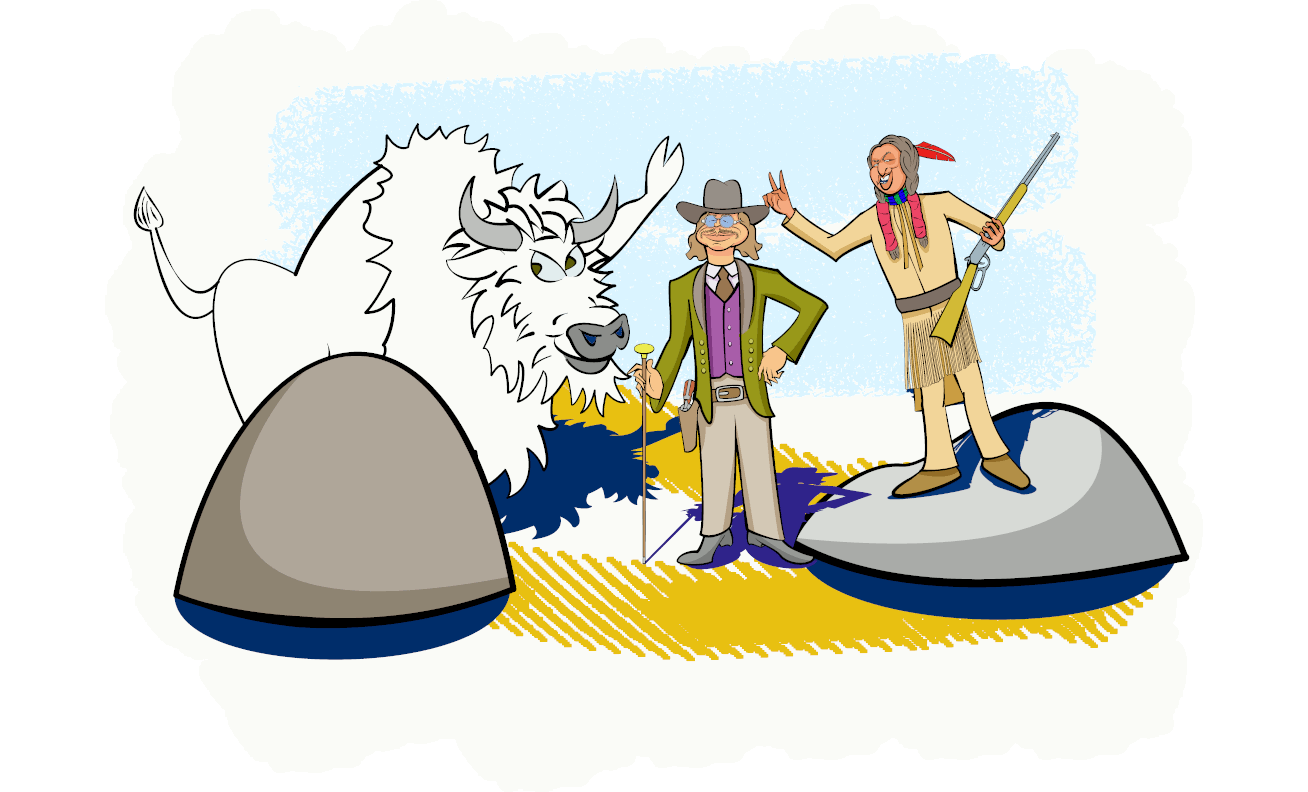
It was the unreliability of the old cap-and-ball revolvers that saved Bill's life. Bill was standing at the bar when Lonergan walked up and grabbed Bill's arms from behind. In most accounts he and Bill fell to the ground where Kile pulled his gun and stuck it in Bill's ear. But the gun misfired and Bill wrested his hand free, pulled his own gun, and shot both Kile and Loneran. Lonergan recovered but Kile died the next day.
Not sure what was going to happen after he killed two soldiers, Bill armed himself with a Winchester and extra ammunition and hid out in the Boot Hill cemetery. As no one showed up - and in fact the Army decided to not pursue the matter - he left town the following day.
After Bill lost the next election as Sheriff of Ellis County, he moved to Abilene where in 1871 the city council hired him as city marshal. He got paid $150 a month, plus a portion of the fines. Although one of his jobs was to keep stray dogs off the street, his main duty was to keep the Texas drovers in line after they dropped off their cows at the railhead stockyards. Normally indulgent of the Texans' hijinks (such as repeatedly tossing a bartender's glasses out into the street), Bill had a zero tolerance policy if any rowdiness involved gunplay. Ironically it was a problem with one of Abilene's own citizens, a man named Phil Coe, and not the Texas cowboys that ended Bill's career in public service.
Phil Coe was a bartender and owner of the Bullshead Saloon. In boasting of his fine products, Phil put out a sign which showed a bull with an anatomical exactness that bestowed a secondary meaning to his saloon's name. In any case, the sign offended some of Abilene's more delicate citizens, and Bill made Phil tone the sign down. Nothing immediate came of the fracas, but Phil didn't take too kindly to Bill's meddling with his freedom of expression.
On the night of October 5, 1871, a gang of rowdies gathered on the street outside the Alamo Saloon and among them was Phil. Phil fired a shot - at a passing dog he said. Bill, investigating the gunfire, demanded Phil give up his gun which was illegal to carry in town. Phil shot at Bill and missed (a common enough event among inebriated wannabe gunfighters). Immediately Bill yanked his own gun and the bullet hit Phil in the stomach. Then hearing footsteps running up from behind, Bill spun around and quite literally shot first before asking any questions. But the man he gunned down was his own deputy, Mike Wilson, who had been running up to help.
Outraged Bill ran through town and closed down all the saloons. Both Mike and Phil succumbed to their wounds. This incident had a major influence on the city fathers' long term plans. Within two months, they banned the cattle trade from the town and told Wild Bill his services were no longer required.
Wild Bill Hickok never drew his gun again. He drifted through the West, was arrested a number of times for vagrancy, and ended up getting married in Cheyenne, Wyoming, to a former dance hall girl named Agnes Thatcher ("I don't think the[y] meant it," the minister wrote in the registry). That was March 5, 1876. After a brief honeymoon (in exotic Cincinnati), Bill moved back west. He returned to Wyoming, and in the summer of 1876 he headed to Fort Laramie. From there he moved on to Deadwood, Dakota Territory, without - that's without - Agnes in tow.
Deadwood was the center of the Black Hills Gold Rush in what is now South Dakota. Bill wrote Agnes affectionate letters and said he'd be heading out to the goldfields soon. But instead he mostly stayed in Deadwood's saloons playing poker. It was there that Bill had what is officially called his last gunfight.
Of course, Bill did not head to Deadwood on his own. This was still the American Frontier, and when he left Fort Laramie, Bill had hitched up with a wagon train. In the group was Richard Seymour (called "Bloody Dick") and two brothers, Steve and Charlier Utter. There was even one lady present named Margaret Cosgrove who was traveling with her husband of courtesy William.
Maggie, though, was even more footloose than Wild Bill and later assumed the sobriquet Jane. For some reason people who knew her tacked on another name and Maggie Cosgrove became Calamity Jane. But that, as they say, is another story.
Mrs. Maggie Cosgrove
(After the Sobriquet)
References and Further Reading
Wild Bill Hickok: The Man and His Myth, Joseph Rosa, University of Kansas Press, 1996.
"Hickok, James Butler (Wild Bill)", Encyclopedia of Western Gunfighters, Bill O'Neal, University of Oklahoma Press, 1979.
"'Wild Bill' Tamed by a Bullet", The Cheyenne [Wyoming] Daily Leader, August 12, 1876, p. 4.
"Telegraphic Clippings", The Memphis [Tennessee] Daily Appeal, August 13, 1876, p. 1.
"The Wife of Wild Bill", Bismarck [Dakota Territory] Tri-Weekly Tribune, July 16, 1877, p. 2.
"A Complete History of the Dead Man’s Hand – A Legendary Poker Tale", Connor Whiteley, Card Player Lifestyle, June 28, 2022.
"Jack McCall – Cowardly Killer of Wild Bill Hickok", Legends of America.
"Execution of Jack McCall", The New York Herald, March 2, 1877, p. 4.
"Public Notice", Nebraska Advertiser, August 16, 1862, p. 3.
"Rock Creek Station, Nebraska, and the McCanles Massacre", Kathy Alexander, Legends of America, May 2020.
"Wild Bill" Hickok Court Documents, Kansas State Historical Society.
"Calamity Jane: The Devil in Buckskins", Richard Etulain, True West, May 16, 2019.
"Now You Know: Why Are There Two Dakotas?", Merrill Fabry, Time, July 14, 2016.
"Local Items", Springfield Weekly Patriot, July 27, 1865, p. 3.
"Letters List", St. Louis Globe-Democrat, August 4, 1866, p. 3.
"Letters List", St. Louis Globe-Democrat, May 26, 1866, p. 5.
Chronicling America, Library of Congress
Missouri Digital Newspapers, State Historical Society of Missouri
"How Many Men Did Marshal Dillon Kill in the Gunsmoke Series?", Marshall Trimble, Ask the Marshall, True West Magazine, March 26, 2018.
"The American West: Debunking Three Deadwood Wild Bill Hickok Legends", Bill Markley, Cowboy State Daily, September 7, 2024.
"The Gunfighter and the Explorer", Tom Clavin, The History Reader.
"An Interview With Wild Bill Hickok", Dakota Livesay, Cowboy to Cowboy.
"Monroe McCanles", Find-a-Grave, Memorial ID 51484711, April 22, 2010.
Calamity Jane: Her Life and Legend, Doris Faber, Houghton Mifflin Harcourt, 1997, 2010.
Calamity Jane, Adam Woog, Chelsea House, 2010.
Calamity Jane, The Woman and the Legend, James McLaird, University of Oklahoma Press, 2005.
"Wild Bill Hickok", Bob Terry (presenter), The Old West, June 14, 2019.
"Purchasing Power Today - US$", Measuring Worth