Calamity Jane(s)
(Click on the image to zoom in and out.)
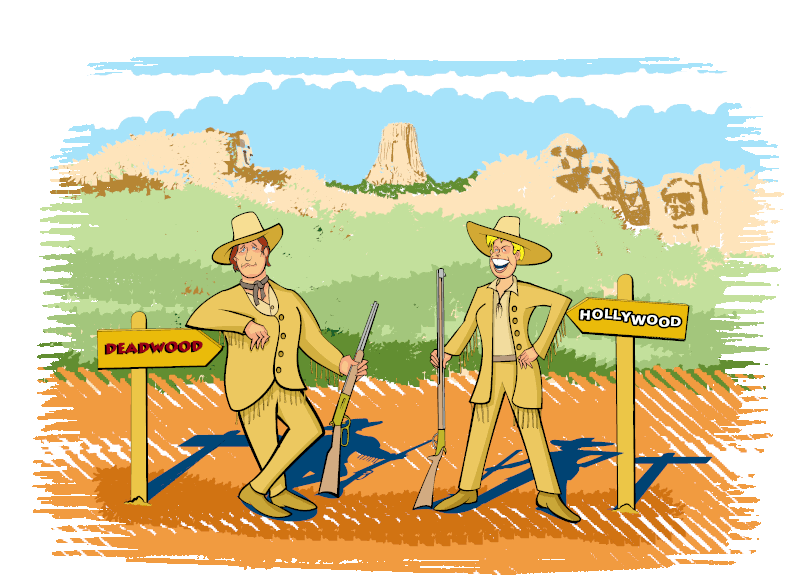
In the summer of 1876, James Butler Hickock - by then well known to virtually all Americans as "Wild Bill" - found himself in Laramie, Wyoming. He was planning to head out to Deadwood, Dakota Territory. Deadwood (now in South Dakota) was the center of the Black Hills Gold Rush, and Bill wrote to his wife, Agnes, that he would be heading to the goldfields soon.
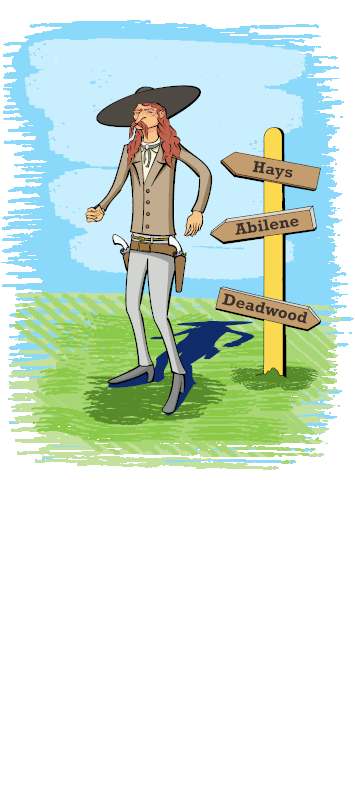
James
(Click to zoom in.)
Of course, Bill did not head to Deadwood on his own. This was still the American Frontier, and when he left Fort Laramie, Bill had hitched up with a wagon train. In the group were Richard Seymour (called "Bloody Dick") and two brothers, Steve and Charlie Utter. There was even one lady present named Margaret Cosgrove who was traveling with her husband, William.
Now William was Maggie's husband in a title of courtesy. In fact, the name Margaret may be a bit of an assumption as Mrs. Cosgrove today is better known as Martha Jane Canary.
But a year before her arrival in Deadwood, Martha had been dubbed with another sobriquet. On June 19, 1875, the Chicago Tribune reported:
THE GOLD-HUNTERS
Advance of the Government Expedi-
tion from Fort Laramie to
the Black Hills.
Camping on the Old Woman’s Fork,
the Cheyenne, and the
Beaver Rivers.
Classical Origin of the First-
Mentioned Name---The
Bloody Sioux.
First Sight of the Promised Land---
Progress Made in a Nine-
Days' March.
Make-Up of the Expedition---The
Scientific Gentlemen Un-
der Prof. Jenny.
Lesser Notabilities---"California Joe,"
"Tige," and "Calamity Jane"-
Their Curious Ante-
cedents.
After some general discussion of the pandemonium in the Black Hills Gold Rush, the reporter came to the lady named Calamity Jane.
It is all strange that
CALAMITY JANE
should be here. ... For Calamity Jane, or rather Jane Canary, is a female. Well, how did she come here? It is the same old, old story. Calamity was a few years ago the respectable proprietress of a millinery store in Omaha. Calamity was good looking, and yielding to drink she soon became a homeless outcast, and as a natural result found herself out on the frontier, repenting for a few months, and hiring out to do housework, then being found out, returning to her vicious life, until the next periodical [illegible] of repentance came on. She has been all over the frontier, and on several dangerous scouts. A year or so ago, while out with a scouting party in the Powder River country, she strayed away from the command, and one of the men remarked that it would be a great calamity if she should be captured or killed by the Indians. The soldiers thought that the word "Calamity" was good, and this was the occasion of her receiving the sobriquet of Calamity Jane. She wanted to see the Hills; so donning a suit of blue, and taking her brother, a lad of 16, whom she supports, with her, she got into a Government wagon, and, with the help of drivers and soldiers, here she is. Her adventures would make a creditable novel of Ouida's style. Who says that a woman cannot endure hardships equal to man?
First like so much written about Martha Canary - her given middle name was likely not Jane - this early account is a plethora of fact and fiction. We know that there is some unreliability in the story from no less a personage than Martha herself. When she was interviewed for a book about the Black Hills, Yellowstone, and the Big Horn regions she replied with some emphasis.
"Calamity Jane" insists that she has been shamefully abused by the public press, from New York to San Francisco, having been variously reported by the sensation-mongers as a "horse thief," a "highwaywoman," a "three-card monte sharp," and "a minister's daughter." She says all these charges are false, the last especially.
But then Martha went on to spin a few whoppers herself.
She admits, however, that she has, dressed in male attire manufactured out of buck-skins, acted in the capacity of a scout in the Indian service; been a stage-driver; and made several long trips as a bull-whacker. "Hasn't a poor woman as good a right to make a living as a man?" she protestingly asks, and she charges - probably with much truth - that if she has "done anything wrong society, and not herself, is to blame, as she always came near starving to death when she tried to support herself in a more womanly way. "Calamity Jane" can throw an oyster-can into the air and put two bullet-holes into it from her revolver before it reaches the ground, and offers to bet she can knock a fly off an ox's ear with a sixteen-foot whip-lash three times out of five.
In fact, much of the early tales are, to put it mildly, horse hockey, bullshine, and poppycock, even when told by people who had - or at least claimed to have - firsthand information of the lady. One of these informants was a Des Moines physician, Dr. A. K. Hendricks. In a story from July 23, 1877, Dr. Hendricks spoke quite volubly about Calamity Jane even though he had trouble remembering her name and just about everything else:
"Why," said Dr. Hendricks, "I was acquainted with her in Iowa, and knew her people well. Before I came west I learned that she had acquired the sobriquet by which she is better known." The Sun reporter asked him to relate what he knew of her early history, with which request the Doctor complied and is in substance as follows.
Calalmity Jane, whose real name is Jane Coombs, was born at Burlington, Iowa, in 1847, and is therefore now about thirty years of age. She is the youngest of a family of four children, two boys and two girls. The father, B. W. Coombs, now dead, was for many years pastor of the First Baptist Church of Burlington. In 1862 she fell desperately in love with a young man, who was, with herself, a member of her father's church, and an engagement followed. The father looked with favor upon the proposed marriage, but the mother, alas, had conceived a hearty dislike for the young man and forbade him the house. All efforts at reconciliation failed, and the young couple, under cover of the darkness of a bitter winter's night, fled from their parental roofs and from the state of their birth. The young man, whose name was Washburne, took Miss Coombs to Galesburg, Illinois, and there they were married.
Leaving his wife, a young girl not yet sixteen, in that city, Washburne entered the Sixth Illinois Infantry as a private soldier and finally rose by gradual promotion to a captaincy. At the battle of Mill Springs, Kentucky, with General Zollicoffer's forces, and in which that gallant Confederate officer fell, Washburne sealed his devotion with his blood. As soon as Mrs. Washburne, now known as Calamity Jane, heard of his death she resolved to avenge it. Leaving Galesburg about the beginning of 1863, she donned male attire and entered the Union army as a scout and spy, serving in that capacity until the close of the war in 1865. A portion of the time she carried a musket, and was in three of the severest engagements, finally marching with Tecumseh Sherman to the sea and back again, and stacking her musket within the shadow of the nation's capital. It was not until after the war that her sex was discovered.
In the army she passed by the name of Frank Marden. At the close of the war, like Othello, her occupation was gone. She drifted to Texas, and there attired in male clothing hunted the wild horse with the lasso, becoming quite an expert in that line. Since going to the lone [sic] Lone Star state in 1866 she has traveled all over the states and territories west of the Missouri River, and her name is as well known to the frontiersman [sic] as are those of Wild Bill, Texas Jack or Buffalo Bill. She has hunted the red man of the plains and the buffalo served as a guide to inexperienced miners and trappers and dresses in buckskin from top to toe a great portion of her time. She is one of the best horseback riders in the west, plays a good game of cards or billiards, and is at all times competent to get away with her allowance of spiritual sustenance. Altogether she is a remarkable subject for the basis of a novel in the hands of Ned Buntline, Dr. Beadle or Sylvanus Cobb.
One thing to note is that the first article to mention Calamity Jane was not about her trip to Deadwood with Wild Bill Hickok. Instead it was written a year before - 1875 - when she was with a US government scientific expedition. Yes, that's a US government scientific expedition. There will be more about this expedition later.
As far as the facts about Calamity Jane, she was born in 1844, 1847, 1851, 1852, 1856, or 1860 in Princeton, Missouri; Burlington, Iowa; La Salle, Illinois; Salt Lake City, Utah; Fort Laramie, Wyoming, or some other place and time. Perhaps the most authoritative scholarship puts the year as 1856 and the place as Princeton, Missouri. This information is about as good as you can get as it was taken from the actual census records from 1860. So it seems - amazingly - that Calamity Jane was garnering national attention when she was only 19 years old.
But when and wherever she was born, young Martha's family pulled up stakes and after various short-term residences ended up in Montana where they ultimately settled in Virginia City. This is Virginia City, Montana, and is not to be confused with the Nevada town frequented by the Cartwrights. But rather than settle down to farm or pursue a trade Martha's dad, Robert, seemed to have spent his time in the saloons gambling what little he earned from gold prospecting. Martha's mother, Charlotte, took in laundry and - if some rather disparaging remarks be true - could have inspired the title of one of Oscar Brand's more winkable songs. In such an environment, it's not surprising that people in Virginia City remembered Martha and her sisters going door-to-door asking for handouts.
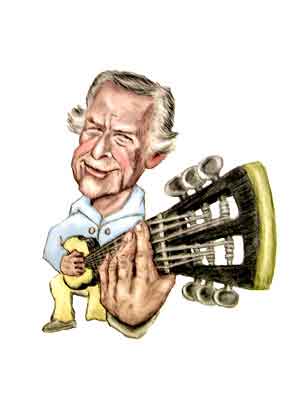
Oscar Brand
Winkable Songs
But any hopes for a normal family life ended in 1866 when Charlotte died of some as yet identified malady. Robert took the kids away to Salt Lake City where he set up a farm and things might have turned out pretty normally. But the next year Robert also died leaving the girls orphaned. As was common at the time, local families took the kids in but Martha - although still a preteen if the census record is correct - decided to strike out on her own.
Martha's doings for the next few years are vague, contradictory, and it's virtually impossible to sift through the legends and the facts. But every now and then some truth slips in. She claimed - and other records confirm - that she moved to Piedmont, Wyoming, which is now a few abandoned and dilapidated buildings in the southwest corner of the state.
But throughout her life Martha rarely stayed in one place very long and she was able to find work as a cook or laundress along the route of the Transcontinental Railway which was then undergoing construction. Her taking up wearing men's clothing was probably simply a matter of practicality as masculine attire was more available than ladies' clothes. However when possible she did seem to select apparel - as the stories of the time would say - "appropriate for her sex".
Sometimes it didn't matter what clothes she wore. One story has her tagging along with troops guarding the railroad construction crews. At one point the soldiers figured they'd take a refreshing break in a nearby stream. Of course specialized swimming outfits were scarce on the Frontier and so Martha and the soldiers jumped in sans maillots de bain. When the commanding officer noted the undraped civilian of the opposite gender cavorting with his men, he, like Queen Victoria, was not amused and ordered her from the camp.
This is a good example of Matha's modus getaroundi. She would find a group of men - often soldiers - and just kind of latch on. The men were often more amused than not. If the commander did order her out of the camp, Martha could simply ride off a short distance and rejoin the group when the officer left.
By the early 1870's Martha, still in her teens, was acting doubly contrary to Horace Greeley's advice and was working her way east. Between 1870 and 1872, sources place her mostly in Wyoming while migrating toward the Dakota Territory. By 1875 we saw her presence was reliably documented in the Black Hills.
Although it seems strange that newspapers would report a young waif arriving in town - which allows some reliability in tracing her whereabouts - this was the time that newspapers would regularly print who had arrived in town and who had left. Even into the 1960's you could read stories like, "Mr. Joe Blow and his wife Josephine have just arrived from Moose Jaw, Saskatchewan, for a visit with Mrs. Blow's brother, Aloysius Gump." Certainly a young girl with men's duds and a salty vocabulary roaming around on her own was enough of a novelty to elicit a comment from the local editors.
Somewhere in her wanderings from Utah to Dakota, Martha Canary became Calamity Jane. The tellings of how she picked up the famous sobriquet are legion. Martha herself claimed she had been traveling as a scout with the army and came to the rescue of Captain James Egan, who commanded the troops from a fort near Sheridan, Wyoming. According to Martha this was during a Nez Perce uprising in 1872, and Captain Egan and the soldiers came under attack.
Martha - so she said - had been riding as an advance scout. When she saw Captain Egan was wounded she spun her horse around and reached him before he fell. They made it back to the fort and after Captain Egan recovered he grandly named his young rescuer "Calamity Jane, the Heroine of the Plains."
Needless to say most historians consider this story of dubious quality. One of the doubters was none other than Captain Eagan's wife who later stated most emphatically that her husband was never rescued by Calamity Jane and that the incident was complete fiction.
One of the more popular tellings of how Martha became Calamity - as we'll now call her - was she had been helping some soldiers during the "calamity" of an epidemic. Then there was also a newspaper reporter who claimed he gave her the name when they had been playing poker. Whenever she lost she'd cry out, "What a calamity!" No one really believes this story either.
The truth is "Calamity" was a nickname bestowed on a number of characters of the Old West who had a tendency to raise a ruckus. There was a Calamity Joe and a Calamity Sal and there were even other Calamity Janes, "Jane" just being slang for a woman.1 One was a Calamity Jane who was mentioned in a newspaper in Pueblo, Colorado. This though was not our Calamity Jane and instead was a woman who had gotten into a vigorous argument with her husband.
Footnote
However, whether the word "jane" was used for "woman" back in Jane's time isn't clear. Vague and unreferenced sources state the use was first found in America writings in 1906 but the example then given wasn't published until 1967. However, novels published in the early 1930's have the men characters referring to a "jane" when speaking about a woman.
The obvious source would be "jane" came from the Edgar Rice Burroughs's Tarzan books. But Jane Porter as a character didn't show up until the first book, Tarzan of the Apes published in 1912.
Instead the first reference to our Calamity being Calamity Jane was the article quoted above from the Chicago Tribune in June 1875. Sadly, the truth is that where and how she got her famous name has been lost to history and that's pretty much that.
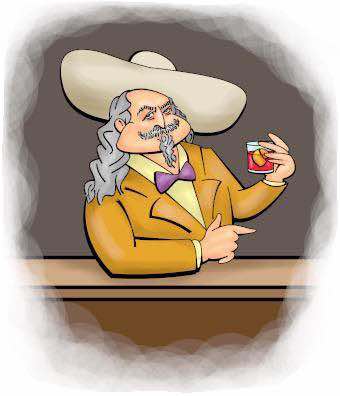
Buffalo Bill
One story about Calamity that has considerable credibility is given to us by none other than William Frederick Cody, known to everyone as Buffalo Bill. Now, Buffalo Bill was indeed a bonafide scout for the US Army and in 1874 he was the guide for an expedition into the Big Horn Mountains in Montana. At one point his group bumped into a band of prospectors and Calamity Jane was with them. Calamity and her group tagged along with Bill for several weeks.
Bill's description is perhaps one of the more objective, unbiased, and sympathetic contemporary views of Calamity Jane. She did, Bill said, dress in men's clothes and could easily be mistaken for a man. She was a good hunter and seemed at home in what Bill admitted was a wild country. But he added that she never acted as a scout for the army.
According to Bill, Calamity was generally liked by the soldiers. Knowing that the commanders might object to her presence, Bill said she would join the expeditions when they were so far away from settlements that it would have been dangerous to send her away on her own.
But in the famous Black Hills Expedition of 1875 it is certain Calamity was present. The expedition was led by two government geologists, Walter Jenney and Henry Newton and their purpose was to assess the mineral resources of the area. Often referred to as the Jenny Expedition or the Newton–Jenney Party, there was a military guard of 400 soldiers as well as the scientists and engineers. In the group was the surgeon and writer Valentine T. McGillycuddy (that's his real name). Valentine later became the Indian Agent of considerable controversy at the Lakota Pine Ridge Reservation in South Dakota. But everyone remembered Calamity was in the party. Valentine said the soldiers looked on Calamity as a regimental mascot and she helped cook the meals and mend the clothes for the boys.
Also along was Captain Jack Crawford who had already garnered a reputation as a "poet scout". He would send back news dispatches about the Expedition and later mentioned a mining claim called the "Calamity Bar". The name he added was "from a woman who accompanied the soldiers last summer. They called her Calamity Jane." Keeping with his nickname he penned some verse "To the Miners in Custer" which included the lines:
Now Calamity Bar is a good one,
Yes, Calamity, that's its name;
And it must be a great calamity,
If it's like old Calamity Jane.
If further proof is needed of Calamity's presence on the Black Hills Expedition, we have her picture. When the expedition reached an encampment near French Creek (not far from present day Laramie) they found a traveling photographer who took the first known photograph of Calamity Jane. It seems it was at this point that Calamity left the group and returned to her usual hangouts around Fort Laramie and Fort Fetterman.
With news stories mentioning the wild and crazy lady who traveled with the guys, Calamity began gaining some regional fame. But the big news was the Jenney Expedition did indeed confirm that gold was in Them Thar Black Hills. As usual when gold was discovered on Native lands, the United States Government declared them open for white settlement. So on January 31, 1876, the government declared the Native Tribes in the region must leave and report to the official government reservations. If not they would be declared hostile and forcibly removed from the area.
To enforce the order, General Phillip Sheridan sent in General George Crook. The troops left Fort Fetterman on March 17 and were immediately hit by a massive snowstorm. So it's no surprise that they managed to attack only a single village and inflict one casualty. The campaign was so ineffective that George had to return to Fort Fetterman to wait for more temperate weather.
Supposedly Calamity had gone along on the trip although she did so by sneaking in dressed in her masculine attire. When she was discovered there was considerable consternation. But given the conditions and location there wasn't much anyone could do. So she remained with the troops. But as Spring turned to Summer, the Lakota were still ignoring the government's order and in fact, most probably had never heard of it. So they continued their nomadic existence in Wyoming, Montana, and Dakota.
As far as Calamity she left the army when they got back, and for the first time we read she had landed in some real difficulty. On May 22, she was arrested in Cheyenne, Wyoming, and for grand larceny no less. It seems that she was wanting to find a more appropriate costume and she had stolen some women's clothes worth 12 dollars. Although she gave an assumed name at the station, the local reporters found that it was indeed the now famous Calamity Jane who was in the Cheyenne hoosegow.
Calamity was held in jail for three weeks and was released after a brief trial. Evidently the time served was deemed sufficient payment to society, and according to the news accounts she celebrated her release with élan.
Happy to be back in the wide world, Calamity rented a buggy to drive the three miles to Fort Russell. But due to the lingering effects of her celebration she missed the turn and ended up at Fort Laramie over seventy miles to the north. After a few days a city policeman from Cheyenne showed up but as he had no authority to arrest Calamity he simply returned with the rig.
Back at Fort Laramie, Calamity learned that George Crook was planning another expedition. This time he was better prepared and the timing had improved. On May 29, 1876, he and his army of over a thousand men headed north toward the Rosebud River. But better planned or not, the expedition was not a success. On June 17 while George and his men were traveling along the Rosebud, a band of Lakota led by a warrior named Crazy Horse attacked. Crazy Horse and the others left the cavalry in such bad shape that Crook knew they couldn't continue.
Calamity claimed she went along with George and even served as a scout. Of course, scholarly opinion ranges from she may have served in some capacity as a guide to the whole story being complete balderdash.
On the other hand there is an apparently authoritative source that Calamity went along. That was one of Crook's bonafide scouts, Frank Grouard. So that would seem to cinch it. But the problem is that the other scouts he mentions - Charlie Chapin, Bill Zimmers, Jim Phoenix, and Black Hills Frank - were NOT with Crook on that expedition. Worse, Frank's memoirs were an "as told to" story and they were related to a reporter named Joe DeBarthe. Joe would today be called a tabloid journalist and his other writings are known not to be stellar examples of factual reporting.
Another source of her presence, though, is a little more reliable. That was from Captain Anson Mills, who left his memoirs of his life as a soldier. He said that Calamity had snuck in with the soldiers and as usual at one point she was discovered by some officers. Anson had known who Calamity was (she may have worked as a cook for a neighbor), and for her safety, Anson waited until he could send her back with the next contingent of wounded soldiers.
So after many and convoluted wanderings Calamity Jane found herself back again at Fort Laramie. It was then in June that she joined the wagon train heading to Deadwood along with Wild Bill Hickock and the others.
Calamity was not the only woman on the trip and one of the men remembered there were actually fourteen (count 'em) ladies present. In addition to Calamity, two others, Eleanor Dumont - known as "Madame Mustache" - and a lady known as "Dirty Em" achieved fame in the annals of Western history. Reportedly Wild Bill did not much associate with Calamity although she seems to have been a frequent sampler of the whiskey keg he brought along.
The group arrived in Deadwood around mid-July. Interestingly, only Calamity was deemed important enough for the papers to mention. In Deadwood she was regarded as something of a character and was generally liked by the residents.
Calamity often lived on a shoestring budget and in Deadwood, the first thing she did was to ask the guys for a loan so she could buy some more suitable clothes. Now dressed as a lady, she began to frequent the dance halls where the women were paid a given amount to dance with the men who came in. Although there are many a nodding head at the (wink, wink) "dance halls", comedian Eddie Foy remembered that many of the women did in fact limit their activities to dancing and nothing else. In Deadwood most people remembered Calamity as a dance-hall girl.
The big question was and is: What was the deal between Wild Bill and Calamity Jane? The stories of a romantic liaison have become part of the legend and so naturally everyone wants to know what was the scoop.
As usual the information is contradictory. Some who knew both Wild Bill said he had nothing to do with Calamity while others remember them being frequently about town - not surprising since both of them spent a lot of their time in the saloons. For her part Calamity claimed Wild Bill was her one true love and they were planning to get married, a rather unusual story since Bill was already legally married to Agnes. Later Calamity claimed she played a major part in the apprehension, arrest, trial, and execution of "Broken Nose" Jack McCall who shot Wild Bill on August 2, 1876. However, her story has - according to one scholar - glaring omissions and inaccuracies. The truth is she had known Wild Bill for only a few weeks and was not involved in the aftermath of Wild Bill's murder.
So by 1876 Calamity's fame was beginning to reach a national audience. However, there were millions and millions of people who had yet to hear of her. But within a year, she was to become literally a household name.
How, we ask, did this come about?
Here we must bring up a 19th and early 20th Century phenomenon known as the dime novels. Dime novels - as reported in a popular informational reference - were a form of late 19th-century and early 20th-century popular American fiction issued as inexpensive paperback editions. Some dime novels were single issue volumes; others were continuing series.
Dime novels served the purpose of motion pictures and television in the later decades. They were a way for a person to put their brains in neutral and coast along with the story. Like motion pictures and television today, dime novels had a huge market, some editions having a printing of half a million copies or more. As the name indicates the cost of a volume could be a dime but sometimes they were less.
Dime novels were possible because of the printing revolution in the early 19th Century. Up to the year 1800 books and pamphlets were still being printed on the old flatbed presses similar to those used in the days of Johannes Gutenberg. But in the early 1800's, the combination of the invention of the cylinder press and steam power could print literally tens of thousands of pages per day.
In 1814, the London Times began using a steam-powered cylinder press and the rapid printing revolutionized the magazine industry where the book format was more convenient than the foldable newspapers. It was this same technology that produced the massive magazine output that could also knock out thousands of dime novels in a day.
Of course, to crank out the dime novels you needed authors. These, though, were readily available from the growing supply of newspaper reporters. In particular, there were news reporters who were not attached to any publication but would send in stories on a freelance basis. Many of these men (although some were women) were not full-time reporters as we saw with Captain Jack Crawford who was in George Crook's army.
But the quintessential of the dime novelists was Edward Lytton Wheeler. His specialty was stories of the Old West which had already become a legendary epoch. And once the Black Hills Gold Rush began, Edward began writing about the exploits of "Deadwood Dick". Deadwood Dick was a masked bandit but still basically a good guy with the designation of the Black Rider of the Black Hills.
Deadwood Dick was fictional, of course, but many of the other characters in the novels were real people at least by name. Dime novels featured Kit Carson, Buffalo Bill, and Wild Bill Hickock. And in the Deadwood Dick novels beginning in 1877, Edward began including the lady from Deadwood named Calamity Jane.
In the Deadwood Dick stories, Calamity was one tough cookie. She dresses like a man, smokes, drinks, and would "drop the rude vernacular of the mines" - ergo, she cusses. But her behavior was not her fault, Edward wrote, as she had been "ruined" by a "villain" and "set adrift in the world". So she should not be judged harshly and she was always on the side of good and righteousness. Calamity ended up as a character in about half of the Deadwood Dick novels.
So by 1878 everyone in America - and we mean everyone - knew about Calamity Jane and her many heroic exploits even though most of them had never happened. Other dime novelists soon picked Calamity up as a character. The intended audience was largely the more credulous Easterners who wouldn't recognize that the stories were completely impossible.
The dime novels, though, also produced what sociologists call a moral panic. As later happened with movies and television, dime novels were often denounced as glorifying the baser side of life - Deadwood Dick was an outlaw after all. Making a hero out of an outlaw just wouldn't do, and the good citizens lamented the novels' effects on children. Ironically one of the biggest critics of the dime novel was none other than Captain Jack Crawford, Calamity's friend from the Black Hills Expedition. Captain Jack would go into spittle-flinging diatribes about how many an inmate in America's penitentiaries had assured him that their life of crime began directly from their reading dime novels.
But of course the real Calamity Jane was still around. By the 1880's railroad travel was becoming the norm making her wandering from place to place even easier. As before she never stayed in one place very long.
At times Calamity seemed to get irritated with her new found fame and would curtly inform inquirers that her name was not Calamity Jane. However, what she used as her real name varied as she tended to introduce a number of different men as her husband. As late as 1877 she was still calling herself Maggie Cosgrove from her "husband" George who had been with her on the trip from Fort Laramie to Deadwood. However, in 1878 she seems to have switched husbands to someone named Jim who no one seems to know anything about.
One of the stories that does seem to have some truth is that Calamity would be kind to others. One girl living in Deadwood remembered Calamity was nice to her and would sometimes give her gifts. The stories that she would happily help people who were sick or injured also seem to be based in fact and Deadwood's newspaper would mention how appreciative people were of her charitable work. When she herself fell ill people helped her as they could.
Although today Calamity is always associated with Deadwood her time there was actually brief and intermittent. In late 1878 she was reported living in Le Mars, Iowa, and in 1880, she relocated to Fort Pierre across the Missouri River from the modern Pierre, South Dakota. If the reports are true Calamity began showing an entrepreneurial side and she reportedly ran a saloon until due to a mishap she broke her leg. She recovered and soon left town.
In February, 1882, the newspapers in Miles City, Montana, reported the famous Calamity Jane was in town. Again she seems to have been following the railroad construction crews, this time those of the Northern Pacific Company. Soon she moved to Helena and newspapers reported she was ranching on the Rosebud River. But in September, she was living in Billings where she may have been running a restaurant and saloon. Others, though, say she was simply working as a cook at a stage waystation. Stories that she spent some time rustling cattle probably have little basis in fact.
In 1883 a traveler reported he had found Calamity operating a freighting business. However, in this case the reference was probably about another enterprising businesswoman from the area. Old-timers also remember Calamity living in Spokane, Washington, in 1883.
The Spokane Calamity may also be a case of mistaken identity as it was also in 1883 that the banafie Calalmity was back in Miles City. There she met the cowboy writer Edward Charles "Teddy Blue" Abbott whose book We Pointed Them North is one of the few first hand accounts of the Old West written by a real cowboy. There is a photograph of Teddy Blue sharing a drink with a lady dressed in proper women's attire but whose features are without doubt our Calamity Jane. It also looks like Teddy Blue borrowed one of Calamity's flower-bedecked hats for the photo.
In 1884 Calamity was definitely living in Livingston, Montana, where she reportedly got into a hefty fight with a lady named Madame Bull Dog. Madame outweighed Calamity by about a hundred and fifty pounds but she, not Calamity, ended up on the floor.
At this point it seems that Calamity's fame began opening up new opportunities. At least in the summer of 1884 she signed on to appear in a Wild West show run by Tom Hardwick. However, the show went bankrupt in a few months and Calamity headed out for newer pastures.
For the next ten years, 1884 to 1894, Calamity's life was centered in Wyoming although as usual she moved from town to town. In Rawlins she evidently picked up another husband and was calling herself Mattie King. Moving to the town of Lander, she received a boost in her fame when she was interviewed by a correspondent of the well-circulated Cheyenne Daily Leader.
After a side trip to Nebraska (again following the railroad construction), Calamity was back in Rawlins where she got into an argument with her new boyfriend William Steers (she was still going by her "married name" of Mattie King). Bill, it seems, was a rather tough character, and he and Calamity got into altercations from time to time. Such tussles would occasionally land them in court and produced rather lengthy separations. However by 1886 she was introducing herself as Mrs. Mary Jane Steers.
By now Calamity's drinking - always a sardonic and snarky topic for the reporters - was definitely getting out of hand. Back in Oelrichs, it was reported that she went to a saloon only to find the door locked. Putting expediency above decorum, she pulled out a revolver and shot the lock off the door. Evidently no official action was taken. Calamity Jane was after all Calamity Jane.
In 1887 "Mrs. Steers" gave birth to a daughter who she named Jessie. Domesticity did not improve the marital relationship and in 1888 while in living Green River, Wyoming, Calamity had Bill jailed for domestic abuse. However, Martha herself was arrested on occasion often for appearing on the streets inebriated and disorderly. She did not, according to the reports, come along quietly but fought back with considerable vigor.
The year 1888 was also notable because by then Calamity and Bill were definitely (and legally) married. They set up a home in Pocatello, Idaho, about 100 miles southeast of Sun Valley. A mention of them living in the town, published in May, 1888, was the last we hear of Bill, the one uncontestable husband of Calamity Jane. Evidently they went their separate ways in what may have been if not the briefest of marriages was certainly brief enough.
What happened to Calamity's daughter was not learned until years later. Evidently she was taken care of by other families, and in the 1930's a Jessie Oaks wrote to various newspapers and historical societies for information about Calamity Jane. Jessie, though, was not sure of her actual relationship was with the famous Calamity Jane and actually thought she might be her granddaughter. Historians, though, have concluded that this Jessie was indeed Calamity's daughter. Her birthday, October 28, 1887, is correct, and Jessie said she remembered living with Calamity in the 1890's.
In 1889 Calamity had relocated to Casper, Wyoming, where evidently she would visit saloons and raise her voice to a hoop and a holler as she walked down the streets. In 1890 and 1891 she may have taken a trip to Creede, Colorado, where the silver mines were bringing in big money. Then after a quick trip to Omaha, Nebraska, she was back in Wyoming in 1893. Mostly she kept to her old haunts of Lander, Rawlins, Billings, and Miles City. In Billings we hear she was again running a restaurant.
But back in Miles City she was arrested for reasons that were not quite clear. Somehow she managed to avoid paying the rather steep $100 fine and then caught a ride to Ekalaka, Montana. At Ekalaka, she began introducing a cowboy named Clinton Burke as her husband and it seems her daughter Jessie was with her.
Of course, all roads lead to Deadwood, and the hamlet of Ekalaka was only about 100 miles north. Her return in 1894 was after an 18 year absence. When she arrived she commented most firmly that she was not to be called Calamity Jane. It was "Mrs. Burke".
Whatever the name, Deadwood's townspeople greeted her with open arms. Newspapers in neighboring towns scratched their journalistic heads and wondered why the civic leaders of the town were so enthusiastic about the return of the cantankerous women who had spent much of her time in the saloons, swearing up a storm, and sometimes behaving badly. But Martha Burke née Canary was now a national celebrity who had been one of the town's pioneers in the Days of '76. The people in Deadwood also remembered her kindness to others and how she would help the sick and infirm.
The trip wasn't just for old times' sake. Recruiters for The Diamond Dick and Company Wild West Show were in town and looking for famous Old West figures. Unfortunately that job didn't shake out. But Calamity did manage to wrangle a contract for a tour on the "dime museum" circuit.
Dime museums - named after the typical admittance fee - were establishments where the public would pay a small fee and come in to view "curiosities". Ostensibly open to educate the public the dime museums housed weird, often macabre, and sometimes phony items as well as live people with deformities. What were called "freak shows" remained mainstream entertainment in the state fairs up throughout the 1970's.
But dime museums also featured more or less standard performers. These were often people who claimed extraordinary powers: mind readers, fortune tellers, spiritualists, and conjurers. Sometimes you might even get a fairly normal singing or dance troupe or just interesting people like Calamity Jane. Many celebrities of the later 19th and early 20th Century got their start in the dime museums, including a young immigrant from Hungary who with his family had settled in Appleton, Wisconsin, and who took the name and later changed it legally to Harry Houdini.
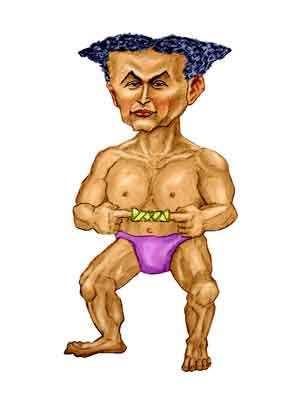
Houdini
Dime Museum Harry?
Calamity would go on the stage and tell stories of her life. She may have even exhibited her shooting prowess. The actual itinerary of the tour isn't completely clear but seems to have included at least Chicago and may have moved on to Cincinnati, Philadelphia, and New York.
The tour over, Calamity returned to Deadwood in 1895 where she sold her photographs and copies of her autobiography The Life and Adventures of Calamity Jane (still readily available today). However, she soon departed once again for Montana.
On the way she stopped at Sheridan, Wyoming and found that years of neglect had been wreaking dental havoc. The town's dentist, Dr. William Frackelton, was rather nervous about having to treat the notorious Calamity Jane. But although it took several sessions to fix her long-neglected choppers, Dr. Frackelton found her a quiet and calm patient. Although her vocabulary remained quite robust, he realized that was just Calamity Jane talking.
In Castle, Montana, we learn that Calamity and her husband Bill set up a restaurant. Although they hoped for a long stay, plans went awry when they found their debts quickly exceeded their assets. Moving on to Billings Calamity took a trip to Yellowstone, now the first United States national park, where again she found a market for her photographs and autobiography with the tourists.2
Footnote
An interesting aside in the history of Yellowstone comes from it being established a national park during what was called the Indian Wars. In 1877 the Nez Perce War broke out which pitted Chief Joseph against General Oliver Otis Howard. At one point General Howard pursued the warriors into Yellowstone and the Indians came into contact with some groups of tourists. Although there were two instances where fighting broke out, the Nez Perce leaders did what they could to protect the tourists who were taken prisoner and released them when it was practical.
Suddenly and unexpectedly in June, 1898, Calamity showed up in Dawson, Canada, after gold had been discovered in the Klondike. At first this seems like another spurious Calamity Jane story, but the newspaper accounts make it clear that this was indeed the famous Calamity Jane. She did little if any prospecting and was back in Montana in August. The next month she was at the Crow Indian Reservation where the Battle of the Little Bighorn had been fought. Whether she stopped by the Custer Battlefield isn't known.
Although she still traveled extensively, by the end of the century Billings seems to have become her central headquarters. When the autobiography and photograph business was slow she could always find work as a cook. She also economized by the simple expedient of buying items on credit, and as we surmise from rather sour comments of the local businessmen, not paying her bills.
In fact, Calamity was finding it harder and harder to make ends meet. Then while passing through Livingston, Calamity became seriously ill. With virtually no money she had to stay in the local charity home in nearby Bozeman. Soon word got out how Calamity was literally in the poorhouse and a number of people from the various towns chipped in to help her get back on the road.
As the fin de siècle turned, Calamity was now in her mid-forties and so was pushing into old age by the standards of the time. She also didn't seem quite as sharp as in the old days and people commented on how worn down she seemed. It looked like she might end up her days literally living on what meager institutionalized charity was available.
But while she was recuperating Calamity had a visit from a most unusual individual. That was Josephine Winifred Brake who was a rarity of the era. Josephine was not only a woman reporter but she was considered one of the best journalists in the nation. She invited Calamity to come to New York where she'd help Calamity establish a business suitable for someone of her fame.
Calamity decided to take up the offer. But from the first it seems that Josephine - a rather elegant woman - was having difficulty adapting to traveling with her boisterous and salty-speaking companion. However, they finally made it to Buffalo and Calamity became a hit with the locals. She was even honored with a banquet at the elegant and rebuilt Iroquois Hotel.
There Calamity met "Doc" Waddell who was a press agent for the Indian Congress. The Indian Congress was a group whose members were selected from thirty-one of the Native American Tribes and who had been performing at the Pan-American Exposition which had been opened that year in Buffalo.
The Pan-American Exposition of 1901 was an example of the once popular but now virtually extinct phenomenon called a "World's Fair". World's Fairs were collections of exhibitions from around the world that were set up for visitors to come in and see the Wonders of the World. They were also the place to go and see "The World of the Future" which never seemed to happen as predicted.
The World's Fairs had been a gradual development from the 18th Century but really began in the modern sense in 1851 with the opening of London's "Great Exhibition" at the now vanished Crystal Palace which had been constructed under Prince Albert's supervision in Hyde Park. Although technically World's Fairs are still around, for all practical purposes they ended with Expo 67 in Montreal.
But in 1901 the World's Fairs were big. At Buffalo the visitors included dignitaries like Theodore Roosevelt, Kaiser Wilhelm of Germany, Admiral George "Fire When Ready Gridley" Dewey, and General Nelson A. Miles who had taken over George Custer's job after the Battle of the Little Bighorn. From the opening on May 1 until it closed on November 2, over 8 million people attended the Exposition.
Calamity was a hit. She performed before the crowds dressed in her trademark buckskins and entered the ring riding on a horse. Of course she sold her photographs and copies of her autobiography.
But the most famous happening at the Pan American Exposition was one of the most unfortunate. On September 6, 1901, President William McKinley arrived. As he stood shaking hands in the Temple of Music, a newly converted anarchist named Leon Czolgosz came up and shot the President in the stomach. McKinley died a week later.
By then Calamity had moved on. Although Josephine had gotten Calamity to abjure drinking, once Calamity got her first paycheck she considered any such agreement null and void. Her condition was such that she was hauled to the police station and at the trial the understanding judge gave her a suspended sentence. Although she had met some of her old friends at the Exposition - including Buffalo Bill - she decided the East was not for her.
Making her way back to the West was a bit touch and go. Even though Buffalo Bill had given her a stake to get back home on, she tended to run through her money pretty quick. Fortunately she was still the Famous Calamity Jane and found work at dime museums in the cities along the way. Even though the newspapers reported on her progress, there were times when no one had any idea where she was.
She finally reached South Dakota - admitted as the 40th State in 1889 immediately after its northern namesake - and spent some time in its capital city Pierre. From there she continued her meanderings (duly reported by the papers) and finally arrived once more in Montana.
Yes, Calamity was still Calamity and after she reached Livingston her behavior landed her a night in jail. By this time it seems the novelty of having the famous Calamity Jane in your town was wearing off and she was released on the proviso she would leave town.
On November 2, 1902, Calamity was back living in Billings. But the Billings of 1902 was no longer the wild and woolly Billings of 1880 and her drinking continued to land her in jail. Finally Calamity decided to head back to the Black Hills, and on December 15 the Deadwood Evening Independent reported the famous Calamity Jane was back once more.
Of course, she didn't stay long and continued her never-ending roaming to other towns. At Belle Forche about twenty miles to the north, she was able to find work doing laundry and cooking and a local storeowner actually remembered her paying her bills. Although she usually wore proper feminine attire, when she was out on the town she would return to sporting her buckskins. Her drinking sprees were characterized by her usual loud whoops and yells as she walked down the streets.
Finally in early July Calamity returned to Deadwood. There John Mayo, a local businessman and photographer, asked her to pose standing by the grave of Wild Bill Hickock. The picture showing Calamity striking a jaunty pose in front of the fenced-in gravesite was taken after some difficulty and is now one of the most famous photographs of Calamity Jane.
Then on July 24 Calamity was visiting Terry, a small town about 5 miles southwest of Deadwood. There the papers reported she had fallen seriously ill and on August 1, 1903, Calamity Jane died. The transport of her body the short distance to Deadwood had something of a carnival atmosphere with frequent stops by roadside saloons.
She was buried next to Wild Bill Hickock although some of Bill's friends murmured that this was simply perpetuating an old and long debunked legend. But others suspect that it was actually Bill's friends - who had reserved the plot - giving a posthumous tweak to Wild Bill's ample proboscis.
The grave was marked with reasonable accuracy:
CALAMITY JANE
DIED AUG. 1. 1903
AGED 47 YRS.
Calamity Jane soon became part of 
 Culture. From the time she died mostly inaccurate stories continued to appear in the newspapers. Her name was also appropriated for other characters. One early comic strip around 1917 had a maid named Calamity Jane and a famous show cow bore the name.
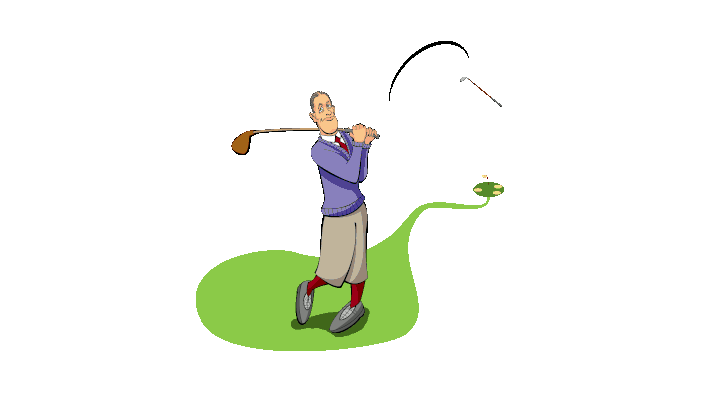
Babby and Calalmity
(Click to zoom in and out.)
In the 1920's the great golfer Bobby Jones dubbed one of his putters "Calamity Jane" due to its (perceived) erratic behavior. In the 1959 novel Goldfinger when James Bond and Auric Goldfinger were playing a skins match for $10,000, Bond muses that his "old hickory Calamity Jane had its good days and its bad."
Calamity would show up as a character in fiction. Dime novels were still in circulation in the early 20th Century and in the 1920's the Calamity character began appearing in plays. Deadwood was now a tourist attraction and regularly staged a melodrama The Trial of Jack McCall. One of the characters was (of course) Calamity Jane.
It was inevitable that Calamity would land in the movies. The earliest film with Calamity was in 1915 in The Days of '75 and '76. Freeda Hartzell Romine played Calamity and A. L. Johnson was Wild Bill Hickock. Not what you would call a Hollywood extravaganza, the film was produced by the Black Hills Film Company based in Chadron, Nebraska. Freeda, by the way, was a crack shot who also gave demonstrations like those of Annie Oakley.
In 1923 the famous cowboy star William S. Hart starred in Wild Bill Hickock and Ethel Grey Terry played Calamity. In the movie Wild Bill is helped out by Calamity as well as by his friends Wyatt Earp, Bat Masterson, Doc Holliday, Charlie Bassett, Luke Short, and Bill Tilghman. Together they all run the baddies out of town. Historically in 1883, Wyatt, Bat, Charlie, and Luke did get their photograph taken in Dodge City, Kansas, but Wild Bill (of course) was not present.
The first sound film where Calamity appears was in 1936. There Gary Cooper starred in The Plainsman along with Jane Arthur. The movie was directed by no less a personage than a pre-Ten Commandments Cecil B. DeMille. Jane played a whip cracking Calamity and Gary was of course Wild Bill Hickock. The plot is absolutely ridiculous and a remake thirty years later where Hollywood Squares panelist Abby Dalton plays Calamity didn't fare any better.
Of course during the Roaring Twenties and Thunderous Thirties, radio soon became the most popular (and cheapest) form of entertainment. After the initial purchase everything was free, and some of the biggest names in the movies and television gained their first national audiences from the radio shows. So it's no surprise that in 1944 one of the programs on the airways was "The Lone Ranger Meets Calamity Jane".
In 1948 one of the biggest comedy hits was The Paleface starring Bob Hope as a character named Painless Potter. Jane Russell was - yes - Calamity Jane. Of course, the long convoluted plot has absolutely no historical basis.
Then came Doris Kappelhoff.
Doris is better known as Doris Day and was one of the megastars of the 20th Century. Although she began singing with big bands in the late 1930's her acting career spanned the late 1940's through the 1960's. Her sunny girl-next-door type characters became popular with mainstream cinema goers.
By 1953 Doris had already appeared in fourteen motion pictures. Then she was cast in - yes - Calamity Jane. This was a musical where Calamity, appealingly decked out in a Civil War uniform, meets Wild Bill Hickock (Howard Keel) in Deadwood, a town where it seems everyone breaks out into song at a moment's notice.
Of course in the plot Calamity and Wild Bill finally fall for each other and ultimately get hitched. Somewhat in reverse of the usual modus, the movie was later adapted to a stage musical which at this time is still being performed literally throughout the world.
Today the Western, if not a thing of the past, has become something of a novelty item, and Calamity Jane doesn't quite have the name recognition she once enjoyed. In the 1960's you'd still find her on shows like Peabody's Improbable History from The Rocky and Bullwinkle Show and there was an animated series The Legend of Calamity Jane that was broadcast for two seasons starting in 1996.
Of course, Calamity was a character in the TV series Deadwood which ran for three seasons beginning in 2004. Even as late as 2024 there was a motion picture about Calamity's life. It was, of course, suitably embellished and fictionalized and was not received particularly well either critically or financially.
Although not particularly numerous, there are jokes where Calamity Jane is mentioned. One of the modern Calamity capprichios runs like:
At ten o'clock one morning Calamity Jane walked into a bar in Deadwood.
"Give me a cup of coffee," she said.
The bartender pours her a cup.
After she drinks it down Calamity looks at the wall where a stuffed buffalo head is displayed. She pulls out her gun and blasts the head. After it fell to the floor she kept shooting at it until it was splintered and the fragments were lying all over the floor with bullet holes peppering the walls. Then she started walking out.
The bartender calls out.
"Calamity! What did you do that for? Look at the mess you made!"
She just laughed and said "Why, I'm studying to go into corporate management!"
"Corporate management?" the bartender asks.
"Sure," she said, "Show up at ten o'clock, drink coffee, shoot the bull, and leave a mess for others to clean up!"
References and Further Reading
Calamity Jane: Her Life and Legend, Doris Faber, Houghton Mifflin Harcourt, 1997, 2010.
Calamity Jane, The Woman and the Legend, James McLaird, University of Oklahoma Press, 2005.
"Calamity Jane: The Devil in Buckskins", Richard Etulain, True West, May 16, 2019.
"Now You Know: Why Are There Two Dakotas?", Merrill Fabry, Time, July 14, 2016.
"Local Items", Springfield Weekly Patriot, July 27, 1865, p. 3.
"Letters List", St. Louis Globe-Democrat, August 4, 1866, p. 3.
"Letters List", St. Louis Globe-Democrat, May 26, 1866, p. 5.
Chronicling America, Library of Congress
Missouri Digital Newspapers, State Historical Society of Missouri
"How Many Men Did Marshal Dillon Kill in the Gunsmoke Series?", Marshall Trimble, Ask the Marshall, True West Magazine, March 26, 2018.
"The American West: Debunking Three Deadwood Wild Bill Hickok Legends", Bill Markley, September 7, 2024.
The Life and Adventures of Calamity Jane by Herself, Martha Jane Burke, Post Print 1896.
"The Gold Hunters", Chicago Daily Tribune, June 19, 1875, p. 9.
"Calamity Jane", Daily Press and Dakotaian, July 23, 1877, p. 2.
The Coming Empire: A Complete and Reliable Treatise on the Black Hills, Yellowstone, and Big Horn Regions, H. N. Maguire, Watkins & Smead Publishers, (Sioux City, Iowa), 1878.
"The Real Calamity Jane", Margot Mifflin, Salon, December 6, 2005.
"Uncovering the Real Story of Calamity Jane: An Interview with Jane Biographer James D. McLaird", Sierra Adare, History Net, January 29, 2020.
Calamity Jane, Adam Woog, Chelsea House, 2010.
"On the Frontier with Calamity Jane", The [Ogden City, Utah] Evening Standard, May 6, 1911, p. 12.
"Mackenzie and Jones Have Unlucky Break", Ross Conklin, The Washington Times, August 3, 1926, p. 19.
"Wild Bill Hickok", Bob Terry (presenter), The Old West, June 14, 2019.
"Somewhere in New York", The Evening World, November 9, 1917, p. 24.
Calamity Jane and the Lady Wildcats, Duncan Aikman, Henry Hold and Company, 1927.
"Wild Bill Hickock", Peter Andrews, Motion Picture Story Magazine, Volume 27, p. 60, 1923.
Wild Bill Hickock, William S. Hart (actor, writer, producer), Ellen Grey Terry (actor), Kathleen O'Connor (actor), James Farley (actor), Jack Gardner (actor), Carl Gerard (actor), William Dyer, Clifford Smith (director), J.G. Hawks (writer), Adolph Zukor (producer), Paramount Pictures, 1923.
"The Lone Ranger Meets Calamity Jane", Bruce Beemer, Old Time Radio, April 10, 1944.
"Purchasing Power Today - US$", Measuring Worth